
 English
 Español
 русский
 Français
 عربى
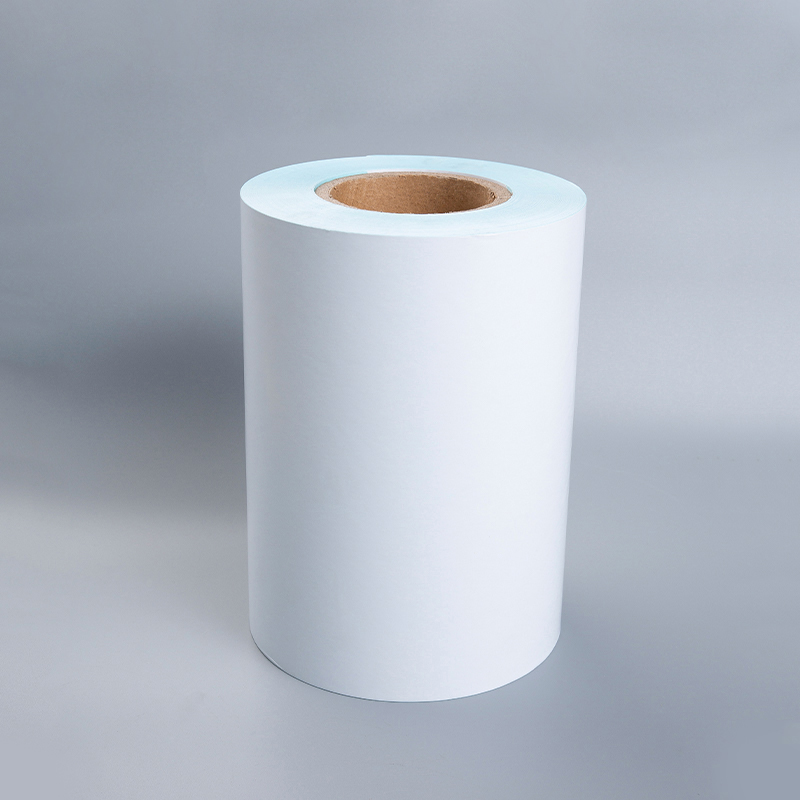
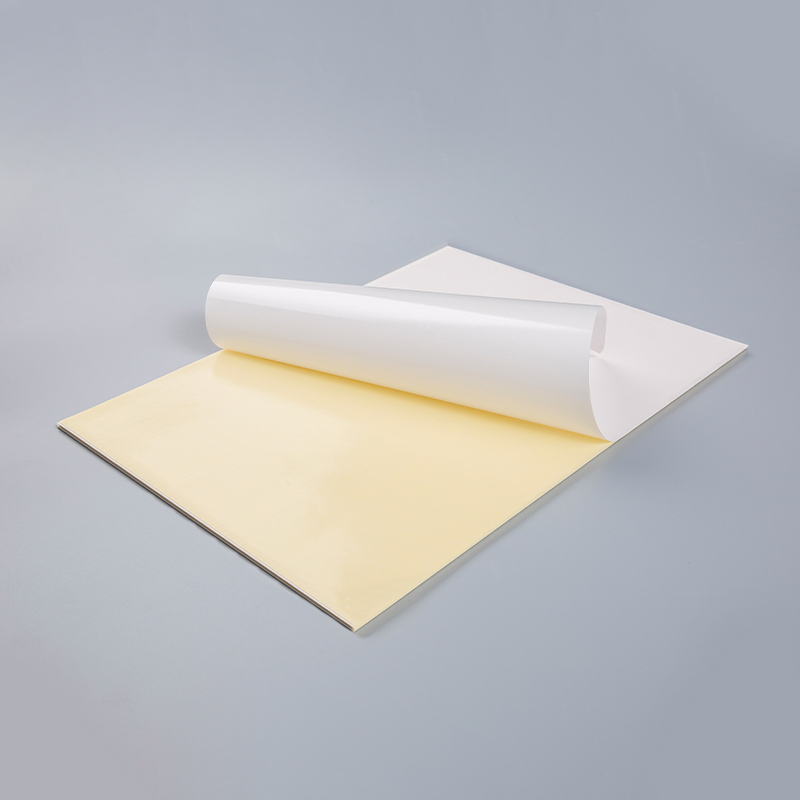
عربىDouble side adhesive paper in Yellow PEK is a versatile bonding material designed for applications that require strong adhesion, stable processing, clean handling, and reliable performance across a wide range of surfaces. Built with a double-sided adhesive structure and protected by release liners, this material offers an efficient solution for labels, signage, mounting, laminating, converting, packaging, and industrial assembly. Its practical construction allows users to bond two surfaces together without visible fasteners, liquid glue, mechanical clips, or complex application equipment.
The product is especially suitable for customers who need dependable bonding on glass, metal, plastic, paperboard, synthetic substrates, and other common industrial materials. Its waterproof characteristics, strong viscosity, and flexible customization options make it a competitive choice for both everyday labeling and demanding industrial use. Whether used in home organization, office display systems, commercial labeling, retail fixtures, or manufacturing lines, double side adhesive paper in Yellow PEK provides consistent bonding value with easy conversion and convenient application.
This article introduces the structure, technical advantages, application value, production strengths, customization possibilities, packaging methods, and quality considerations of double side adhesive paper in Yellow PEK. It also explains why a manufacturer with integrated gluing, laminating, cutting, testing, research, and after-sales capabilities can deliver a more dependable product than suppliers who only provide simple converting or trading services.

Double Side Adhesive Paper In Yellow PEK
Content
- 1 Understanding Double Side Adhesive Paper in Yellow PEK
- 2 Core Product Specifications
- 3 Why the Material Structure Matters
- 4 Adhesive Options for Different Performance Needs
- 5 Advantages Over Ordinary Competing Products
- 6 Application Areas
- 7 Manufacturing Strength Behind Product Quality
- 8 Advanced Manufacturing Processes
- 9 Quality Control and Reliability
- 10 Customization and OEM/ODM Capability
- 11 Packaging and Delivery Protection
- 12 Sustainable Development and Responsible Manufacturing
- 13 How to Select the Right Structure
- 14 Why Integrated Manufacturing Creates Customer Value
- 15 Company Strengths Supporting Global Customers
- 16 Practical Storage and Handling Recommendations
- 17 Q&A Section
- 17.1 Q1: What is double side adhesive paper in Yellow PEK used for?
- 17.2 Q2: What makes this product different from ordinary double-sided adhesive materials?
- 17.3 Q3: Which adhesive options are available?
- 17.4 Q4: Can the product be customized?
- 17.5 Q5: Is it suitable for cold environments?
- 17.6 Q6: Why is yellow release paper useful?
- 17.7 Q7: Can it be used on plastic surfaces?
- 17.8 Q8: How is the product packed for delivery?
- 17.9 Q9: Why choose a manufacturer with gluing, laminating, cutting, and testing capabilities?
- 17.10 Q10: What information should customers provide before ordering?
- 18 Conclusion
- 19 References
- 20 Product: Double Side Adhesive Paper In Yellow PEK
Understanding Double Side Adhesive Paper in Yellow PEK
Double side adhesive paper is a material that carries adhesive on both sides, allowing it to connect two surfaces firmly. Unlike single-sided labels, which are designed to display information on one exposed face while bonding to a surface on the back, double side adhesive paper functions as an intermediate bonding layer. It is often used where an invisible, clean, and efficient attachment method is required.
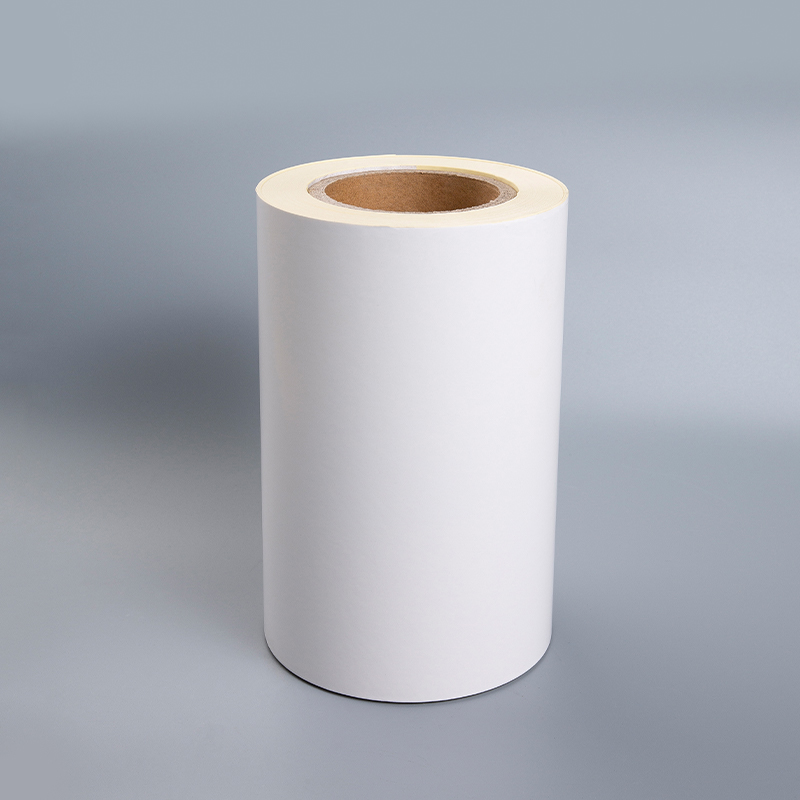
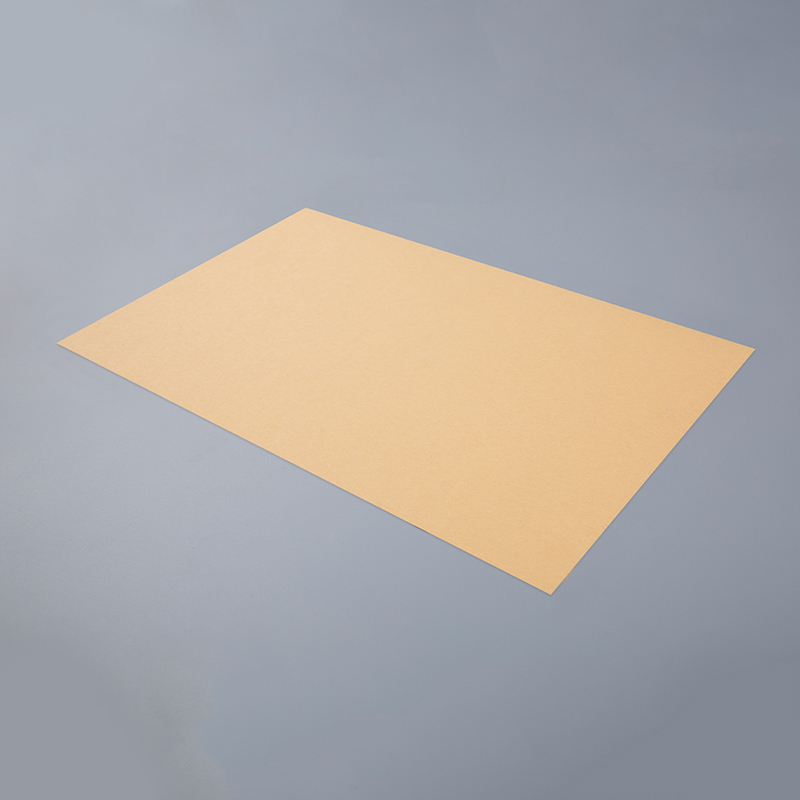
The Yellow PEK version refers to a product structure protected by yellow release paper, which helps users distinguish the liner, handle the roll or sheet more conveniently, and support smooth processing during die-cutting, slitting, printing preparation, lamination, and manual application. The yellow liner provides visual clarity and practical separation performance, especially in workshops where multiple adhesive materials may be processed at the same time.
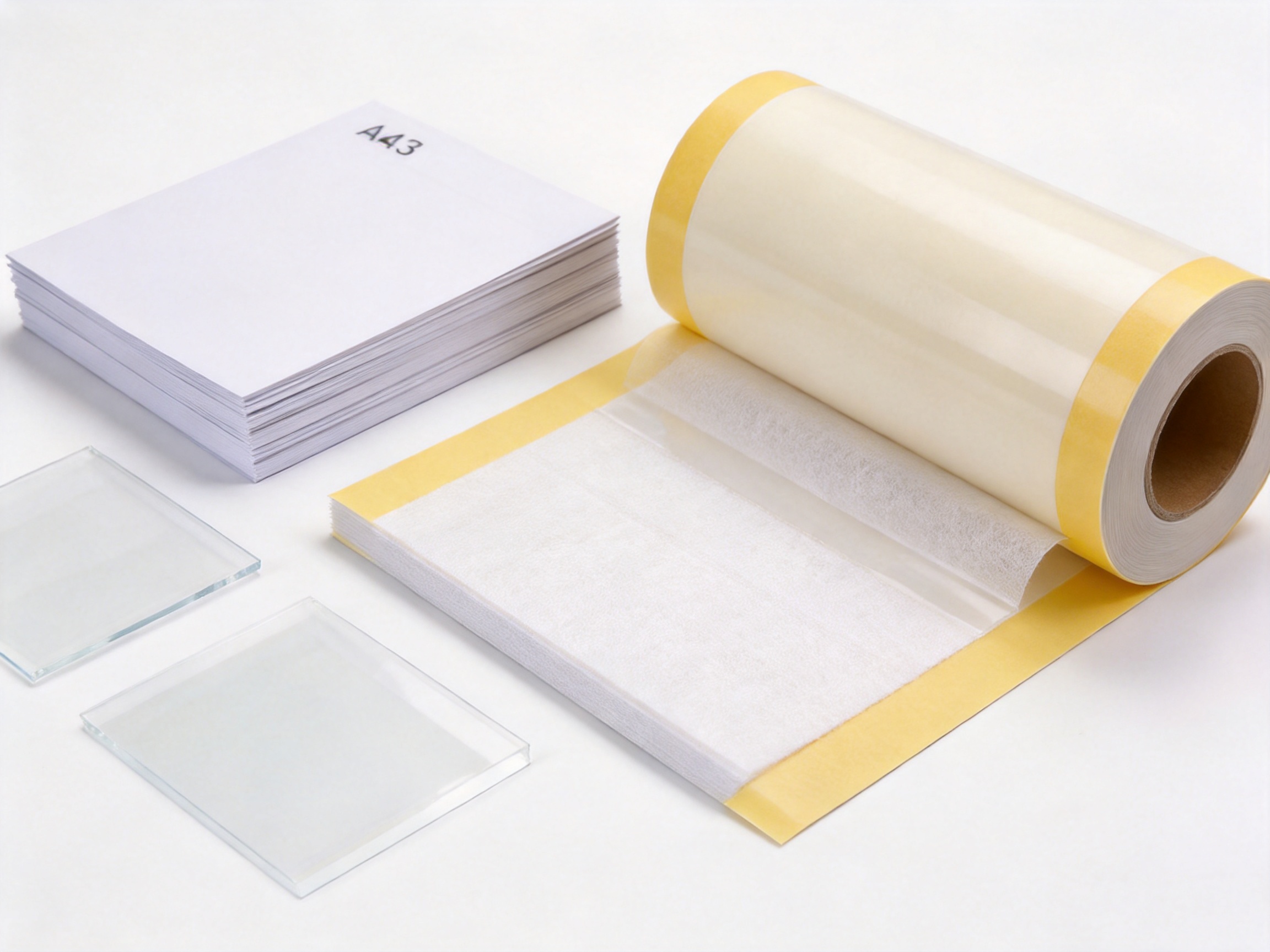
A typical structure includes a sandwiched carrier material, adhesive layers, and release liners. The carrier can be 15g white non-woven material, while transparent PET in 19 micron, 25 micron, or 50 micron thickness is also available. The adhesive can be selected according to the required end use, including water-based adhesive, hotmelt adhesive, solvent adhesive, anti-freeze adhesive, removable adhesive, cryogenic adhesive, or tyre-grade rubber adhesive. The two side liners are commonly 90g yellow release paper, with 90g white release paper available as an alternative.
This flexible structure allows the product to serve different market requirements. For general indoor bonding, a water-based adhesive may offer an economical and environmentally considerate solution. For high-tack applications, hotmelt adhesive may be selected. For demanding surfaces or harsh use conditions, solvent adhesive, anti-freeze adhesive, or rubber adhesive options may provide the required performance. For temporary bonding or repositionable use, removable adhesive can be considered.
Core Product Specifications
The following table summarizes the major product information and available customization options.
Item |
Standard or Available Options |
Practical Value |
Product Type |
Double side adhesive paper in Yellow PEK |
Designed for bonding, mounting, labeling, laminating, and industrial assembly applications. |
Sandwiched Material |
15g white non-woven material; 19, 25, or 50 micron transparent PET available |
Provides structural stability, dimensional control, and options for different bonding requirements. |
Adhesive |
Water-based adhesive as a common option; hotmelt, solvent, anti-freeze, removable, cryogenic, and tyre-grade rubber adhesive available |
Allows the material to match different surfaces, temperatures, service conditions, and removability needs. |
Two Side Liners |
90g yellow release paper; 90g white release paper available |
Protects adhesive before use and supports smooth release during processing and application. |
Jumbo Roll Width |
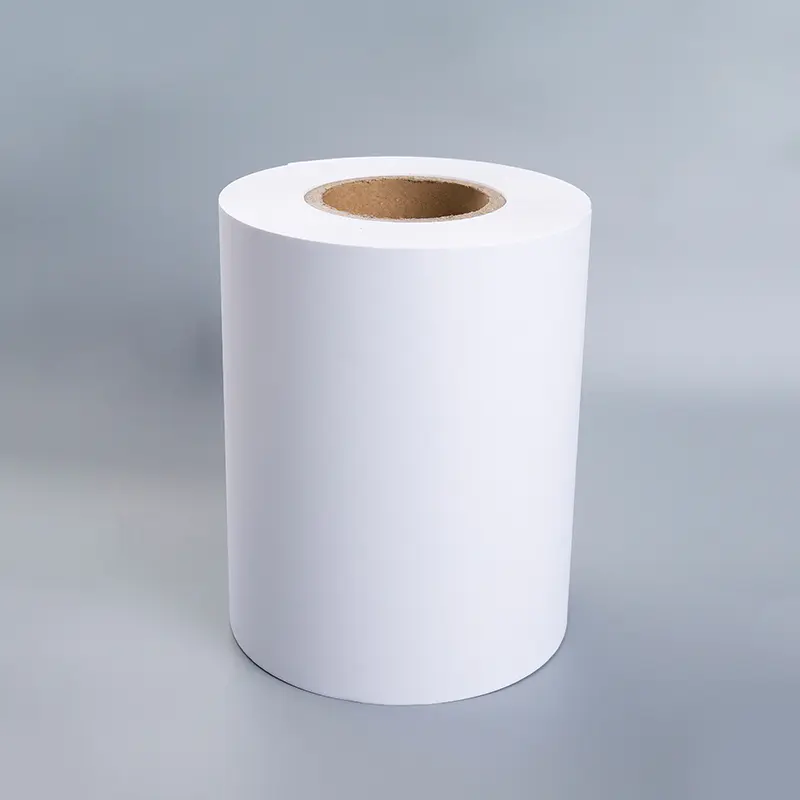
1000mm, 1020mm, 1080mm, or 1530mm |
Suitable for industrial converting, slitting, die-cutting, and large-volume production. |
Sheet Size |
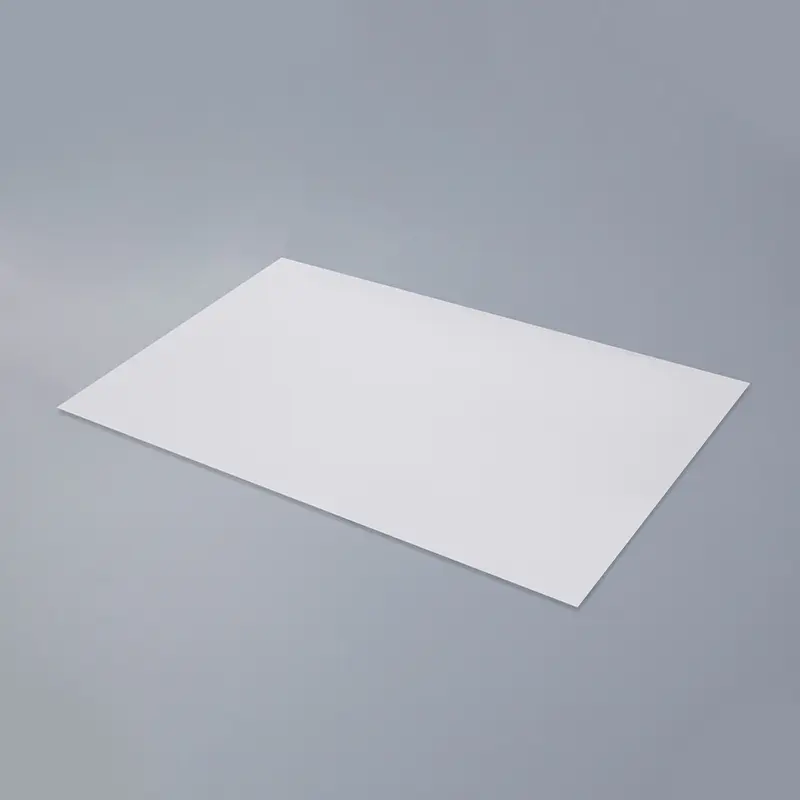
A4, A3, 20 x 30, 21 x 30, 24 x 36, 50cm x 70cm, 70cm x 100cm, and customized sizes |
Supports both standard office-style use and industrial sheet processing. |
Packaging |
Sea-transit-worthy poly-wood pallet packing and carton packing for rolls or sheets |
Protects material during storage, export, and long-distance transportation. |
Why the Material Structure Matters
The performance of double side adhesive paper depends not only on adhesive strength but also on the balanced design of the entire material structure. The carrier, adhesive, liner, coating uniformity, release force, roll stability, and packaging all influence user experience. A strong adhesive without a stable carrier may deform during die-cutting. A good carrier with poor release paper may cause difficult peeling. A suitable adhesive with inconsistent coating may create bonding failures. Therefore, a reliable product requires complete control from raw material selection to finished roll or sheet inspection.
The 15g white non-woven material option provides flexibility and adaptability for many general bonding applications. Non-woven carriers can conform well to slightly uneven surfaces and are often preferred when users need good wet-out and practical handling. Transparent PET options, including 19 micron, 25 micron, and 50 micron film, provide higher dimensional stability and can be selected when the user needs improved strength, clarity, or resistance to stretching. PET carriers are valuable in precision converting, electronics-related mounting, display applications, and processes that require a flatter, more stable adhesive layer.
The release liner also plays an essential role. The 90g yellow release paper protects the adhesive during storage and transportation, prevents contamination, and enables controlled release when users peel the liner away. Yellow release paper also helps operators visually identify the release side and reduces confusion during assembly. In manufacturing environments where multiple white papers, films, and liners are present, color differentiation can improve efficiency and reduce errors.
Adhesive Options for Different Performance Needs
One of the most important advantages of this double side adhesive paper is the availability of different adhesive systems. Competitors may offer only one standard adhesive grade, forcing customers to adapt their process to the material. A stronger manufacturer can instead provide adhesive options that match the customer’s surface, operating temperature, bonding duration, and removal requirements.
Water-based adhesive is a practical choice for many labeling and paper-based bonding applications. It can offer good adhesion, stable coating, and a more environmentally considerate profile compared with some traditional solvent-heavy solutions. For common commercial and industrial use, water-based adhesive can provide a balanced combination of performance and production efficiency.
Hotmelt adhesive is often selected where high initial tack is required. It can bond quickly and is suitable for applications that need fast handling strength. In packaging, display mounting, foam bonding, or temporary assembly processes, high initial tack may improve production speed and reduce waiting time.
Solvent adhesive can be selected when higher resistance or more demanding bonding performance is required. It may be suitable for applications involving difficult surfaces, higher durability expectations, or environmental stress. When customers require stronger chemical or aging resistance, the correct solvent adhesive system can be an important advantage.
Anti-freeze adhesive and cryogenic adhesive options expand the product’s usability in cold-chain, outdoor, refrigerated, winter storage, and low-temperature industrial environments. Many ordinary adhesives lose tack or become brittle in cold conditions. A material designed with low-temperature adhesive can maintain bonding reliability when conventional double-sided products fail.
Removable adhesive provides another useful option. Some applications require secure temporary bonding without surface damage or heavy residue. Removable double side adhesive paper can be used for temporary signage, promotional displays, repositionable mounting, sample books, protective pads, and removable labels. This creates value for customers who need clean removal rather than permanent attachment.
Tyre-grade rubber adhesive is designed for challenging rubber-related bonding requirements. Rubber surfaces can be difficult to bond because of texture, flexibility, surface energy, and possible contamination. A tyre-grade adhesive option helps address demanding applications where ordinary paper-based double-sided adhesives may not perform sufficiently.
Advantages Over Ordinary Competing Products
In a crowded adhesive material market, many products may look similar from the outside. However, real performance differences appear during converting, storage, transport, application, and long-term use. Double side adhesive paper in Yellow PEK has several advantages that help customers reduce risk and improve productivity.
Strong Viscosity Across Multiple Surfaces
The product is suitable for surfaces such as glass, metal, plastic, and other materials. This broad compatibility makes it a universal bonding material for many industries. Customers do not need to maintain too many separate adhesive products for different surface types, which simplifies inventory and purchasing.
Waterproof Practicality
Its waterproof properties allow it to perform better in conditions where moisture, humidity, or occasional contact with water may affect ordinary adhesive paper. This is valuable for labels, signs, displays, and mounted components used in kitchens, bathrooms, warehouses, retail environments, logistics areas, and semi-outdoor locations.
Multiple Adhesive Systems
Competitors that provide only standard adhesive materials may not meet specialized requirements. The availability of water-based, hotmelt, solvent, anti-freeze, removable, cryogenic, and rubber adhesive options makes the product adaptable. This flexibility helps users select a structure based on their technical needs instead of compromising performance.
Choice of Non-Woven or PET Carrier
Non-woven material provides adaptability and good conformability, while PET carrier options provide strength and dimensional stability. This gives converters and end users the freedom to choose based on processing requirements. PET thickness choices of 19, 25, and 50 microns allow additional control over rigidity, transparency, and mechanical behavior.
Reliable Release Liner
The 90g yellow release paper provides strong liner support, helping maintain adhesive protection and processing stability. Poor release liners can tear, curl, release unevenly, or contaminate adhesive. A stable liner is especially important when the material is converted into small shapes, narrow strips, labels, pads, or precision parts.
Jumbo Roll and Sheet Availability
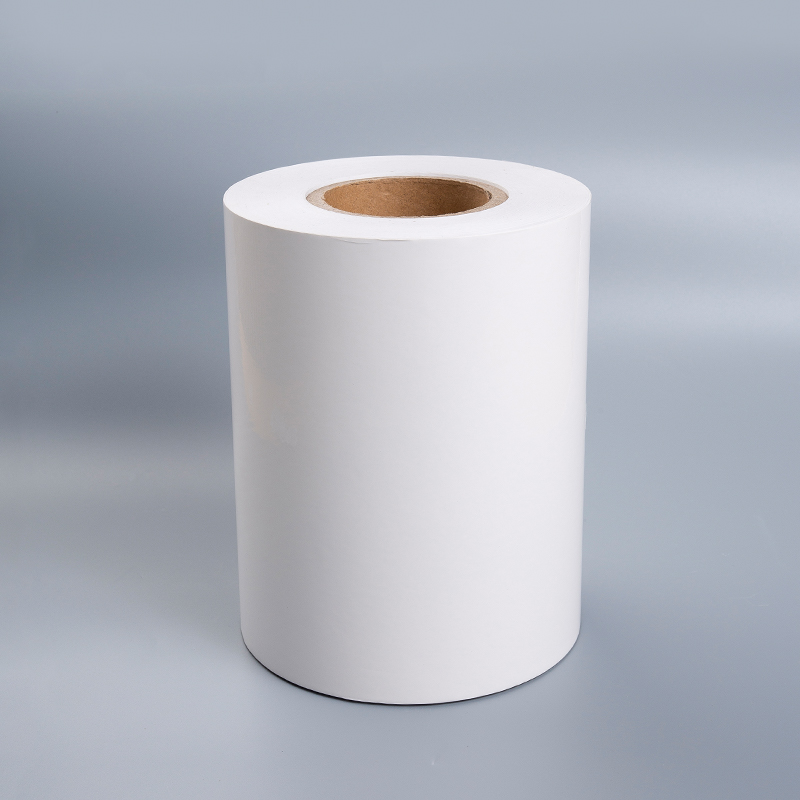
The product is available in jumbo roll widths such as 1000mm, 1020mm, 1080mm, and 1530mm. It can also be supplied in sheet sizes including A4, A3, 20 x 30, 21 x 30, 24 x 36, 50cm x 70cm, 70cm x 100cm, and customized dimensions. This makes it suitable for both high-volume converters and smaller users who need ready-to-use sheets.
Export-Ready Packaging
Sea-transit-worthy poly-wood pallet packing and carton packing support safe delivery for rolls and sheets. Each ream can be packed with strong PE-coated kraft paper wrapper, while pallets are wrapped with stretch film and fastened with plastic belts. This reduces damage risk during long-distance transportation and helps preserve material quality.
Application Areas
Double side adhesive paper in Yellow PEK can be used in many fields because it combines strong bonding, easy handling, and broad material compatibility. It is not limited to one industry. Instead, it supports manufacturers, converters, label producers, packaging companies, office suppliers, sign makers, and general industrial users.
Label and Signage Applications
Double-sided adhesive labels can be used as a clean signage solution. They can bond signs, nameplates, information cards, instructional panels, decorative elements, and warning labels to glass, metal, plastic, or coated surfaces. Because the adhesive is hidden between surfaces, the final appearance is neat and professional.
Industrial Assembly
In industrial production, double side adhesive paper can replace liquid glue or mechanical fastening in some light-duty or medium-duty applications. It can be used for attaching insulation materials, thin plastic parts, foam pads, gaskets, membrane switches, decorative trims, product inserts, sample boards, and temporary fixtures. The benefit is improved application speed and reduced mess.
Packaging and Display
Packaging manufacturers can use double side adhesive paper for box reinforcement, promotional displays, product samples, hanging cards, shelf talkers, and point-of-sale materials. Compared with liquid glue, double-sided adhesive materials provide more controlled bonding and can reduce drying time. They are also suitable for pre-applied adhesive components that customers activate by removing the liner.
Office and Home Use
In offices, the material can be used for mounting charts, signs, labels, dividers, temporary instructions, and display materials. At home, it can support organization, craft projects, light mounting, labels, decoration, and repair tasks. The availability of sheet sizes such as A4 and A3 makes the product convenient for users who need simple cutting and manual application.
Printing and Converting
Converters can process the material into rolls, sheets, die-cut parts, strips, pads, and customized adhesive shapes. Stable liner release and consistent adhesive coating are essential for efficient conversion. The jumbo roll widths provide flexibility for slitting and reducing material waste. Customized sheet sizes also help customers fit existing equipment and production workflows.
Cold-Environment Applications
With anti-freeze or cryogenic adhesive options, the product can serve cold-storage labels, refrigerated packaging, winter logistics markings, laboratory applications, and low-temperature industrial bonding. This advantage is important because many standard adhesives perform poorly when exposed to cold conditions.
Manufacturing Strength Behind Product Quality
A high-quality double side adhesive paper cannot be produced by adhesive selection alone. It requires advanced manufacturing systems, stable production management, precise coating technology, professional inspection, and long-term materials expertise. Suzhou Piaozhihua Composite Material Technology Co., Ltd. specializes in high-grade self-adhesive labels and adhesive materials, integrating research and development, production, sales, and after-sales service. This integrated model allows the company to control product quality from formulation to delivery.
The company operates a full range of production lines, including gluing, laminating, and cutting. This means that the key stages of adhesive material manufacturing are managed in-house rather than outsourced without control. Integrated production improves consistency, shortens response time, and supports technical customization for customers with special requirements.
With an annual production capacity of more than 280 million square meters, the company is able to support large-volume orders while maintaining stable supply. Capacity matters because adhesive material customers often need dependable delivery schedules for label production, packaging, and industrial manufacturing. A supplier with limited capacity may struggle during seasonal demand, large projects, or urgent restocking. A high-capacity manufacturer can better support long-term cooperation.
The company has more than 20 years of OEM manufacturing experience. This experience helps it understand different market standards, customer expectations, converting problems, export packaging requirements, and application challenges. OEM experience is especially important for customers who need private-label products, customized structures, special sizes, or materials based on drawings or samples.
Advanced Manufacturing Processes
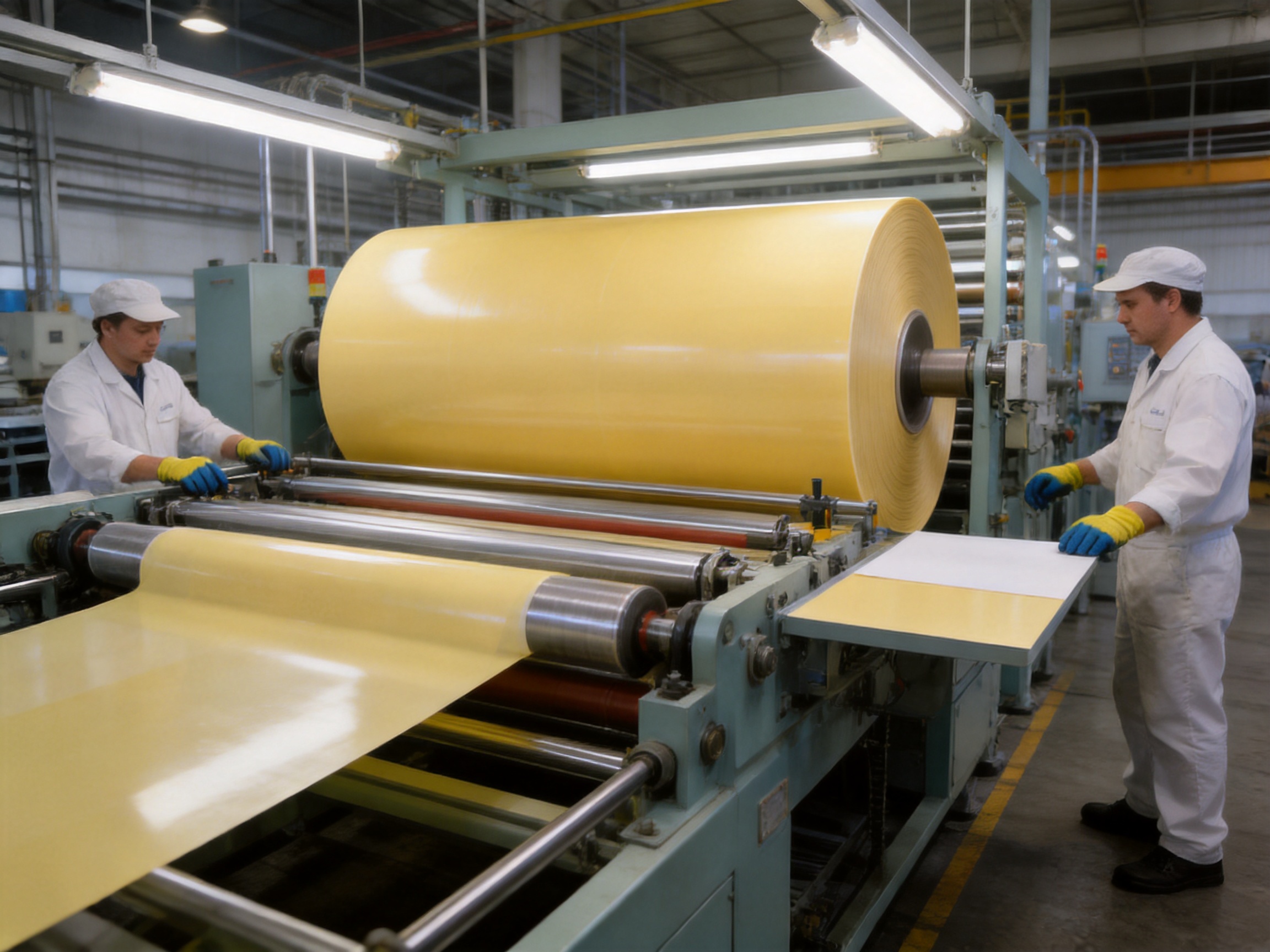
The manufacturing of double side adhesive paper involves several key processes. Each process affects the finished product’s adhesive performance, appearance, stability, and usability.
Raw Material Selection
The production process begins with selecting appropriate carriers, adhesives, and release liners. The carrier must match the product’s intended performance. Non-woven material provides flexibility and conformability, while PET provides dimensional strength. Release paper must have controlled silicone release performance and sufficient basis weight to withstand processing. Adhesive raw materials must be selected according to tack, peel strength, temperature resistance, aging behavior, and surface compatibility.
Adhesive Preparation
Adhesive preparation is a technical step that determines coating stability. Water-based, hotmelt, solvent, removable, cold-resistant, and rubber adhesive systems require different handling conditions. Viscosity, solids content, coating behavior, and drying or curing conditions must be controlled. Professional preparation helps prevent problems such as uneven coating, bubbles, adhesive transfer, poor wet-out, and weak bonding.
Precision Gluing
Gluing is one of the most important production stages. The adhesive layer must be applied evenly across the web. If coating weight varies, the product may bond strongly in some areas and weakly in others. Uneven glue can also cause die-cutting problems, edge ooze, roll blocking, or visual defects. Advanced gluing lines help maintain coating uniformity and support stable jumbo roll production.
Lamination
During lamination, the adhesive-coated material is combined with the carrier and release liner under controlled conditions. Proper lamination ensures smooth structure, good contact, and stable release. Poor lamination can lead to wrinkles, bubbles, liner lifting, or inconsistent peel. A manufacturer with dedicated laminating capability can optimize process settings for different carrier and adhesive combinations.
Drying and Stabilization
Depending on the adhesive system, drying or stabilization may be required. Temperature, airflow, line speed, and residence time can influence final adhesive performance. Insufficient drying may leave moisture or solvent residues, while excessive heat may damage the carrier or release liner. Balanced process control ensures the finished adhesive layer performs as intended.
Slitting and Cutting
After lamination, the material may be converted into jumbo rolls, smaller rolls, or sheets. Cutting accuracy is important because customers often use the material in automated or semi-automated processes. Clean edges reduce dust, adhesive contamination, and feeding problems. Available sheet sizes such as A4, A3, 50cm x 70cm, and 70cm x 100cm provide flexibility for different users.
Inspection and Testing
The company has its own testing lab and advanced inspection equipment. Testing helps verify adhesive performance, release force, coating consistency, thickness, appearance, and other quality indicators. In adhesive material manufacturing, testing is not just a final step; it is part of continuous process improvement. Regular inspection helps detect variation early and ensures each batch meets customer expectations.
Quality Control and Reliability
For users of double side adhesive paper, quality reliability is directly connected to production efficiency and final product reputation. If adhesive paper fails after being applied, the cost is not limited to material waste. It may include rejected products, customer complaints, replacement labor, delayed shipments, and damage to brand trust. Therefore, choosing a supplier with rigorous quality control is essential.
Important quality factors include adhesive strength, release force, liner flatness, coating uniformity, roll winding tension, sheet dimensional accuracy, and packaging protection. A high-quality product should peel smoothly, bond consistently, resist contamination, and remain stable during storage. It should also process well during slitting, die-cutting, laminating, and manual application.
The company’s manufacturing philosophy emphasizes quality. With advanced inspection equipment and a dedicated testing lab, production can be monitored and adjusted to reduce defects. This is an advantage over trading companies or small workshops that may not have technical testing capacity. When customers need data-based improvement, sample evaluation, or application troubleshooting, an integrated manufacturer can provide more meaningful support.
Customization and OEM/ODM Capability
Different customers need different adhesive products. A label converter may need jumbo rolls for high-speed slitting. A packaging company may need sheets in a special format. An industrial assembly customer may need a PET carrier with high dimensional stability. A cold-chain packaging user may need anti-freeze adhesive. A promotional display maker may need removable adhesive. For these reasons, customization is a major advantage.
The company offers OEM and ODM services and can produce products based on customer drawings or samples. This is valuable for customers developing new products or replacing an existing material. Instead of forcing users to select only a catalog item, the manufacturer can adjust structure, adhesive type, liner choice, size, and packaging.
ODM capability is supported by a professional research and development team with multiple patents. Innovation allows the company to develop improved materials, eco-friendly solutions, and customized adhesive systems. In markets where sustainability, performance, and cost control are all important, technical development capability helps customers stay competitive.
OEM experience also matters for export customers and brand owners. A manufacturer with long-term OEM service experience understands confidentiality, consistency, packaging requirements, labeling needs, batch stability, and repeat-order accuracy. This helps customers build their own product lines without investing in adhesive material production facilities.
Packaging and Delivery Protection
Packaging is often overlooked, but it is critical for adhesive materials. Double side adhesive paper must be protected from moisture, dust, pressure damage, edge deformation, and contamination. Poor packaging can cause roll distortion, sheet curling, liner damage, or adhesive failure before the material even reaches the customer.
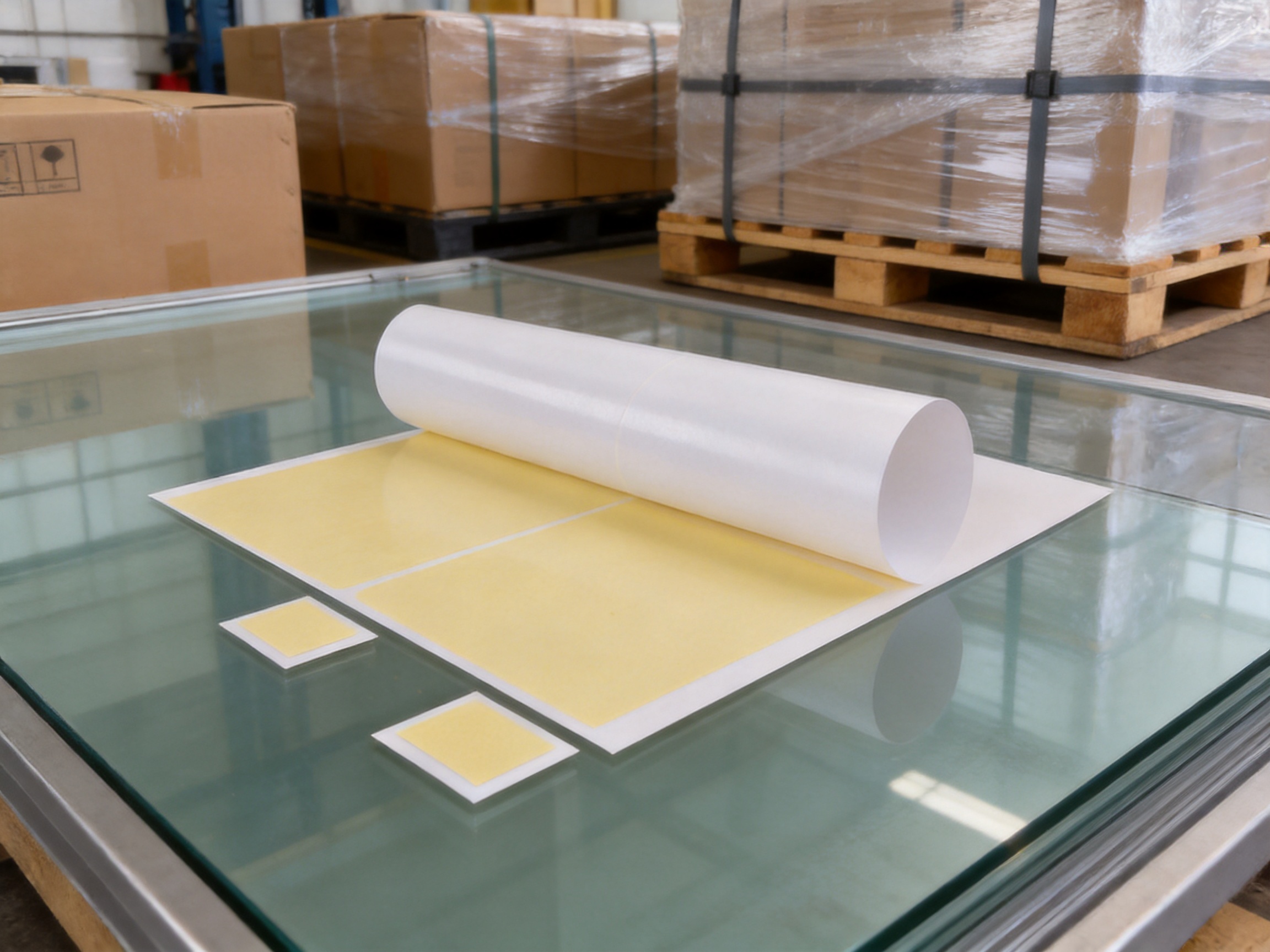
The product can be packed in sea-transit-worthy poly-wood pallets and cartons, suitable for both rolls and sheets. For sheet products, 100 sheets per ream can be packed with a strong PE-coated kraft paper wrapper. Strong pallets are wrapped with stretch film and fastened with plastic belts. This approach helps protect goods during loading, long-distance transportation, warehouse storage, and export handling.
For international customers, export-ready packaging reduces risk. Sea transportation can involve humidity, vibration, compression, temperature changes, and multiple handling stages. Strong packaging helps maintain product condition from the factory to the destination. This is another advantage over competitors who may use weak cartons, insufficient pallet wrapping, or unsuitable packaging for overseas shipments.
Sustainable Development and Responsible Manufacturing
Modern adhesive material customers increasingly care about sustainability. They want materials that support performance while reducing unnecessary environmental impact. The company’s brand positioning focuses on sustainable development and environmental protection, including eco-friendly solutions for face materials, adhesives, and backing papers. This direction is important for customers serving international markets, retail chains, consumer brands, and regulated industries.
Water-based adhesive options can support customers seeking a more environmentally considerate adhesive choice. Efficient production and stable quality also reduce waste because fewer defective materials are produced and fewer products fail during use. Customization can further reduce waste by supplying exact roll widths or sheet sizes, helping converters improve yield and minimize trimming loss.
Responsibility in manufacturing also includes after-sales service. Adhesive material selection often requires technical communication. Customers may need help choosing adhesive type, liner, carrier, or size. They may need troubleshooting support if a bonding surface is unusual or if processing conditions change. A manufacturer that provides full after-sales service can help customers solve problems rather than simply shipping material.
How to Select the Right Structure
Choosing the right double side adhesive paper requires understanding the application. The best structure depends on surface type, bonding area, service temperature, required life, removal needs, processing method, and cost target. Customers should consider the following questions before placing an order.
First, what surfaces need to be bonded? Glass, metal, plastic, paper, rubber, and coated materials have different surface energies and textures. Smooth surfaces may bond differently from rough or porous surfaces. Difficult plastics may require special adhesive selection.
Second, is the bond permanent or temporary? Permanent mounting requires strong long-term adhesion, while temporary displays or repositionable parts may require removable adhesive.
Third, what temperature will the product experience? Standard indoor use may not require cold-resistant adhesive, but refrigerated, outdoor, or winter logistics applications may need anti-freeze or cryogenic adhesive.
Fourth, how will the product be processed? High-speed slitting, die-cutting, sheet cutting, manual assembly, and lamination each require different material behavior. PET carrier may be preferred for dimensional stability, while non-woven carrier may be preferred for conformability.
Fifth, what size format is required? Jumbo rolls are suitable for converters, while sheets are useful for smaller operations, offices, and manual production. Custom sizes can improve efficiency and reduce waste.
Sixth, what packaging is needed? Export customers should consider pallet strength, moisture protection, and carton suitability. Proper packaging prevents transportation damage and protects adhesive quality.
Why Integrated Manufacturing Creates Customer Value
Compared with competitors that only resell adhesive materials, an integrated manufacturer offers deeper value. It can control production, adjust formulas, test performance, customize sizes, improve packaging, and provide technical advice. This reduces communication barriers and allows faster problem solving.
For example, if a customer reports difficult liner release, a trading supplier may not know whether the problem comes from silicone coating, adhesive transfer, storage conditions, or conversion pressure. An integrated manufacturer with gluing, laminating, cutting, and testing capabilities can investigate the structure and process. This leads to better solutions.
If a customer wants a material for low-temperature plastic bonding, a basic supplier may offer only a standard double-sided tape. A technically capable manufacturer can recommend anti-freeze or cryogenic adhesive and suitable carrier options. If a customer needs a specific roll width, the manufacturer can cut material to match equipment. If a customer needs private-label supply, OEM experience supports stable production and packaging.
Such advantages are especially important for long-term buyers. Adhesive materials are not one-time purchases for many industries. They become part of production systems. Stable supply, repeatable quality, and responsive service are as important as initial price. A product with low price but inconsistent coating, unstable release, or poor packaging may create higher total cost. High-quality double side adhesive paper helps reduce production interruptions and improves final product reliability.
Company Strengths Supporting Global Customers
Suzhou Piaozhihua Composite Material Technology Co., Ltd. is located in Taicang City, Suzhou City, Jiangsu Province, China. The company specializes in self-adhesive labels and composite adhesive materials and has built a strong position through more than 20 years of development. Its strengths include integrated production lines, large annual capacity, research and development capability, testing facilities, OEM and ODM service, and international market experience.
The company’s sales network covers many regions in China, including Shanghai, Ningbo, Hangzhou, Chengdu, Harbin, Wuhan, Chongqing, Guangzhou, Changsha, Beijing, and other areas. Internationally, its marketing network reaches countries and regions such as the United States, Germany, Japan, South Korea, Brazil, Mexico, Russia, and the Middle East, as well as broader markets across Asia, Europe, the Americas, Africa, and other regions. This market coverage demonstrates the ability to serve different customer requirements and maintain long-term stable supply relationships.
The company’s core values include quality, integrity, innovation, win-win cooperation, and responsibility. These values are closely related to adhesive material supply. Quality ensures product performance. Integrity supports trustworthy cooperation. Innovation drives improved materials. Win-win thinking supports customer growth. Responsibility encourages sustainable development and service commitment.
Practical Storage and Handling Recommendations
To obtain the best performance from double side adhesive paper in Yellow PEK, users should follow proper storage and handling practices. Adhesive materials should be stored in a clean, dry environment away from direct sunlight, extreme temperature, and excessive humidity. Rolls should be kept in stable packaging until use. Sheets should remain wrapped to prevent dust and moisture exposure.
Before application, the bonding surface should be clean, dry, and free of oil, dust, release agents, and loose particles. Surface contamination is one of the most common causes of adhesive failure. For metal, glass, and plastic surfaces, cleaning may significantly improve bonding strength. Users should also apply sufficient pressure after positioning the adhesive, because pressure helps the adhesive wet the surface and develop stronger contact.
If the material will be used in cold environments, customers should select the correct adhesive grade and test performance under real conditions. If removable bonding is required, testing should confirm both adhesion and clean removal from the actual surface. If die-cutting is involved, converters should verify cutting depth to avoid damaging the liner or causing difficult waste removal.
Q&A Section
Q1: What is double side adhesive paper in Yellow PEK used for?
It is used for bonding two surfaces together in applications such as labels, signage, mounting, packaging, display production, office use, home organization, and industrial assembly. It is suitable for surfaces including glass, metal, plastic, and other common materials.
Q2: What makes this product different from ordinary double-sided adhesive materials?
It offers strong viscosity, waterproof practicality, multiple adhesive options, non-woven or PET carrier choices, stable 90g yellow release paper, jumbo roll and sheet availability, and export-ready packaging. These features provide better adaptability and reliability than many standard products.
Q3: Which adhesive options are available?
Available adhesive options include water-based adhesive, hotmelt adhesive, solvent adhesive, anti-freeze adhesive, removable adhesive, cryogenic adhesive, and tyre-grade rubber adhesive. The correct choice depends on surface type, temperature, permanence, and application environment.
Q4: Can the product be customized?
Yes. Jumbo roll widths include 1000mm, 1020mm, 1080mm, and 1530mm. Sheet sizes include A4, A3, 20 x 30, 21 x 30, 24 x 36, 50cm x 70cm, 70cm x 100cm, and customized sizes. Carrier, adhesive, liner, and packaging can also be discussed according to customer needs.
Q5: Is it suitable for cold environments?
Yes, when anti-freeze or cryogenic adhesive is selected. These adhesive options are designed for applications where standard adhesives may lose tack or reliability at low temperatures.
Q6: Why is yellow release paper useful?
Yellow release paper protects the adhesive and helps users identify the liner clearly during processing and application. It supports smooth peeling, reduces handling mistakes, and improves production efficiency in converting environments.
Q7: Can it be used on plastic surfaces?
Yes, it is suitable for plastic surfaces, but the exact performance depends on the type of plastic, surface energy, cleanliness, and adhesive grade. Testing on the actual surface is recommended for critical applications.
Q8: How is the product packed for delivery?
It can be packed in sea-transit-worthy poly-wood pallets and cartons for rolls or sheets. Sheet products may be packed as 100 sheets per ream with strong PE-coated kraft paper wrapper, while pallets are wrapped with stretch film and fastened with plastic belts.
Q9: Why choose a manufacturer with gluing, laminating, cutting, and testing capabilities?
Integrated manufacturing improves quality control, customization ability, response speed, and technical support. It helps ensure consistent coating, stable release, accurate sizing, and reliable batch-to-batch performance.
Q10: What information should customers provide before ordering?
Customers should provide the bonding surface, required adhesive strength, operating temperature, permanent or removable use, roll or sheet size, processing method, packaging requirements, and any special performance expectations.
Conclusion
Double side adhesive paper in Yellow PEK is a practical and adaptable bonding material for customers who need strong adhesion, waterproof performance, clean application, and flexible customization. Its structure can include 15g white non-woven material or transparent PET carrier options, multiple adhesive systems, and 90g yellow release paper. It is available in jumbo rolls and many sheet sizes, making it suitable for converters, manufacturers, packaging companies, sign makers, offices, and industrial users.
The product’s advantages over ordinary competitors come from its broad surface compatibility, selectable adhesive systems, stable release liner, reliable packaging, and manufacturing support. Behind the material is an integrated production capability that includes gluing, laminating, cutting, inspection, research, OEM service, ODM development, and after-sales support. This combination helps customers obtain not only an adhesive product but also a dependable supply solution.
For applications involving glass, metal, plastic, labels, signage, displays, packaging, cold environments, removable bonding, or industrial assembly, double side adhesive paper in Yellow PEK offers a strong balance of performance and usability. When supplied by an experienced manufacturer with advanced processes and quality-focused production, it becomes a valuable material for improving efficiency, product appearance, and bonding reliability.
References
1. Benedek, I. Pressure-Sensitive Adhesives and Applications. CRC Press.
2. Satas, D. Handbook of Pressure Sensitive Adhesive Technology. Satas & Associates.
3. Petrie, E. M. Handbook of Adhesives and Sealants. McGraw-Hill Education.
4. Kinloch, A. J. Adhesion and Adhesives: Science and Technology. Springer.
5. Mittal, K. L. Adhesion Measurement of Films and Coatings. CRC Press.
6. Industry technical literature on release liners, silicone release paper, pressure-sensitive adhesives, and label converting processes.