
 English
 Español
 русский
 Français
 عربى
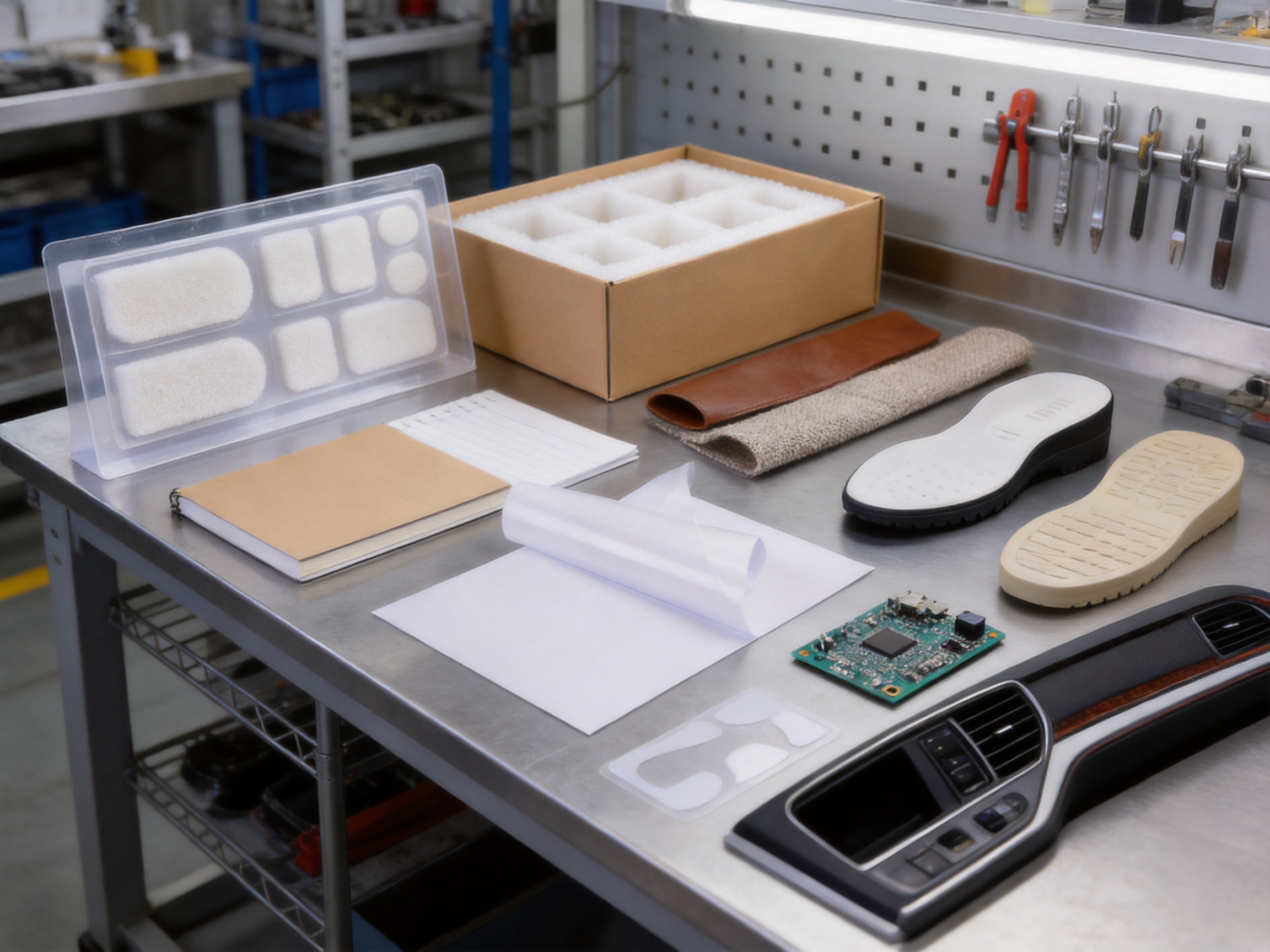
عربىDouble side adhesive paper in White PEK is a high-performance bonding material designed for applications where stable adhesion, clean conversion, and reliable handling are required. Unlike ordinary single-sided labels that attach only one printed or functional surface to a substrate, double side adhesive paper creates an adhesive layer on both sides of a carrier, allowing it to bond two different surfaces together with consistency and strength. This makes it suitable not only for labeling and sticker production, but also for stationery, office products, leather goods, pearl cotton, sponge, footwear, electronics, and automobile decoration components.
In many manufacturing and packaging environments, the need for thinner, cleaner, and more convenient bonding methods continues to increase. Mechanical fastening can be bulky, liquid glue can be messy, and low-grade adhesive tapes may fail under stress or during processing. Double side adhesive paper provides a practical alternative: it is easy to die-cut, laminate, sheet, roll, store, and apply. When properly selected, it improves assembly efficiency, reduces waste, and supports a cleaner appearance in the finished product.
This article introduces the structure, performance advantages, manufacturing strengths, application value, customization options, packaging standards, and selection guidance for double side adhesive paper in White PEK. It also explains why a specialized self-adhesive material manufacturer with advanced coating, laminating, slitting, and quality inspection capabilities can provide a more stable product than general suppliers.

Double Side Adhesive Paper In White PEK
Content
- 1 1. Product Overview
- 2 2. Why Double Side Adhesive Paper Matters
- 3 3. Core Structure and Material Composition
- 4 4. Product Specifications
- 5 5. Advantages Over Traditional Labels and Ordinary Adhesive Materials
- 6 6. Application Areas
- 7 7. Manufacturing Strengths Behind Product Performance
- 8 8. Research, Customization, and OEM/ODM Capability
- 9 9. Quality Stability and Competitive Advantages
- 10 10. Packaging and Delivery Reliability
- 11 11. Sustainability and Responsible Material Development
- 12 12. How to Select the Right Double Side Adhesive Paper
- 13 13. Practical Performance Benefits for Manufacturers
- 14 14. International Supply Capability
- 15 15. Why Manufacturing Experience Matters
- 16 16. Quality Values in Production and Service
- 17 17. Frequently Asked Questions
- 17.1 Q1: What is double side adhesive paper in White PEK used for?
- 17.2 Q2: How is it different from a traditional paper label?
- 17.3 Q3: What carrier materials are available?
- 17.4 Q4: What adhesive types can be selected?
- 17.5 Q5: What liner options are available?
- 17.6 Q6: Can the material be customized?
- 17.7 Q7: What sizes are commonly available?
- 17.8 Q8: Is it suitable for automatic processing?
- 17.9 Q9: How should the product be packed for delivery?
- 17.10 Q10: Why choose a specialized manufacturer instead of a general supplier?
- 18 18. Conclusion
- 19 References
- 20 Product: Double Side Adhesive Paper In White PEK
1. Product Overview
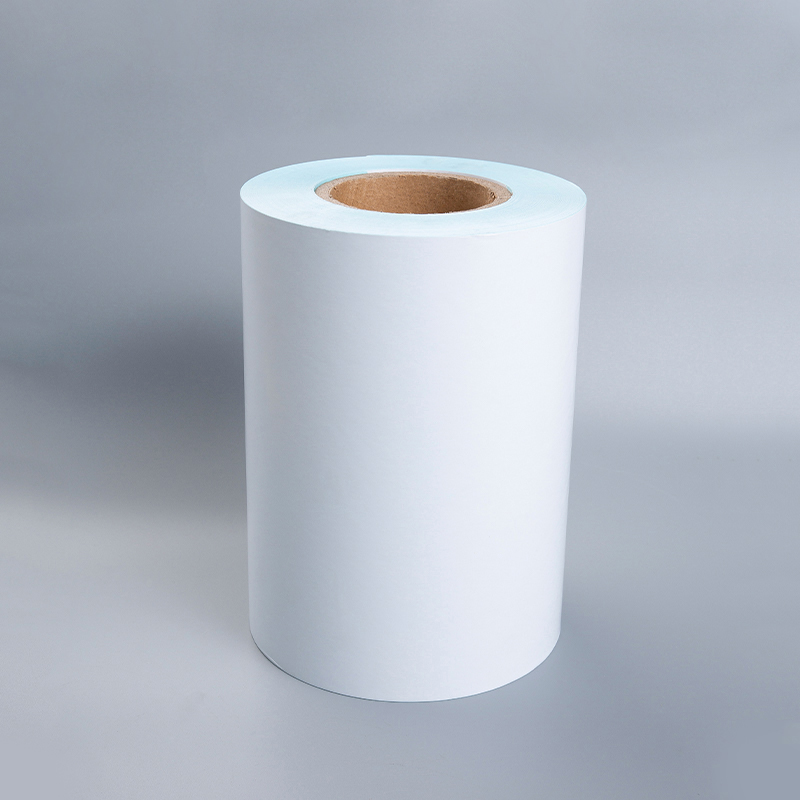
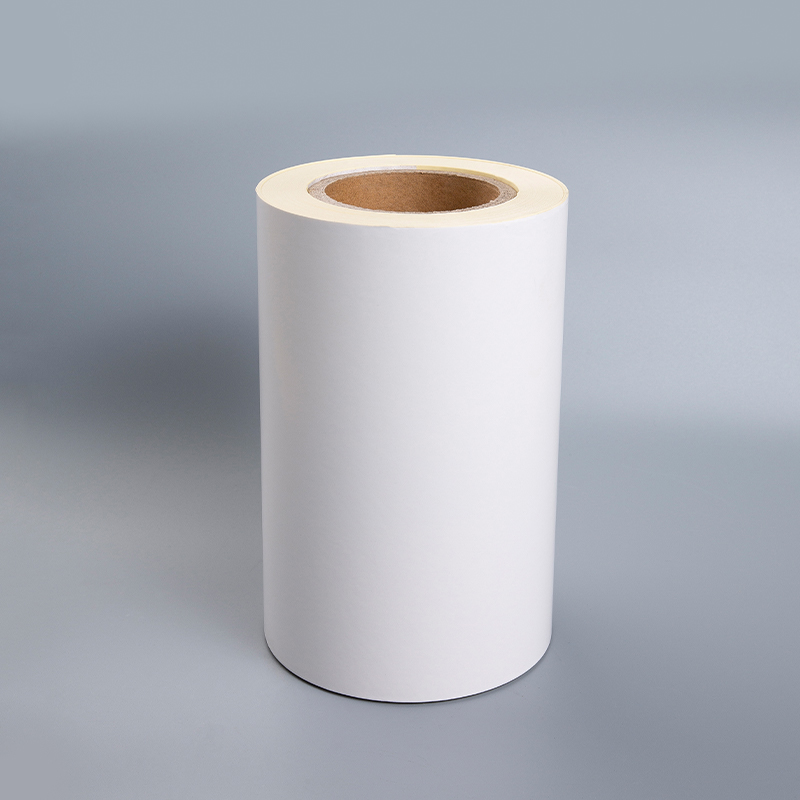
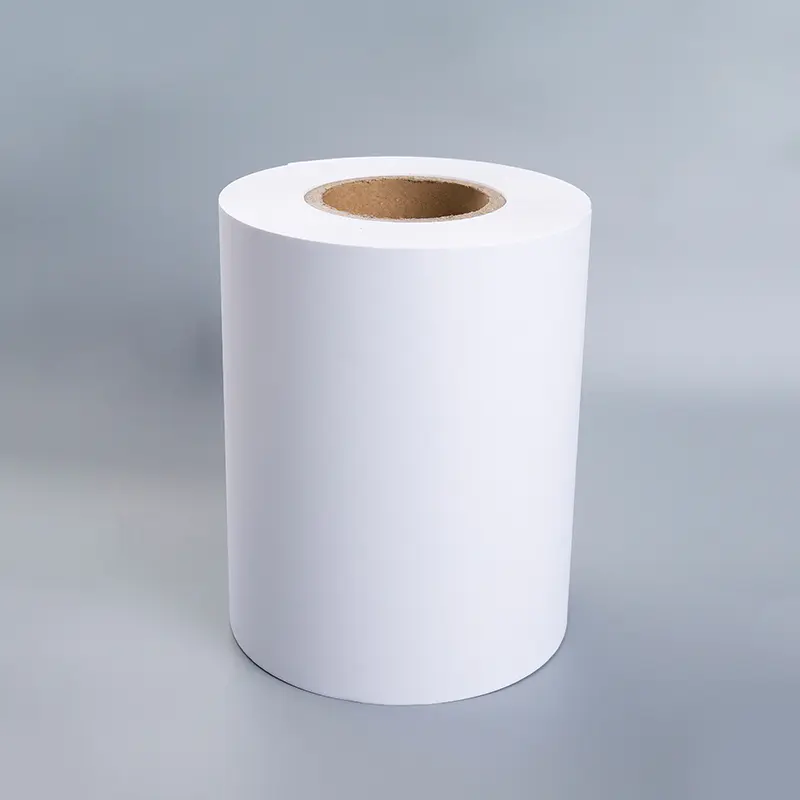
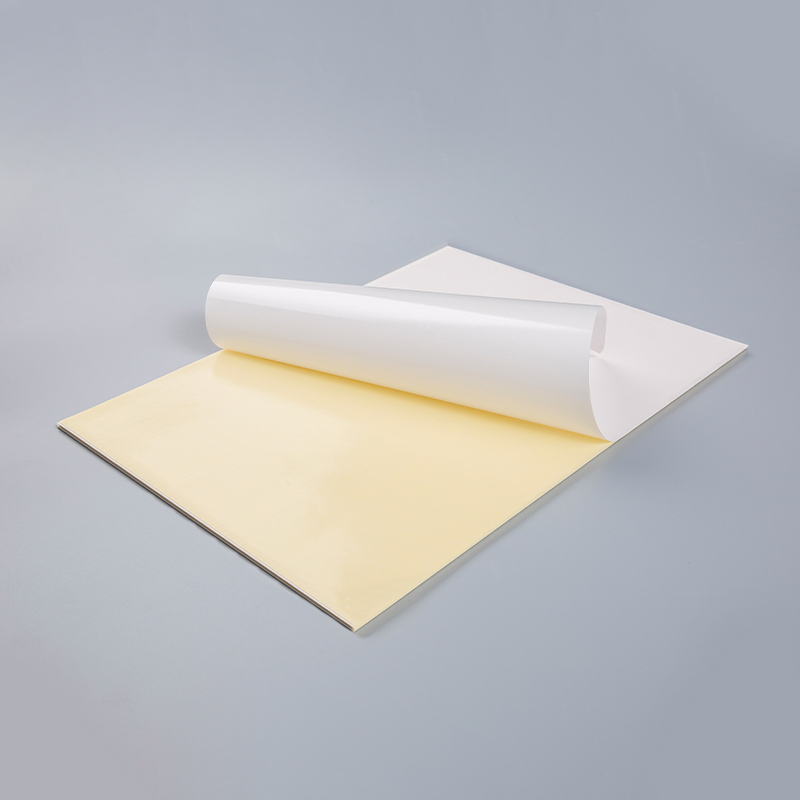
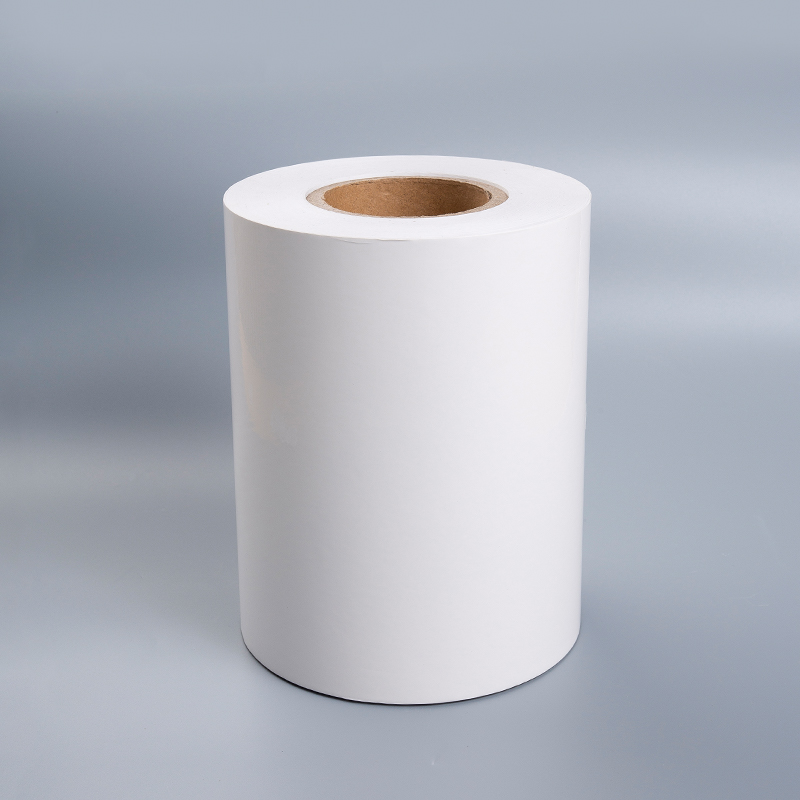
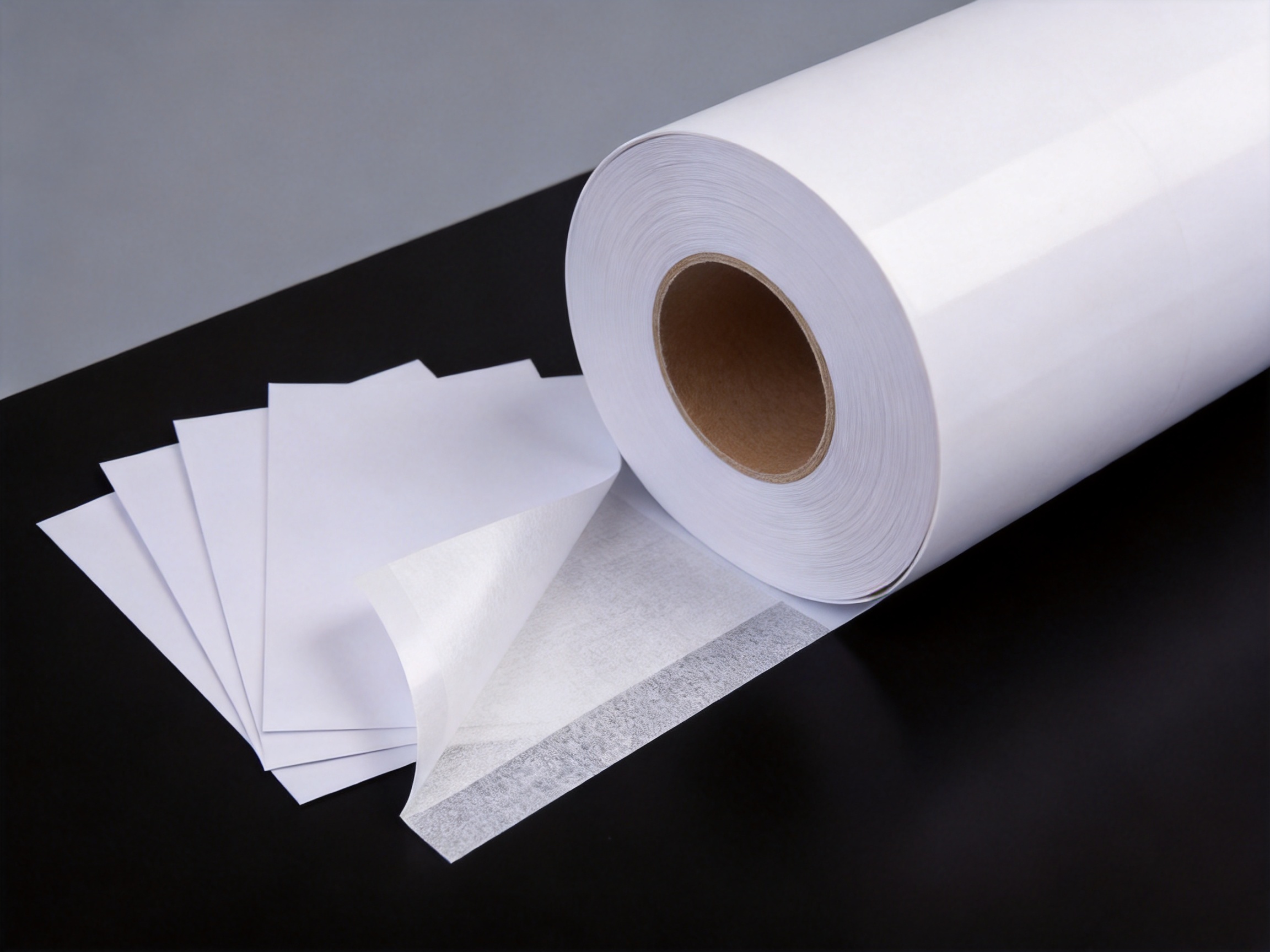
Double side adhesive paper in White PEK is a composite adhesive material generally made with a central carrier, adhesive layers on both sides, and release liners that protect the adhesive before use. The product can be supplied in jumbo rolls, converted rolls, or sheets according to the user’s processing method. It is especially valuable for customers who need high tack, strong bonding, and efficient conversion performance.
The product described here uses a sandwiched material such as 15 g white non-woven material, with transparent PET options of 19 microns, 25 microns, or 50 microns also available. The adhesive can be water-based adhesive as a standard option, while hotmelt adhesive, solvent adhesive, anti-freeze adhesive, removable adhesive, cryogenic adhesive, and tyre-grade rubber adhesive are available for specific performance needs. The two side liners can include 90 g white release paper, with 90 g yellow release paper available as an alternative.
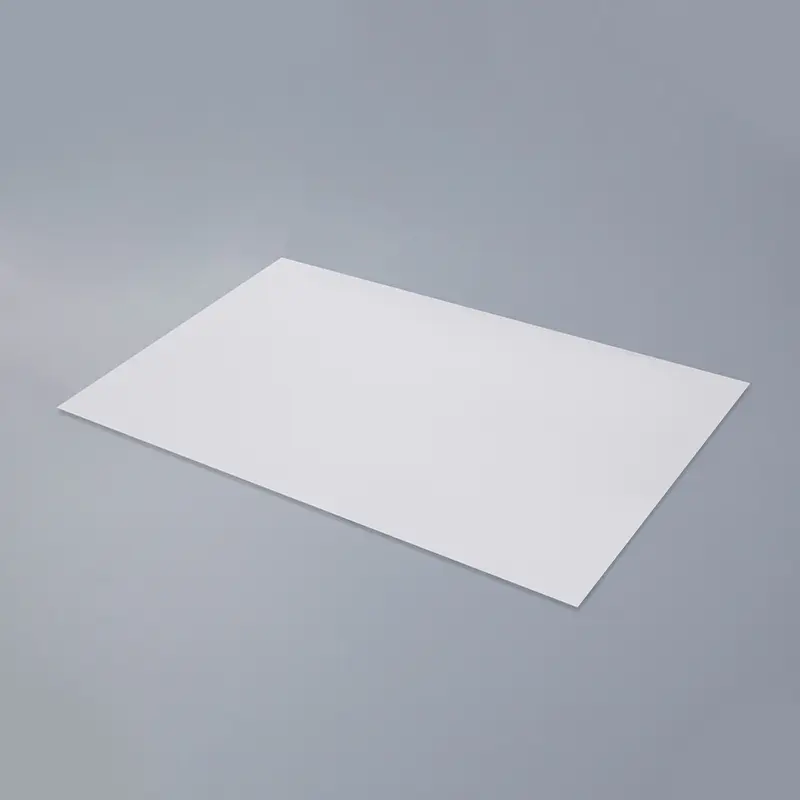
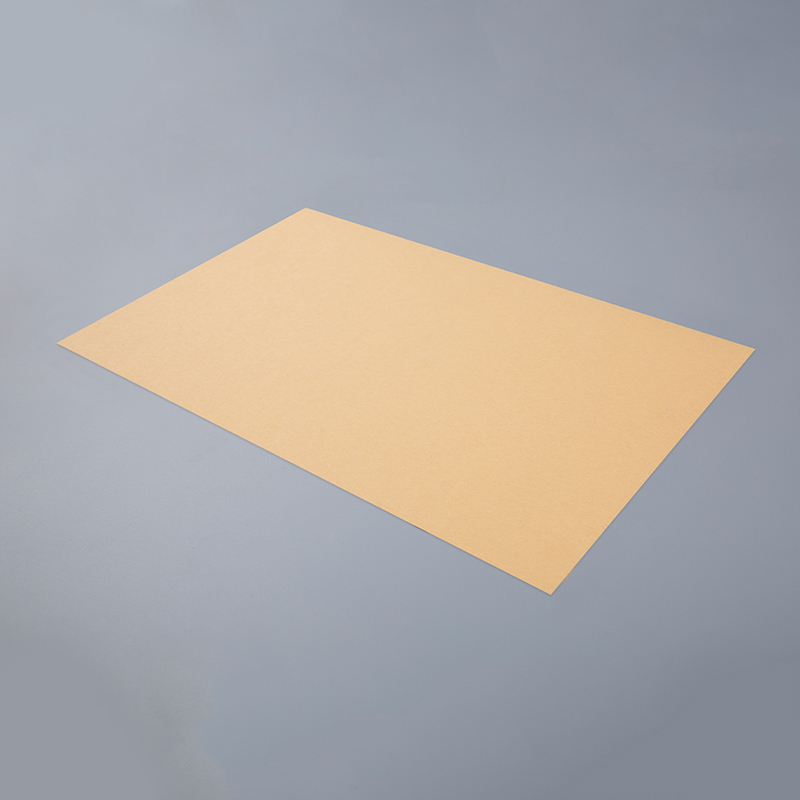
The common jumbo roll widths include 1000 mm, 1020 mm, 1080 mm, and 1530 mm. Sheet sizes can include A4, A3, 20 x 30, 21 x 30, 24 x 36, 50 cm x 70 cm, and 70 cm x 100 cm, while customized sheet sizes are also available. This range of options allows users to match the material to manual application, automatic cutting, sheet-fed processing, roll-to-roll printing, lamination, and other conversion requirements.
2. Why Double Side Adhesive Paper Matters
In industrial and commercial production, adhesion is more than simple stickiness. A good bonding material must hold firmly, remain stable during storage, release smoothly during application, resist lifting at edges, and perform consistently across production batches. Double side adhesive paper addresses these needs by combining adhesive chemistry, carrier design, release liner quality, and precision manufacturing.
Compared with traditional paper labels, double-sided adhesive materials provide higher bonding flexibility. Traditional labels are usually designed to carry printed information on one side and stick to a surface on the other. Double side adhesive paper, however, is often used as an invisible bonding layer between two materials. It can attach decorative panels, foam pads, leather components, sponge pieces, paper cards, plastic films, or electronic accessories without exposing glue lines or requiring drying time.
This feature is especially important in products where appearance matters. For example, automobile interior decoration parts require neat bonding without excess glue. Stationery products require clean edges and convenient peeling. Leather goods require a flexible adhesive layer that can conform to textured surfaces. Electronics components require reliable adhesion in compact spaces. In these cases, double side adhesive paper can simplify assembly and improve the quality of the final product.
3. Core Structure and Material Composition
The performance of double side adhesive paper depends on the balance of four major parts: the center carrier, the adhesive layers, the release liners, and the conversion accuracy. Each element affects the final bonding result.
3.1 Sandwiched Carrier
The carrier is the internal support layer between the two adhesive coatings. A 15 g white non-woven carrier provides flexibility, conformability, and easy die-cutting. It helps the adhesive maintain dimensional stability while allowing the material to adapt to curved or slightly uneven surfaces. For applications that require higher dimensional strength, transparent PET options such as 19 microns, 25 microns, and 50 microns can be selected. PET carriers provide stronger tensile properties, cleaner handling, and better stability in precision converting.
3.2 Adhesive Layers
The adhesive determines the bonding strength, surface compatibility, temperature performance, removability, and aging behavior. Water-based adhesive is widely used because it offers balanced performance and is suitable for many paper, plastic, textile, and light industrial applications. Hotmelt adhesive can provide high initial tack and fast bonding. Solvent adhesive may be used when stronger chemical resistance or special bonding characteristics are required. Anti-freeze and cryogenic adhesives are valuable in low-temperature environments, while removable adhesive allows temporary positioning or clean removal in selected uses. Tyre-grade rubber adhesive is available for demanding rubber-related bonding needs.
3.3 Two Side Release Liners
The two release liners protect the adhesive layers before application. A 90 g white release paper is a practical standard liner because it offers stability, smooth peeling, and easy handling. A 90 g yellow release paper can be selected when visual identification or process differentiation is required. The liner must release evenly without tearing, curling excessively, or leaving residue on the adhesive.
3.4 Conversion Format
The product can be delivered as jumbo rolls, smaller converted rolls, or sheets. Roll materials are suitable for automatic dispensing, laminating, die-cutting, and continuous production. Sheets are suitable for manual application, sample production, office processing, stationery production, and sheet-fed cutting. Availability in both formats improves flexibility for customers with different production scales.
4. Product Specifications
Item |
Available Specification |
Practical Benefit |
Sandwiched Material |
15 g white non-woven material; 19, 25, or 50 micron transparent PET available |
Supports flexible bonding, dimensional stability, and different die-cutting requirements |
Adhesive |
Water-based adhesive; hotmelt, solvent, anti-freeze, removable, cryogenic, and tyre-grade rubber adhesive available |
Allows performance matching for different surfaces, temperatures, and use conditions |
Two Side Liners |
90 g white release paper; 90 g yellow release paper available |
Protects adhesive and provides controlled peeling during application |
Jumbo Roll Width |
1000 mm, 1020 mm, 1080 mm, 1530 mm |
Suitable for large-scale coating, laminating, slitting, and roll-to-roll conversion |
Sheet Size |
A4, A3, 20 x 30, 21 x 30, 24 x 36, 50 cm x 70 cm, 70 cm x 100 cm, customized sizes |
Supports manual use, sheet-fed processing, stationery production, and customized projects |
Packing |
Sea-transit-worthy poly-wood pallet packing and carton packing for rolls or sheets |
Improves transport safety and protects material during storage and delivery |
5. Advantages Over Traditional Labels and Ordinary Adhesive Materials
Double side adhesive paper in White PEK has several advantages over conventional paper labels, ordinary double-sided tapes, and low-grade bonding sheets. These advantages come from its composite design, adhesive options, processing compatibility, and manufacturing consistency.
5.1 Stronger Bonding on Different Surfaces
Traditional paper labels are normally designed for surface identification. They may work well on flat cartons, packages, or smooth bottles, but they are not always strong enough for high-viscosity scenes involving leather, foam, sponge, plastic accessories, or industrial decoration products. Double side adhesive paper provides adhesive on both sides, creating a bonding bridge between two materials. This structure improves the holding ability and reduces the risk of falling off, shifting, or edge lifting during use.
5.2 Cleaner Assembly Than Liquid Glue
Liquid glue can require manual control, drying time, curing conditions, and cleanup. It can overflow at edges, stain surfaces, or cause inconsistent bonding thickness. Double side adhesive paper provides a pre-coated adhesive layer with controlled thickness. Workers or machines can apply it quickly, peel the liner, and complete bonding without waiting for glue to dry. This improves production speed and makes the finished product cleaner.
5.3 Better Processing Efficiency
The material can be die-cut, kiss-cut, laminated, slit, or sheeted. It is suitable for both small-batch and mass-production environments. When supplied in jumbo rolls, it can feed into automated converting systems. When supplied in sheets, it supports manual processing and sheet-fed operations. This flexibility helps manufacturers reduce setup time and adapt to different product designs.
5.4 Suitable for High-Viscosity Application Scenarios
Some applications require a more aggressive bond than common label paper can provide. Leather goods, pearl cotton, sponge, shoe products, electronics, and automobile decoration parts often involve surfaces that are porous, textured, flexible, or exposed to handling stress. Double side adhesive paper can be paired with adhesive types that improve initial tack, holding strength, or low-temperature performance.
5.5 Stable Release and Application
The use of 90 g release paper liners improves handling during storage, cutting, and application. A stable liner helps prevent premature adhesive exposure, blocking, and contamination. Smooth release is important for operators and machines because inconsistent release may slow production or cause material waste.
5.6 Customization for Different End Uses
One of the major advantages of this product is the availability of different carriers, adhesives, liners, widths, and sheet sizes. Customers do not need to force one standard material into all applications. Instead, they can select a structure that matches their bonding surface, operating temperature, peeling requirement, and production method.
6. Application Areas
Double side adhesive paper is used in many industries because it performs as an efficient bonding medium. Its role may be visible in some products and completely hidden in others. The following application areas show why the material has broad value.
6.1 Stickers and Label Converting
In sticker production, double side adhesive paper can create special adhesive structures, multi-layer labels, promotional stickers, and bonding components. It supports die-cut shapes and customized sizes. Because the adhesive layers are protected by release liners, converters can process the material with better control.
6.2 Stationery and Office Products
Stationery products often require clean, safe, and convenient bonding. Double side adhesive paper can be used in craft materials, mounting sheets, adhesive tabs, office labels, teaching aids, sample books, photo mounting, envelopes, and document accessories. The sheet format options such as A4 and A3 are particularly convenient for office and stationery uses.
6.3 Leather Goods
Leather surfaces can be textured, flexible, and difficult to bond with ordinary labels. Double side adhesive paper can help assemble leather accessories, decorative pieces, linings, and temporary positioning components. Depending on the surface and performance requirement, different adhesive types can be selected to improve bonding strength and durability.
6.4 Pearl Cotton and Sponge
Pearl cotton and sponge are porous and compressible materials. Liquid glue can penetrate unevenly, while low-grade tapes may not achieve enough contact. A suitable double side adhesive paper can provide a controlled adhesive layer and simplify the bonding of foam pads, cushions, packaging inserts, shock absorption parts, and protective components.
6.5 Shoe Products
Footwear production involves fabrics, leather, foam, rubber, and synthetic materials. Double side adhesive paper can assist with positioning, inner structure bonding, decorative components, and assembly steps where clean and stable adhesion is required. In some cases, special adhesives may be selected to meet flexibility or rubber-bonding needs.
6.6 Electronics
Electronics manufacturing often needs thin bonding materials that can fit into compact spaces. Double side adhesive paper can be used for component positioning, insulation-related assembly, panel attachment, gasket bonding, label mounting, and protective layer installation. PET carrier options can be useful where dimensional stability and cleaner conversion are important.
6.7 Automobile Decoration Products
Automobile interior and exterior decoration components require neat appearance and dependable adhesion. Double side adhesive paper can bond decorative trims, pads, foams, emblem-related layers, interior accessories, and protective materials. For automotive environments, adhesive selection should consider temperature, surface energy, aging resistance, and vibration exposure.
7. Manufacturing Strengths Behind Product Performance
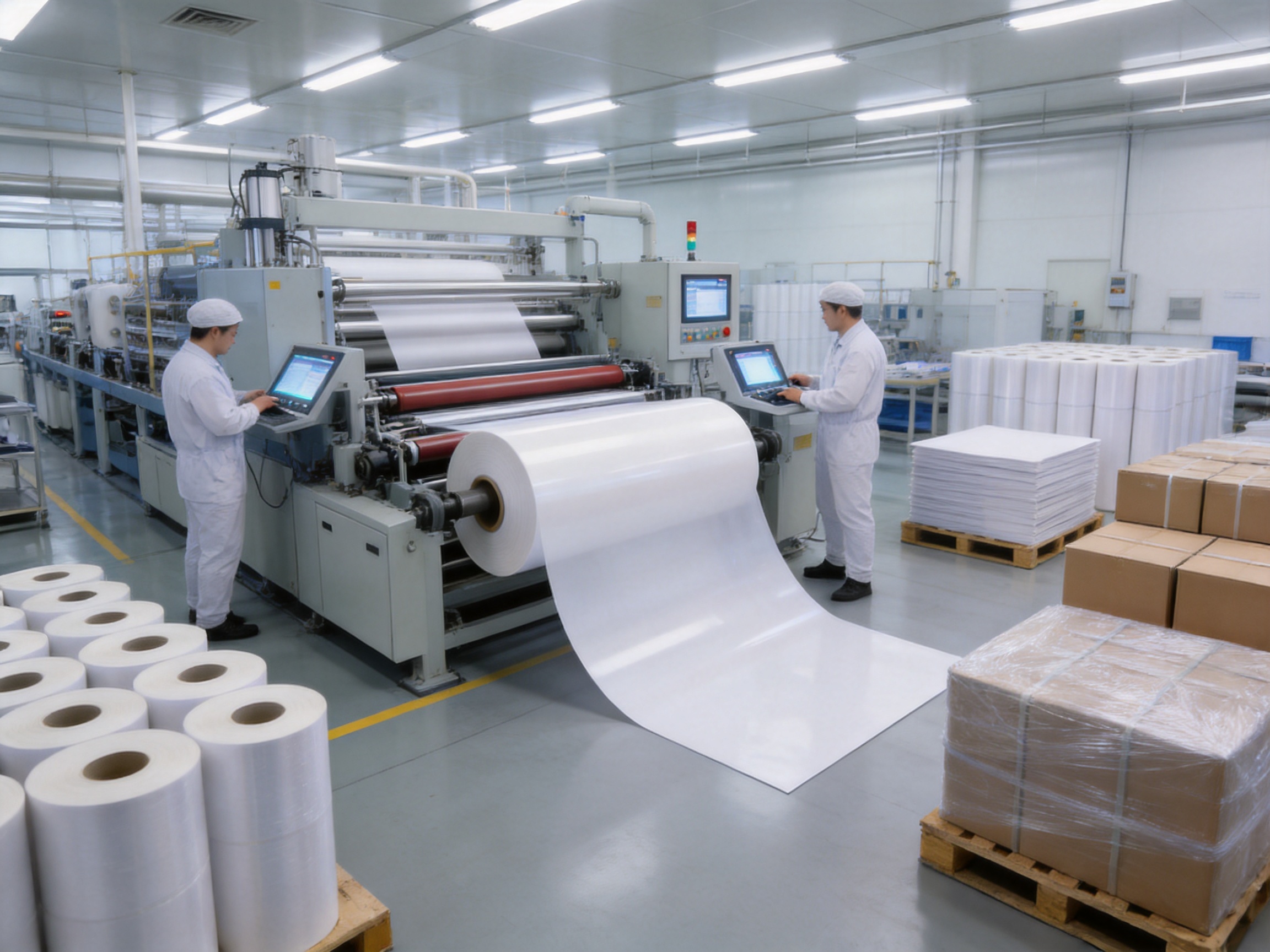
A double side adhesive paper product is only as reliable as the manufacturing system behind it. The coating weight, adhesive uniformity, liner quality, lamination pressure, roll tension, slitting accuracy, and inspection process all influence final performance. Suzhou Piaozhihua Composite Material Technology Co., Ltd. specializes in high-grade self-adhesive label materials and integrates research and development, production, sales, and after-sales service. This integrated model helps ensure that product design and production control work together.
The company operates a full range of production lines, including gluing, laminating, and cutting. These processes are essential for double side adhesive paper because the product requires accurate adhesive coating on both sides, stable carrier handling, smooth liner lamination, and precise conversion into rolls or sheets. When these stages are controlled under one manufacturing system, quality is easier to monitor and product consistency is easier to maintain.
With an annual production capacity of more than 280 million square meters, the manufacturer has the scale needed to support both regular supply and customized orders. Large production capacity also supports stronger material sourcing, more stable batch planning, and faster response for customers who need continuous supply.
7.1 Gluing Process
The gluing process determines how evenly the adhesive is applied to the carrier or liner. Uneven coating can cause weak spots, excessive tack, edge bleeding, curling, or poor die-cutting. Advanced gluing capability helps maintain a controlled adhesive layer so that bonding performance remains consistent across the roll or sheet. This is especially important for customers who run the material on automated equipment because small variations can affect production efficiency.
7.2 Laminating Process
Laminating combines the carrier, adhesive, and release liners into a stable composite structure. Proper lamination requires controlled pressure, alignment, tension, and surface cleanliness. If the lamination is poor, the material may wrinkle, tunnel, delaminate, or release unevenly. A professional laminating process gives the double side adhesive paper better flatness, better roll appearance, and better application reliability.
7.3 Cutting and Slitting Process
After coating and laminating, the material must be cut into jumbo rolls, smaller rolls, or sheets. Precision cutting affects edge quality, roll winding, sheet squareness, and dust control. Clean cutting is especially important for electronics, labels, and decorative products where contamination or rough edges can cause defects. A manufacturer with dedicated cutting capability can provide customized widths and sheet sizes according to production needs.
7.4 Testing and Inspection
Product reliability depends on systematic testing. The company maintains its own testing laboratory and advanced inspection equipment, helping verify adhesive performance, release behavior, material appearance, and production consistency. Inspection reduces the risk of batch variation and supports continuous improvement in adhesive formulation and composite structure.
8. Research, Customization, and OEM/ODM Capability
Different customers often face different bonding challenges. A material that works well on paper may not work on sponge. A product that bonds strongly at room temperature may not perform in cold storage. A structure that is perfect for manual application may not feed smoothly on a high-speed die-cutting machine. For this reason, OEM and ODM capability is a major advantage.
The manufacturer has more than 20 years of OEM manufacturing experience and supports customized solutions based on customer drawings or samples. This experience is valuable because adhesive material development often requires practical testing, not only theoretical selection. The surface to be bonded, application pressure, dwell time, temperature, humidity, conversion process, and final product environment all affect performance.
Strong ODM and OEM capabilities are supported by a professional research and development team and multiple patents. This enables the company to develop customized face materials, adhesives, and backing papers according to customer needs. For double side adhesive paper, customization may include adhesive type, carrier thickness, liner color, release force, roll width, sheet size, or packing method.
The ability to produce based on drawings or samples is useful for converters and end-product manufacturers. If a customer has a special component shape, assembly process, or target bonding strength, the manufacturer can help recommend a suitable material structure and production format. This reduces trial-and-error cost and improves the chance of successful mass production.
9. Quality Stability and Competitive Advantages
In the self-adhesive material market, many suppliers can provide low-cost products, but not all can provide stable performance over repeated orders. For industrial users, stability is often more important than a small price difference. If a material fails during die-cutting or final assembly, the cost of downtime, rejected products, and customer complaints can be much higher than the savings from cheaper material.
9.1 Batch-to-Batch Consistency
Professional production lines and inspection systems help maintain coating consistency, liner release stability, and roll quality. Batch-to-batch consistency allows customers to use the same machine settings and process conditions over time. This reduces production uncertainty and improves efficiency.
9.2 Broad Material Options
The availability of non-woven and PET carriers, multiple adhesive systems, white and yellow liners, various jumbo widths, and many sheet sizes gives customers greater choice. Competitors with limited structures may only offer a general-purpose tape that cannot be optimized for demanding surfaces or temperature conditions.
9.3 Strong Application Adaptability
The product can be used in stickers, stationery, office products, leather goods, pearl cotton, sponge, shoe products, electronics, and automobile decoration products. This wide application range shows that the material is not limited to one narrow industry. It can be adjusted for different bonding requirements.
9.4 Integrated Service
Because the company integrates production, sales, research and development, and after-sales service, customers can receive technical support before and after purchase. This is useful when selecting adhesive types, confirming sheet dimensions, planning packing, or solving application issues.
9.5 Large Production Capacity
An annual capacity of more than 280 million square meters supports stable supply for domestic and international customers. For buyers who need long-term sourcing, production capacity is a key factor. It reduces supply risk and supports future growth.
10. Packaging and Delivery Reliability
Adhesive materials must be protected during storage and transportation. Release paper, adhesive layers, and roll edges can be affected by moisture, pressure, dust, and mechanical impact. Proper packaging helps preserve product quality from the factory to the customer’s warehouse.
The product can be supplied with sea-transit-worthy poly-wood pallet packing and carton packing for both rolls and sheets from stock. For sheet materials, 100 sheets per ream can be packed with strong PE-coated kraft paper wrapper. Strong pallets are wrapped with stretch film and fastened with plastic fastening belts. This packaging system helps reduce movement, moisture exposure, and handling damage during shipping.
For international shipments, reliable packing is especially important because materials may experience long transit time, changes in humidity, container stacking, and multiple handling stages. Proper palletization and wrapping reduce the risk of edge damage, deformation, and contamination. Customers benefit from receiving material that is ready for conversion or application.
11. Sustainability and Responsible Material Development
Modern customers increasingly care about sustainable product design and environmental responsibility. In adhesive materials, sustainability can involve face materials, adhesive chemistry, backing papers, production efficiency, waste reduction, and responsible sourcing. A manufacturer with a clear focus on sustainable development can help customers meet changing market expectations.
The company’s brand positioning emphasizes sustainable development and environmental protection. It develops eco-friendly solutions that include face materials, adhesives, and backing papers to meet sustainable product needs. For double side adhesive paper, this may involve selecting suitable adhesive systems, optimizing coating efficiency, reducing material waste, and offering structures that meet customer requirements without unnecessary excess thickness or complexity.
Quality and sustainability are closely connected. A stable adhesive material reduces waste caused by rejected products, failed bonding, and production downtime. When a product performs reliably, fewer materials are discarded, fewer replacements are needed, and the total production process becomes more efficient.
12. How to Select the Right Double Side Adhesive Paper
Choosing the correct double side adhesive paper requires more than selecting a size. The user should consider the bonding surface, temperature, expected lifetime, processing method, required thickness, release preference, and storage conditions. The following points can help guide material selection.
12.1 Identify the Bonding Substrates
Different surfaces have different bonding behavior. Paper, leather, sponge, PET film, rubber, metal, and painted plastic may require different adhesive types. Smooth high-energy surfaces are usually easier to bond, while rough, porous, low-energy, or flexible surfaces may require stronger tack or special adhesive chemistry.
12.2 Consider Temperature Conditions
If the product will be used in cold storage, winter transportation, or low-temperature assembly, anti-freeze or cryogenic adhesive options may be important. If the application involves heat exposure, the adhesive should be selected for temperature resistance and aging stability.
12.3 Decide Between Non-Woven and PET Carrier
Non-woven carrier is flexible and suitable for many general bonding applications. PET carrier provides greater dimensional stability and may be preferred for precision die-cutting, electronics, and applications requiring stronger internal support. The choice depends on the final product structure and processing method.
12.4 Select the Release Liner
White release paper is a standard practical choice. Yellow release paper can help operators distinguish layers, identify product sides, or manage production workflows. Release force should match the application process so that the liner peels smoothly without causing adhesive transfer problems.
12.5 Choose Roll or Sheet Format
Roll format is suitable for continuous production, automatic die-cutting, laminating, and large-scale conversion. Sheet format is suitable for manual use, stationery, office work, sample preparation, and sheet-fed cutting. Customized sizes can help reduce waste and improve convenience.
12.6 Test Before Mass Production
For critical applications, users should test the material under actual production and end-use conditions. Testing should include initial tack, final bond strength, peeling, aging, temperature exposure, surface compatibility, and die-cutting behavior. A professional supplier can help recommend test methods and material options.
13. Practical Performance Benefits for Manufacturers
For manufacturers, double side adhesive paper offers benefits that go beyond bonding strength. It can influence production cost, workflow, quality control, product appearance, and customer satisfaction.
First, it can reduce assembly time. Since the adhesive is pre-coated and protected by release liners, workers do not need to apply glue manually or wait for drying. This helps improve production speed and reduces labor variability.
Second, it can improve product appearance. A clean adhesive layer helps avoid overflow, stains, and uneven glue marks. This is important for decorative products, leather goods, stationery, and consumer electronics.
Third, it can improve process control. The adhesive thickness and coating are controlled during manufacturing, making the bonding layer more predictable than manually applied liquid glue.
Fourth, it can reduce rejected products. When the material is properly selected, it helps prevent edge lifting, shifting, and falling off. This improves finished product reliability.
Fifth, it supports design flexibility. Because the material can be die-cut into different shapes, it allows designers to create customized bonding patterns for specific products.
14. International Supply Capability
A strong supply network is important for customers who source adhesive materials globally. The manufacturer has built a marketing network in many countries and regions, including the United States, Germany, Japan, South Korea, Brazil, Mexico, Russia, the Middle East, and other areas across Asia, Europe, the Americas, and Africa. This international experience supports better understanding of export packaging, communication, product documentation, and long-term supply expectations.
In China, sales outlets and direct sales networks cover many major cities, supporting domestic service and fast market response. This combination of domestic coverage and international supply experience makes the company suitable for customers who need both manufacturing strength and export reliability.
15. Why Manufacturing Experience Matters
Adhesive material production is a technical field that requires experience in chemistry, coating, web handling, paper treatment, film lamination, release systems, and conversion. More than 20 years of development experience provides practical knowledge that cannot be replaced by equipment alone. Experienced manufacturers understand how small changes in coating weight, liner moisture, adhesive formulation, or winding tension can affect final performance.
This experience is especially important when customers require customized products. A supplier must be able to listen to application problems, identify possible causes, and adjust the material structure. For example, if a customer experiences difficult liner peeling, the issue may involve release coating, adhesive compatibility, storage conditions, or die-cutting pressure. If a customer experiences poor bonding on sponge, the adhesive type or application pressure may need adjustment. Experienced technical support can help solve these issues more efficiently.
16. Quality Values in Production and Service
The company’s core values include quality, integrity, innovation, win-win cooperation, and responsibility. These values are relevant to double side adhesive paper because customers depend on the material for their own finished products. Quality ensures consistent bonding and conversion. Integrity supports accurate communication and dependable supply. Innovation enables new adhesive structures and sustainable solutions. Win-win cooperation helps build long-term partnerships. Responsibility supports after-sales service and continuous improvement.
For customers, these values translate into practical benefits. They can receive material recommendations, customized solutions, production support, and after-sales assistance. They can also work with a supplier that has both technical capacity and long-term market experience.
17. Frequently Asked Questions
Q1: What is double side adhesive paper in White PEK used for?
It is used as a bonding material for stickers, stationery, office products, leather goods, pearl cotton, sponge, shoe products, electronics, automobile decoration products, and other applications requiring adhesive on both sides.
Q2: How is it different from a traditional paper label?
A traditional paper label usually has one adhesive side and one printable or visible side. Double side adhesive paper has adhesive on both sides, allowing it to bond two surfaces together. It is generally more suitable for assembly, mounting, and high-viscosity bonding scenarios.
Q3: What carrier materials are available?
The standard sandwiched material can be 15 g white non-woven material. Transparent PET carriers of 19 microns, 25 microns, and 50 microns are also available for applications requiring stronger dimensional stability.
Q4: What adhesive types can be selected?
Water-based adhesive is available, and options include hotmelt adhesive, solvent adhesive, anti-freeze adhesive, removable adhesive, cryogenic adhesive, and tyre-grade rubber adhesive. The best choice depends on the surface, temperature, and final use.
Q5: What liner options are available?
The product can use 90 g white release paper as a standard option, with 90 g yellow release paper available when visual distinction or process identification is needed.
Q6: Can the material be customized?
Yes. Jumbo roll widths, sheet sizes, carrier materials, adhesive types, liner colors, and other specifications can be customized according to customer requirements, drawings, or samples.
Q7: What sizes are commonly available?
Jumbo roll widths include 1000 mm, 1020 mm, 1080 mm, and 1530 mm. Sheet sizes include A4, A3, 20 x 30, 21 x 30, 24 x 36, 50 cm x 70 cm, and 70 cm x 100 cm, with customized sizes available.
Q8: Is it suitable for automatic processing?
Yes. Roll formats are suitable for die-cutting, laminating, slitting, and continuous production. The final suitability depends on equipment settings, liner release, material thickness, and application design.
Q9: How should the product be packed for delivery?
It can be packed with sea-transit-worthy poly-wood pallets and carton packing. Sheet products can be packed 100 sheets per ream with strong PE-coated kraft paper wrapper, then palletized, stretch wrapped, and fastened with plastic belts.
Q10: Why choose a specialized manufacturer instead of a general supplier?
A specialized manufacturer with gluing, laminating, cutting, testing, research, and customization capabilities can provide more stable performance, better technical support, stronger supply capacity, and more suitable material structures for demanding applications.
18. Conclusion
Double side adhesive paper in White PEK is a practical and versatile bonding material for modern labeling, stationery, office, industrial, electronic, footwear, leather, sponge, pearl cotton, and automobile decoration applications. Its double-sided adhesive structure provides strong bonding, clean assembly, efficient processing, and broad customization potential. Compared with traditional paper labels and ordinary adhesive materials, it offers better suitability for high-viscosity scenes and more flexible bonding between different surfaces.
The value of this material is strengthened by advanced manufacturing processes, including gluing, laminating, cutting, and inspection. A supplier with large production capacity, professional research and development, OEM and ODM experience, testing equipment, and sustainable product development can deliver more than a standard adhesive sheet. It can provide application-focused solutions that help customers improve production efficiency, reduce waste, and enhance finished product quality.
For users seeking reliable double side adhesive paper, the key is to choose the correct combination of carrier, adhesive, liner, format, and size. With proper selection and professional manufacturing support, this material can become an efficient, clean, and dependable bonding solution for a wide range of products.
References
1. Benedek, I. Pressure-Sensitive Adhesives and Applications. CRC Press.
2. Satas, D. Handbook of Pressure Sensitive Adhesive Technology. Satas and Associates.
3. Petrie, E. M. Handbook of Adhesives and Sealants. McGraw-Hill Education.
4. Pizzi, A., and Mittal, K. L. Handbook of Adhesive Technology. CRC Press.
5. Kinloch, A. J. Adhesion and Adhesives: Science and Technology. Springer.
6. Industry practice materials on release liners, coating uniformity, lamination control, and pressure-sensitive adhesive converting.