
 English
 Español
 русский
 Français
 عربى
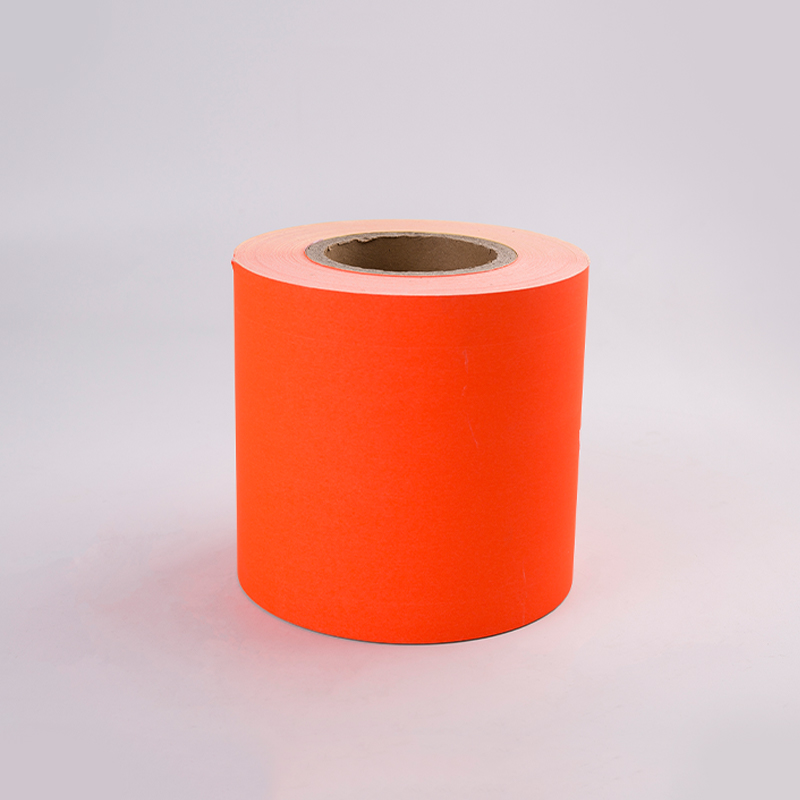
عربىFluorescent paper in rolls is a high-impact self-adhesive label material designed for printing, packaging, advertising, decoration, safety identification, product marking, trademark labeling, and specialty promotional uses. With a bright fluorescent paper face material, reliable adhesive systems, and a release liner suitable for efficient converting, this product provides a practical solution for brands, printers, label converters, distributors, and manufacturers that require vivid color performance, strong visual attention, and stable processing quality.
In competitive labeling and packaging markets, visibility is often the difference between being noticed and being ignored. Fluorescent paper is especially valuable where ordinary white or colored paper cannot provide enough contrast. Its strong brightness makes labels stand out on shelves, cartons, equipment, public notices, promotional materials, toys, gifts, safety items, and special product packaging. When produced as a self-adhesive material in rolls, it also supports high-efficiency printing, die-cutting, slitting, labeling, and inventory management.
Suzhou Piaozhihua Composite Material Technology Co., Ltd. offers fluorescent paper self-adhesive material based on extensive experience in label materials, coating, laminating, and converting. The company specializes in high-grade self-adhesive labels and related materials, integrating research and development, production, sales, and after-sales service. With more than 20 years of manufacturing experience, advanced production lines, strong customization capability, and a large annual production capacity, the company is positioned to support both standard and customized fluorescent paper label material requirements.
Content
- 1 Understanding Fluorescent Paper in Rolls
- 2 Core Product Specifications
- 3 Why Fluorescent Paper Creates Stronger Market Impact
- 4 Wide Printing Compatibility
- 5 Applications in Safety, Public Spaces, and Emergency Identification
- 6 Advantages over Ordinary Label Materials
- 7 Advantages over Fluorescent Film Labels
- 8 Advanced Manufacturing Strengths behind the Product
- 9 Quality Control and Testing Advantages
- 10 Adhesive Options for Different Requirements
- 11 Liner Selection and Converting Performance
- 12 Packaging and Delivery for International Supply
- 13 Manufacturing Capacity and Supply Reliability
- 14 OEM and ODM Customization Capability
- 15 Competitive Advantages for Printers and Label Converters
- 16 Value for Packaging and Advertising
- 17 Use in Toys, Gifts, and Creative Products
- 18 Sustainable Development and Eco-Friendly Direction
- 19 How to Select the Right Fluorescent Paper Construction
- 20 Storage and Handling Recommendations
- 21 Why Experienced Manufacturing Matters
- 22 Q&A Section
- 22.1 Q1: What is fluorescent paper in rolls mainly used for?
- 22.2 Q2: What is the face material of this product?
- 22.3 Q3: Which printing methods are suitable?
- 22.4 Q4: What adhesive is normally used?
- 22.5 Q5: Can the label be removed cleanly?
- 22.6 Q6: Is this material suitable for cold environments?
- 22.7 Q7: What liner options are available?
- 22.8 Q8: What roll widths are available?
- 22.9 Q9: Can the product be supplied in sheets?
- 22.10 Q10: What makes this product competitive?
- 23 Conclusion
- 24 References
- 25 Product: Fluorescent Paper In Rolls
Understanding Fluorescent Paper in Rolls
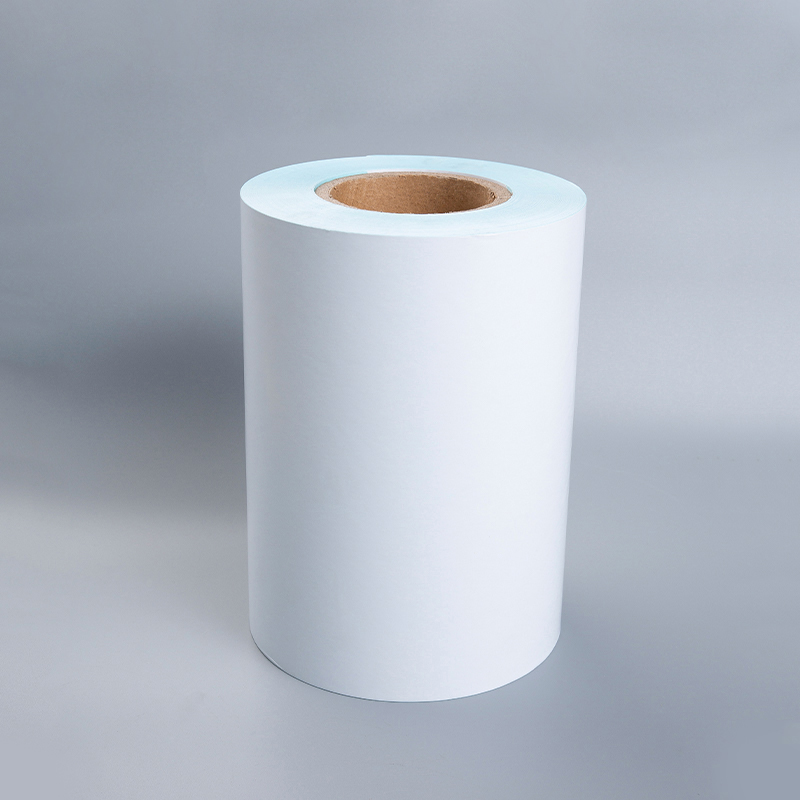
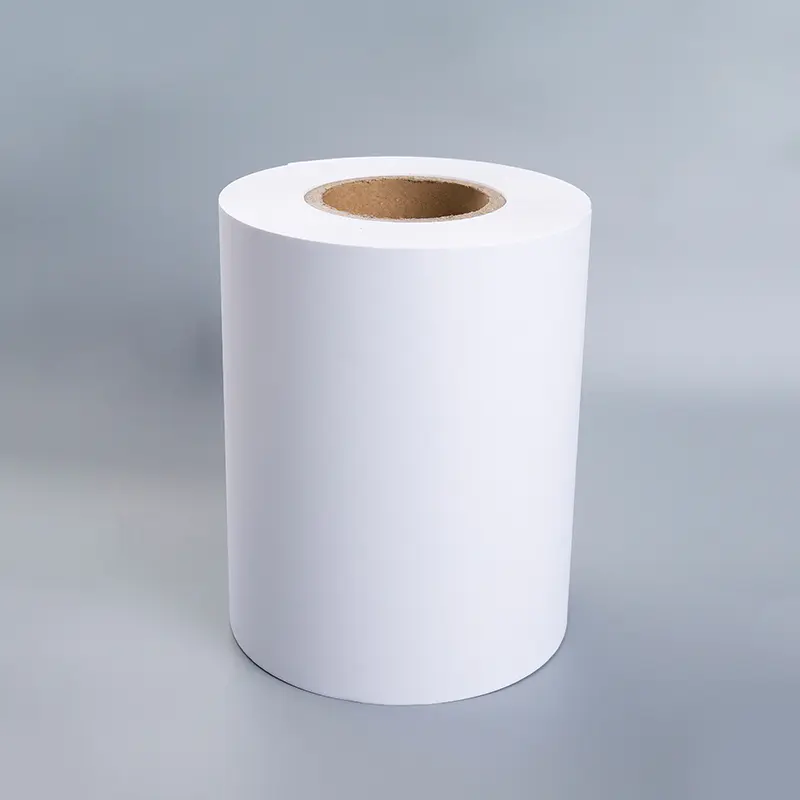
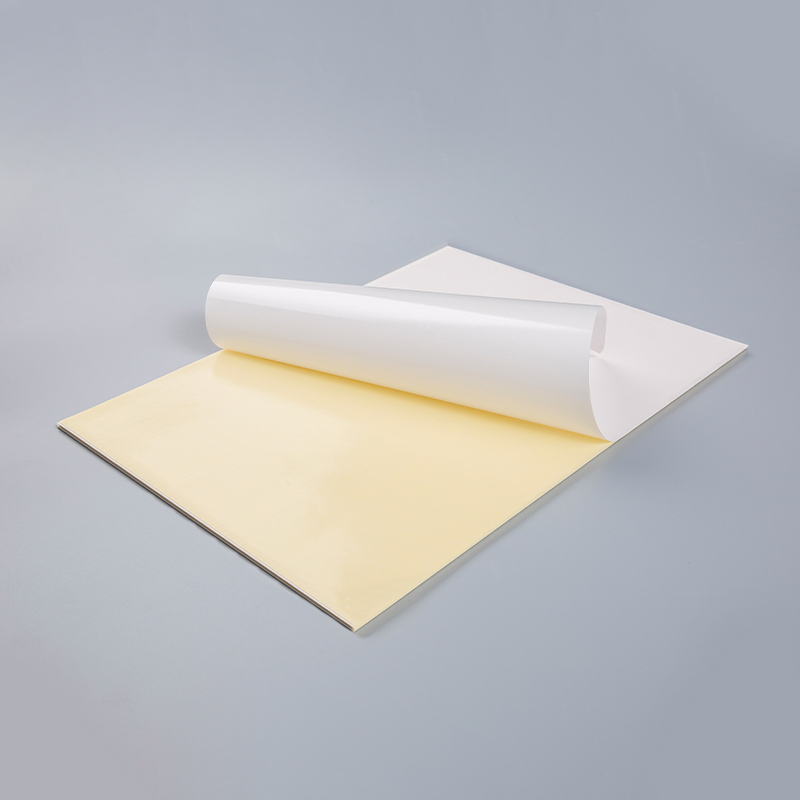
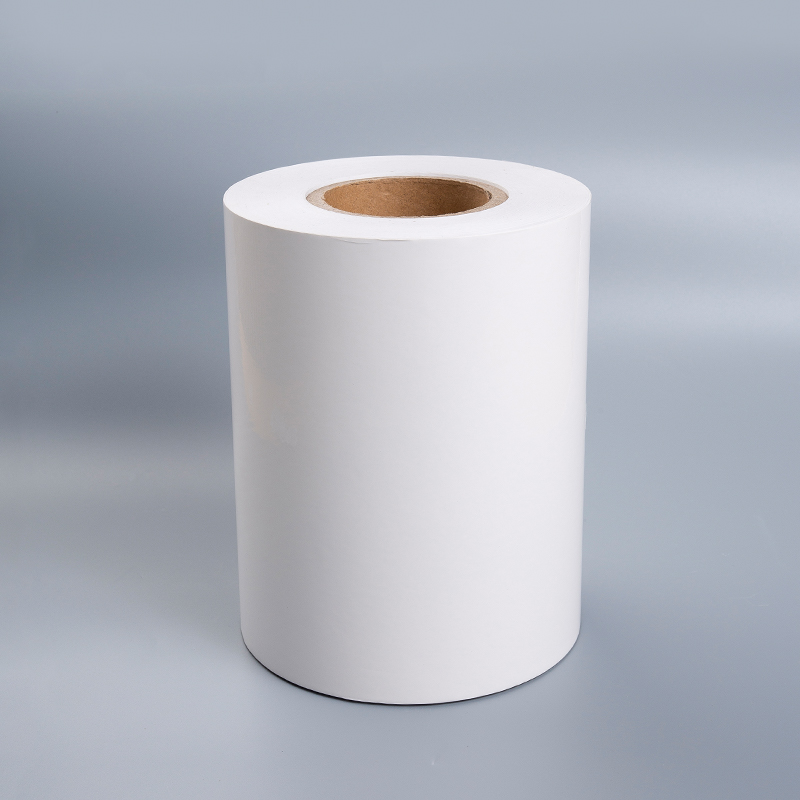
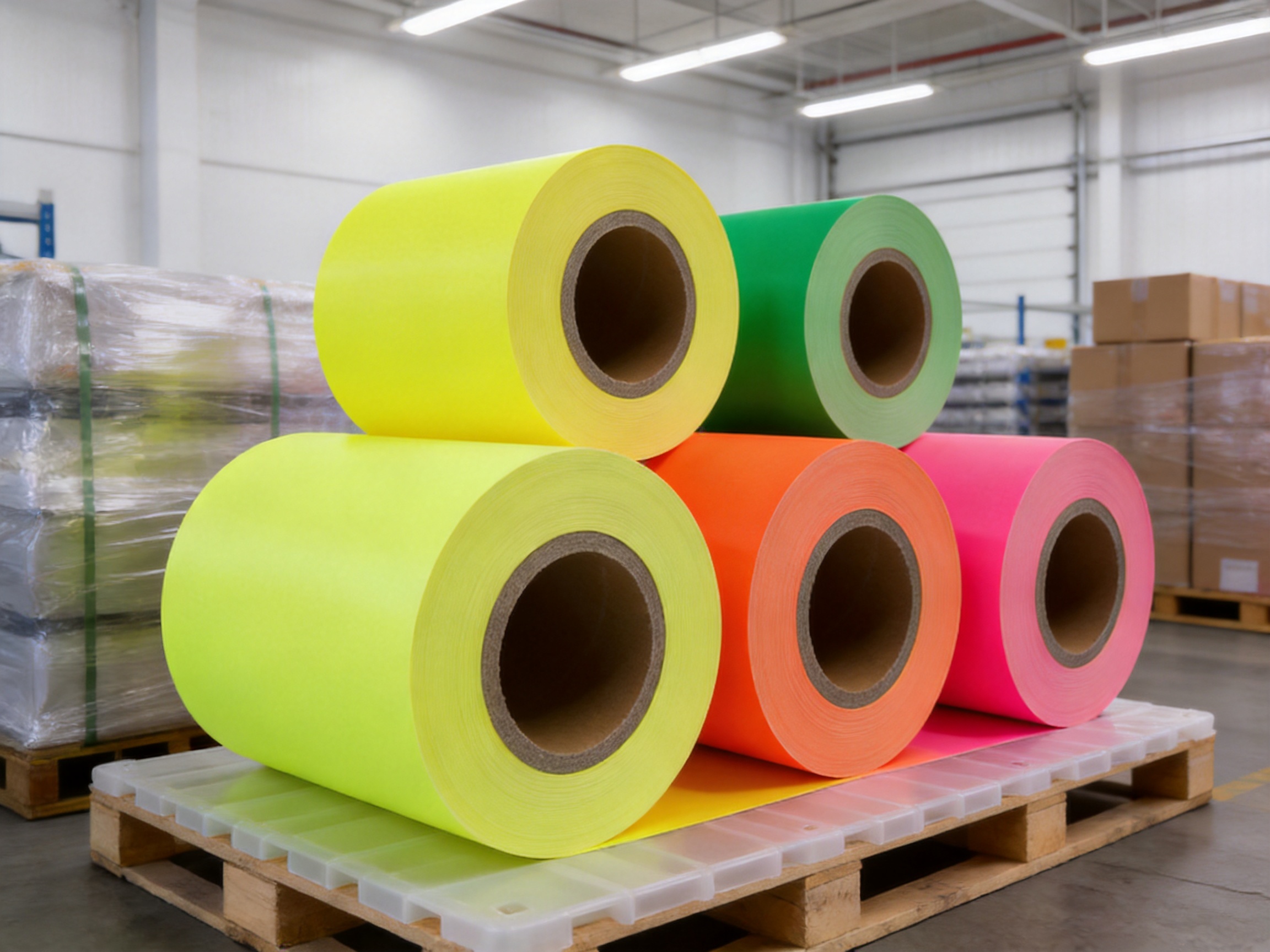
Fluorescent paper in rolls is a pressure-sensitive self-adhesive material composed of a fluorescent paper face stock, an adhesive layer, and a release liner. The face stock provides vivid fluorescent color and printability. The adhesive layer provides bonding performance on different surfaces. The release liner protects the adhesive before use and enables smooth feeding during printing, die-cutting, and labeling operations.
The product described here uses 80gsm fluorescent paper as the face material. This weight offers a practical balance of flexibility, print stability, handling strength, and cost efficiency. It is suitable for many label applications where the label must be bright, visible, and easy to process. Compared with thin materials that may curl or wrinkle during printing, 80gsm paper provides better structure. Compared with overly heavy paper, it is easier to convert and more economical for large-volume applications.
The standard adhesive is waterbased adhesive, which is widely used in paper label materials because of its balanced bonding performance, good coating stability, and compatibility with many printing and converting requirements. In addition, hotmelt adhesive, solvent adhesive, anti-freeze adhesive, removable adhesive, cryogenic adhesive, and tyre-grade rubber adhesive can be provided according to application needs. This adhesive flexibility is one of the major advantages of the product because different industries require different adhesion behavior.
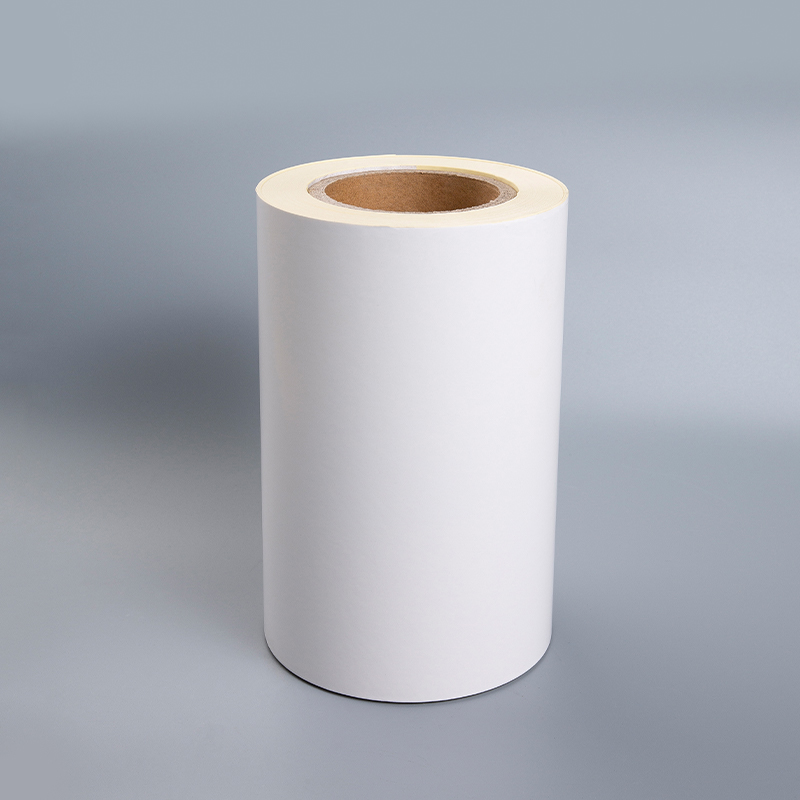
The standard liner is 85g yellow release paper. Other liner options include glassine paper in 50g, 60g, 80g, 100g, and 120g; release paper in 60g, 120g, and 140g; art paper in 140g and 165g; CCK liner in 50g, 80g, 90g, and 120g; and transparent PET liner in 25mic, 36mic, 50mic, and 100mic. This wide liner selection allows the material to be adapted for sheet cutting, roll-to-roll processing, high-speed printing, automatic labeling, and specialty die-cutting.
Core Product Specifications
Item |
Specification |
Practical Value |
Face Material |
80gsm fluorescent paper |
Bright visual impact with reliable printing and converting performance |
Standard Adhesive |
Waterbased adhesive |
Balanced bonding performance for general label applications |
Optional Adhesives |
Hotmelt, solvent, anti-freeze, removable, cryogenic, tyre-grade rubber adhesive |
Supports diverse surface, temperature, and removal requirements |
Standard Liner |
85g yellow release paper |
Stable release and economical converting performance |
Optional Liners |
Glassine, release paper, art paper, CCK liner, transparent PET liner |
Adaptable for different printing, die-cutting, sheet, and roll applications |
Jumbo Roll Width |
1000mm, 1020mm, 1080mm, 1530mm |
Suitable for slitting into multiple roll sizes and large-scale converting |
Sheet Size Options |
A4, A3, 20x30, 21x30, 24x36, 50cm x 70cm, 70cm x 100cm, customized sizes |
Convenient for digital printing, sheet-fed printing, packaging, and office use |
Packaging |
Poly-wood pallet packing and carton packing for rolls or sheets |
Sea-transit-worthy protection for domestic and international delivery |
Why Fluorescent Paper Creates Stronger Market Impact
Ordinary paper labels are often chosen for basic identification, but they may not deliver enough attention in crowded visual environments. Fluorescent paper has an immediate advantage because its color appears brighter and more energetic. This makes it useful for warning labels, promotion labels, shelf tags, discount tags, festive packaging, activity notices, product highlights, public-place reminders, and eye-catching brand communication.
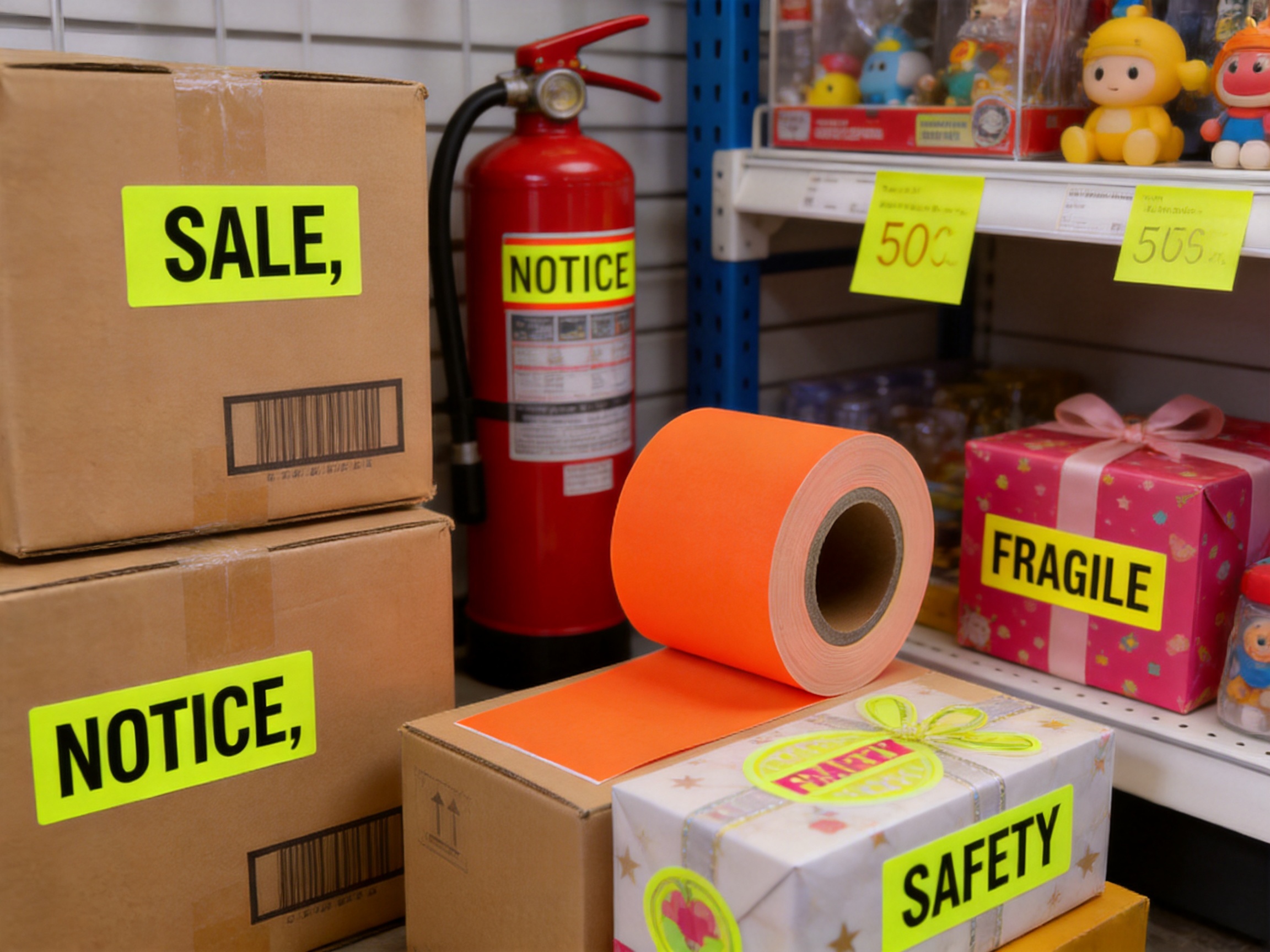
For retail packaging, fluorescent paper labels can help limited-time offers and new product launches stand out. When shoppers compare several products, bright label colors can increase the chance of immediate recognition. For logistics and warehouse management, fluorescent labels can help employees identify priority goods, urgent shipments, fragile items, inventory categories, or inspection status more quickly. For public facilities, they can be applied to fire equipment, emergency reminders, directional signs, and special-use notices.
The vivid appearance of fluorescent paper also benefits creative industries. Toy manufacturers, gift suppliers, stationery producers, event organizers, and advertising companies can use fluorescent paper labels to make packaging more playful, energetic, and memorable. Unlike some decorative films that may require special printing settings or surface treatment, fluorescent paper is compatible with many common printing methods, making it practical for both large production runs and customized short runs.
Another important value is the combination of visual strength and pressure-sensitive convenience. Because the material is self-adhesive, users do not need to apply separate glue, paste, or manual adhesive. Labels can be printed, cut, peeled, and applied efficiently. This improves workflow, reduces labor steps, and makes the material suitable for industrial label production, commercial printing shops, packaging lines, and customized label suppliers.
Wide Printing Compatibility
Fluorescent paper self-adhesive material is suitable for letterpress printing, offset printing, flexographic printing, screen printing, barcode printing, packaging advertising, decorative labeling, and trademark labels. This broad compatibility is important because different customers use different equipment and printing technologies. A label material that works across multiple processes provides greater flexibility and reduces the risk of production limitations.
Letterpress printing remains useful for certain label applications because of its reliable ink transfer and strong color results. Offset printing is popular for high-quality graphics and sheet-fed printed materials. Flexographic printing is widely used in roll label production and packaging due to its speed and efficiency. Screen printing can provide heavy ink coverage and strong visual effects. Barcode printing requires surface stability and accurate print clarity. Fluorescent paper in rolls can support these different production needs when the correct adhesive, liner, ink, and processing settings are selected.
For barcode labels, readability is critical. A fluorescent background can be useful for attention, but barcode contrast must be properly designed. Printers may choose black barcode ink on appropriate fluorescent colors to achieve scan reliability. The paper surface must receive ink consistently to avoid broken bars, smearing, or low-density print. Reliable coating and material consistency from the manufacturer help converters maintain stable barcode output.
For screen printing and promotional graphics, fluorescent paper allows strong color interaction with printed designs. It can be used as a design element rather than only a background. For example, a label may use the fluorescent surface as the main color and add black, white, or metallic print effects. This can reduce ink consumption while producing a bold appearance.
Applications in Safety, Public Spaces, and Emergency Identification
One of the notable application areas for fluorescent paper self-adhesive material is safety-related labeling. It is often attached to fire equipment, public places, special products, emergency notices, and equipment identification signs. The bright surface helps people notice essential information quickly. In locations where attention must be directed immediately, label visibility is not merely decorative; it contributes to communication efficiency.
Fire equipment labels must be highly noticeable. When placed near extinguishers, hose reels, emergency boxes, or safety instructions, fluorescent labels can help guide attention. In public buildings, labels may be used for temporary instructions, maintenance warnings, restricted-area reminders, inspection records, or emergency guidance. Because the material can be supplied with different adhesives, users can choose stronger permanent bonding or removable adhesive depending on the application.
Public-space labels often face different environments, including glass, painted metal, plastic boards, cartons, wooden surfaces, or coated panels. A single adhesive cannot perform ideally on every surface. This is why the availability of waterbased, hotmelt, solvent, anti-freeze, removable, cryogenic, and rubber adhesive options is valuable. The correct adhesive selection can improve bonding strength, reduce lifting, and maintain label appearance during use.
Some fluorescent paper applications may require visibility in darker environments or under special lighting conditions. The provided material description notes that it can glow at night and is often attached to fire equipment and public places. For buyers with specific night-visibility requirements, it is important to confirm the exact performance standard, color, duration, and lighting condition. A professional supplier can help match the product structure to the intended safety or promotional effect.
Advantages over Ordinary Label Materials
Fluorescent paper in rolls offers several advantages over ordinary white paper labels. The first is stronger visibility. White labels depend heavily on printed ink to create visual impact, while fluorescent paper already provides a high-brightness base color. This can reduce the need for heavy color printing and make simple text or graphics appear more prominent.
The second advantage is faster recognition. In warehouses, retail displays, events, offices, and public environments, users can quickly identify fluorescent labels among other materials. This is useful for coding, classification, urgent notices, price changes, promotional messages, and temporary instructions. Faster recognition can improve operational efficiency and reduce mistakes.
The third advantage is flexible design. Fluorescent paper can be used for loud, energetic packaging themes, warning-style labels, seasonal promotions, and creative decoration. Designers can work with the fluorescent surface directly, allowing the background color to become part of the final visual identity. This provides more design possibilities than standard paper.
The fourth advantage is compatibility with pressure-sensitive label manufacturing. The material can be supplied in jumbo roll widths such as 1000mm, 1020mm, 1080mm, and 1530mm, which allows converters to slit the product into many smaller rolls. It can also be supplied in sheets such as A4, A3, 20x30, 21x30, 24x36, 50cm x 70cm, 70cm x 100cm, and customized sizes. This supports both industrial and smaller-scale applications.
The fifth advantage is adhesive customization. Many competitors may offer a limited adhesive range, forcing customers to accept one general-purpose option. However, fluorescent paper labels may be used in different conditions, including cold storage, tires, removable signage, packaging, and high-demand surfaces. The ability to choose different adhesive systems increases application success and reduces customer complaints.
Advantages over Fluorescent Film Labels
Fluorescent film labels have their own value, especially when water resistance, tear resistance, or plastic-like durability is required. However, fluorescent paper labels offer important advantages in many applications. Paper is often more economical, easier to print with conventional methods, and more suitable for short-term or medium-term labeling where extreme durability is not necessary. For promotional labels, packaging stickers, retail notices, and office materials, paper can provide an excellent balance of performance and cost.
Paper labels also tend to provide good ink receptivity for many common printing processes. Some film materials may require corona treatment, special inks, longer drying times, or more careful static control. Fluorescent paper can often be processed more easily in traditional printing environments, making it convenient for printers that already handle paper-based self-adhesive products.
For applications where environmental responsibility and resource efficiency are important, paper-based label materials may be preferred by some customers over plastic films. While the complete sustainability profile depends on adhesive, liner, coating, and disposal conditions, paper materials can support customers seeking alternatives to plastic-heavy label structures. The company’s development direction includes eco-friendly solutions for face materials, adhesives, and backing papers, which aligns with market demand for responsible packaging.
Fluorescent paper also provides a natural tactile feel. For gift packaging, stationery, crafts, promotional stickers, and decorative labels, the paper texture can be more suitable than a glossy plastic film. It can create a friendly, approachable, and creative appearance while still delivering strong fluorescent brightness.
Advanced Manufacturing Strengths behind the Product
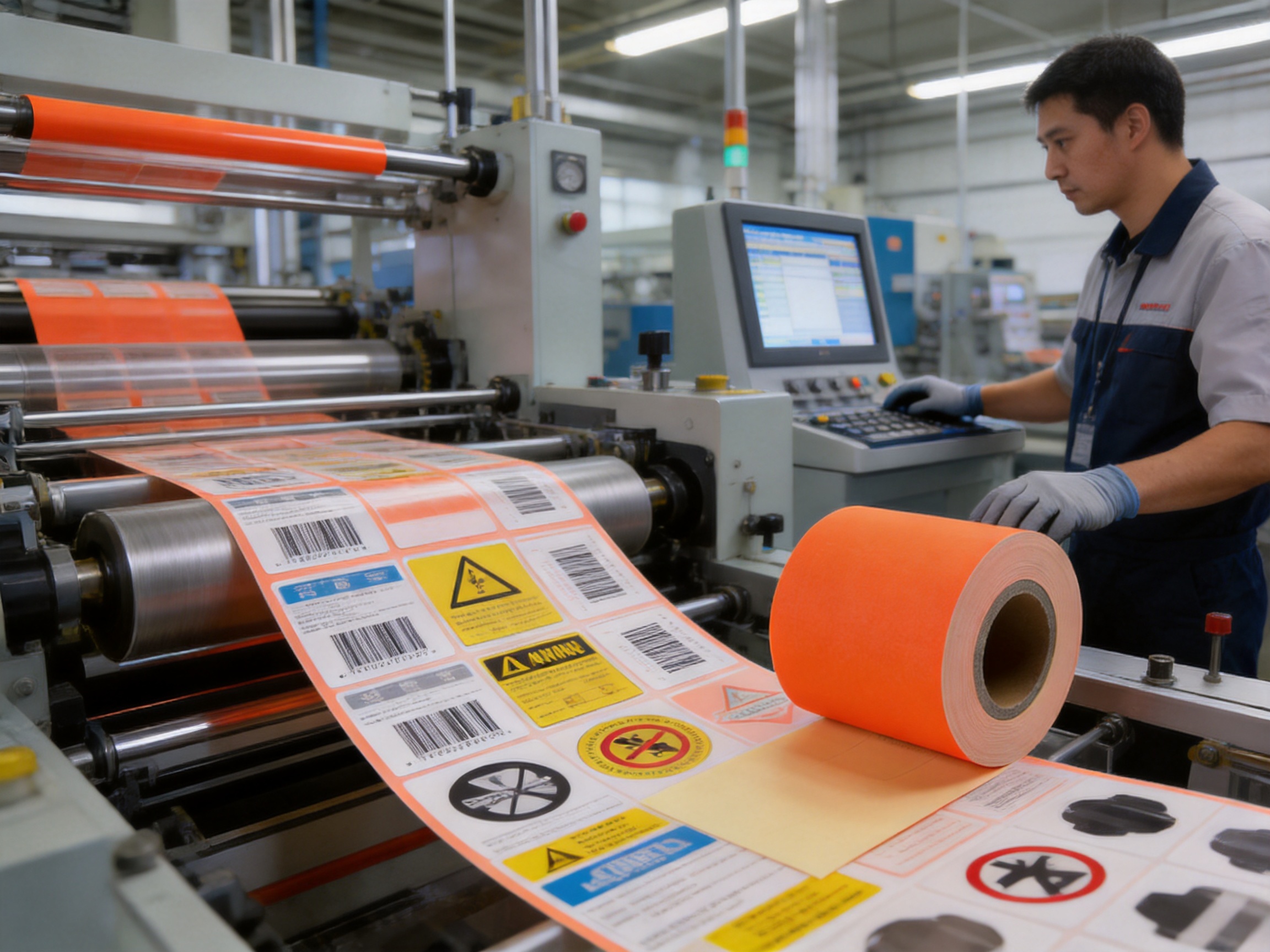
The quality of fluorescent paper in rolls depends not only on the face material but also on the precision of coating, laminating, drying, slitting, and packaging. Suzhou Piaozhihua Composite Material Technology Co., Ltd. has a full range of production lines, including gluing, laminating, and cutting. This integrated manufacturing capability allows the company to manage the product structure from raw material selection to finished roll or sheet delivery.
Gluing is a key process in pressure-sensitive label production. The adhesive must be applied evenly across the width of the web. Uneven coating can cause weak adhesion, adhesive overflow, label curling, poor die-cutting, or inconsistent peeling. Advanced coating control helps ensure that the adhesive weight and distribution remain stable, which is essential for large-volume label converters.
Laminating combines the face material, adhesive, and release liner into a finished self-adhesive construction. During lamination, web tension, alignment, pressure, and surface cleanliness must be controlled carefully. If tension is not stable, the final roll may wrinkle, telescope, curl, or create registration problems during printing. A manufacturer with mature laminating experience can provide more stable materials for demanding downstream operations.
Cutting and slitting convert jumbo rolls into customer-required widths and lengths. Clean slitting edges reduce dust, web breaks, and printing defects. Accurate roll width helps customers set up machines faster and reduce waste. For sheet products, cutting accuracy affects stacking, feeding, packaging, and printing quality. The company’s ability to provide rolls and sheets from stock and customized formats makes it convenient for different market channels.
Quality Control and Testing Advantages
Quality control is one of the most important differences between a reliable label material supplier and an ordinary trader. Fluorescent paper may appear simple from the outside, but its actual performance depends on many technical factors: paper weight, surface smoothness, color consistency, adhesive tack, peel strength, release force, liner flatness, coating uniformity, roll hardness, and dimensional accuracy.
Suzhou Piaozhihua Composite Material Technology Co., Ltd. operates its own testing lab and uses advanced inspection equipment to ensure product quality. This is valuable for customers because label material problems often become expensive only after printing or application. If defects are discovered late, customers may lose ink, labor, production time, delivery schedules, and reputation. Preventive inspection at the manufacturing stage is therefore essential.
Color consistency is especially important for fluorescent paper. If different rolls show visible color variation, printed labels may look inconsistent across one batch or between repeat orders. Professional production control can reduce the risk of color deviation. For brand labels and promotional campaigns, consistent color helps maintain a unified appearance.
Adhesive performance must also be tested according to the application. Initial tack determines how quickly the label grips a surface. Peel strength determines how strongly the label remains attached. Shear resistance indicates how well the adhesive resists sliding under stress. Release force affects how easily the label can be peeled from the liner during manual or automatic application. By managing these properties, the manufacturer can offer a more dependable product.
Roll quality also matters. A roll may have excellent material properties but still create problems if it is wound too loose, too tight, or unevenly. Proper roll winding improves transport safety, storage stability, and machine feeding. Sea-transit-worthy packaging further protects the rolls or sheets during long-distance delivery.
Adhesive Options for Different Requirements
The choice of adhesive can determine whether a fluorescent label succeeds or fails in the final application. A general-purpose waterbased adhesive is suitable for many standard uses, including packaging, advertising, office labels, paperboard surfaces, and general product identification. It is often chosen for balanced performance and efficient manufacturing.
Hotmelt adhesive is typically selected when high initial tack is required. It can be useful for surfaces where fast bonding is needed, or where labels must adhere quickly during high-speed application. For some packaging and logistics uses, strong initial grab can reduce lifting and improve application reliability.
Solvent adhesive can provide strong bonding performance for more demanding applications. It may be selected for special surfaces or conditions where higher resistance is needed. The specific formulation should be chosen according to the substrate, temperature, humidity, and intended life of the label.
Anti-freeze adhesive is valuable for cold environments. Labels used in refrigerated storage, winter logistics, frozen food packaging, or low-temperature warehouses may fail if a standard adhesive becomes stiff or loses tack. Anti-freeze adhesive helps maintain adhesion under colder conditions.
Cryogenic adhesive is used for very low-temperature applications. While not every fluorescent paper label requires such performance, the availability of cryogenic adhesive demonstrates the manufacturer’s broader technical capability. Customers with specialized cold-chain requirements can discuss exact conditions to select the correct material structure.
Removable adhesive is useful when labels must be removed without leaving heavy residue or damaging the surface. This is ideal for temporary notices, promotional stickers, reusable containers, event labels, book labels, decorative labels, or short-term price tags. Removable fluorescent labels combine high visibility with practical clean removal.
Tyre-grade rubber adhesive is designed for challenging surfaces such as tire labels, where the surface is curved, textured, and difficult to bond. This option shows that the product platform can extend beyond standard packaging into specialized industrial labeling. Customers with demanding adhesion requirements benefit from this adhesive diversity.
Liner Selection and Converting Performance
The release liner is sometimes overlooked by buyers, but it plays a critical role in production efficiency. A good liner protects the adhesive, provides dimensional stability, and releases consistently during die-cutting and label dispensing. Poor liner selection can cause web breaks, curling, die-cutting difficulty, or automatic labeling failure.
The standard 85g yellow release paper is a practical liner choice for many applications. It offers stable support and recognizable appearance. For high-speed roll label converting, glassine liners may be selected because they are smooth, dense, and suitable for precise die-cutting. Available glassine weights include 50g, 60g, 80g, 100g, and 120g, allowing customers to balance flexibility and strength.
Release paper in 60g, 120g, and 140g can be used for different sheet and roll applications. Art paper liners in 140g and 165g may be preferred when stiffness and premium handling are required. CCK liners in 50g, 80g, 90g, and 120g offer another option for customers who need specific release and converting characteristics. Transparent PET liners in 25mic, 36mic, 50mic, and 100mic are available for applications where clarity, strength, and smooth release are important.
By offering multiple liner options, the manufacturer helps customers optimize the entire label construction, not only the visible face material. A converter using high-speed die-cutting equipment may need a different liner from a sheet-fed printer. A customer using manual application may prefer another liner structure. This flexibility is a practical competitive advantage.
Packaging and Delivery for International Supply
Fluorescent paper rolls and sheets must be protected against moisture, impact, edge damage, and deformation during shipping. The product can be supplied with sea-transit-worthy poly-wood pallet packing and carton packing for rolls or sheets. This is important for international customers because long-distance transportation may include container loading, vibration, humidity changes, warehousing, and multiple handling steps.
For sheet products, the standard packaging can include 100 sheets per ream, with each ream packed in strong PE-coated kraft paper wrapper. Strong pallets are wrapped with stretch film and fastened with plastic fastening belt. This packaging method helps protect sheet flatness and cleanliness, which is important for feeding and printing.
For roll products, appropriate pallet packing helps maintain roll roundness and protects edges. Edge damage can cause web breaks during printing or slitting. Moisture protection is also important because paper-based materials can absorb humidity, which may affect curling, printing, and adhesive performance. Reliable packaging helps ensure that the material reaches customers in usable condition.
International buyers also benefit from a supplier with experience serving global markets. The company has built a marketing network in many countries and regions, including the United States, Germany, Japan, South Korea, Brazil, Mexico, Russia, the Middle East, and other markets across Asia, Europe, the Americas, and Africa. This international experience supports communication, packaging expectations, customization needs, and long-term supply stability.
Manufacturing Capacity and Supply Reliability
For label converters and distributors, product quality is only one part of the purchasing decision. Supply reliability is equally important. If a material is excellent but unavailable when needed, production schedules may be disrupted. Suzhou Piaozhihua Composite Material Technology Co., Ltd. has an annual production capacity of more than 280 million square meters, supporting large-volume demand and repeat orders.
The company is among the top 10 companies in China for self-adhesive products. This position reflects production scale, market experience, and the ability to serve diverse customers. A larger manufacturing platform can usually provide broader product options, more stable procurement, stronger technical support, and better capacity planning than small-scale suppliers.
The company’s domestic sales network covers major cities such as Shanghai, Ningbo, Hangzhou, Chengdu, Harbin, Wuhan, Chongqing, Guangzhou, Changsha, Beijing, and many franchise chains. This broad market presence helps the company understand different industry needs, from packaging and logistics to printing, retail, and specialty labeling. Market feedback can then support product improvement and new development.
For customers purchasing fluorescent paper in rolls, supply consistency means repeatable material performance between orders. Printers often set machine parameters based on previous batches. If the material changes unexpectedly, they may need to adjust ink, pressure, speed, tension, drying, die depth, or rewinding conditions. Stable manufacturing reduces these adjustments and improves production efficiency.
OEM and ODM Customization Capability
Customization is a major advantage of working with an experienced self-adhesive material manufacturer. Fluorescent paper labels may require special sizes, adhesive types, liner materials, roll widths, sheet formats, color effects, packaging methods, and performance standards. The company accepts OEM and ODM services and can produce materials based on customer drawings or samples.
OEM support is valuable for customers who already have a defined product structure and require a reliable manufacturing partner. ODM support is valuable for customers who have an application requirement but need technical assistance to develop the right material combination. In both cases, professional experience can reduce trial-and-error costs and shorten development time.
The company has strong R&D capability, a professional research team, and multiple patents. This innovation strength is important because label markets continue to change. Customers increasingly require materials for sustainable packaging, low-temperature logistics, removable labeling, digital printing, special surfaces, and high-speed converting. A supplier with R&D capability can respond to these changing needs more effectively than a supplier that only sells standard stock items.
For fluorescent paper in rolls, customization may include jumbo roll width selection, finished roll width, roll length, adhesive formulation, liner thickness, sheet size, and packing method. Customers can also request product testing according to application needs. This makes the material suitable not only for general labels but also for specialized projects.
Competitive Advantages for Printers and Label Converters
Printers and label converters require materials that run smoothly, print clearly, cut cleanly, and deliver consistent adhesion after application. Fluorescent paper in rolls provides strong advantages because it combines visual impact with production adaptability. The material is suitable for common printing methods and can be supplied in jumbo rolls for efficient slitting and converting.
Compared with low-cost materials from less specialized suppliers, this product benefits from more complete manufacturing control. Gluing, laminating, cutting, inspection, packaging, and customization are integrated into the supplier’s production system. This reduces the risk of inconsistent coating, unstable release, poor winding, and uncertain delivery quality.
Converters also benefit from a broad adhesive and liner portfolio. Instead of purchasing from multiple suppliers for different applications, they can work with one manufacturer to develop several product structures. For example, a converter may use waterbased adhesive for standard promotion labels, removable adhesive for temporary retail stickers, anti-freeze adhesive for cold-chain labels, and strong rubber adhesive for difficult surfaces. Using one supplier simplifies sourcing and technical communication.
Another competitive advantage is the ability to support both roll and sheet formats. Some customers require jumbo rolls for industrial label production, while others need A4 or A3 sheets for digital printing, office labels, or smaller promotional batches. The ability to provide both formats helps distributors serve broader customer groups.
Value for Packaging and Advertising
Packaging and advertising depend heavily on attention. Fluorescent paper labels create instant visibility and can communicate urgency, novelty, discount, warning, or special identity. A simple fluorescent sticker can transform ordinary packaging into a promotional display. For seasonal campaigns, limited-time offers, clearance labels, or new product announcements, this material is an efficient tool.
Because fluorescent paper is self-adhesive, it can be applied to existing packaging without redesigning the full carton or bag. This is especially useful when brands need fast changes. Instead of printing an entirely new package, a fluorescent label can add promotional information, language variations, QR codes, barcodes, safety instructions, batch information, or decorative effects.
In advertising, fluorescent labels can be used for event materials, posters, sample packages, direct mail, promotional envelopes, retail signs, and giveaway items. Their bright appearance helps messages stand out in busy environments. For short-run campaigns, sheet formats such as A4 and A3 can be convenient. For large campaigns, roll formats support high-speed printing and die-cutting.
The material is also suitable for decoration and trademark labels. Some brands use fluorescent elements to express energy, youth, creativity, or innovation. When paired with clean typography and suitable printing ink, fluorescent paper can create a strong visual identity without complex finishing processes.
Use in Toys, Gifts, and Creative Products
Toys and gifts often require playful, colorful, and memorable packaging. Fluorescent paper labels support this need by adding brightness and excitement. They can be used for product stickers, decorative seals, warning labels, instruction tags, promotional inserts, craft stickers, and festive packaging.
For children’s products, visibility and clarity are important. Warning labels, age guidance, promotional messages, and product highlights must be easy to notice. Fluorescent paper can help important information stand apart from surrounding graphics. For gifts, fluorescent labels can create a cheerful appearance suitable for celebrations, parties, events, and seasonal promotions.
Creative product makers can also use fluorescent paper for stationery, notebooks, planners, handmade crafts, art labels, and decorative sticker sets. Because sheet sizes can be customized, smaller producers and digital printers can order formats that match their equipment and production workflow.
Sustainable Development and Eco-Friendly Direction
The global label industry is paying greater attention to sustainability. Customers increasingly ask about material reduction, recyclable packaging, responsible sourcing, lower-emission adhesives, and environmentally conscious liner options. Suzhou Piaozhihua Composite Material Technology Co., Ltd. focuses on sustainable development and environmental protection by developing eco-friendly solutions including face materials, adhesives, and backing papers.
Fluorescent paper in rolls can contribute to practical sustainability strategies when selected responsibly. Paper-based label materials may reduce reliance on plastic films in applications where film durability is not necessary. Efficient coating and converting can reduce production waste. Proper roll widths and sheet sizes can reduce trimming loss. Stable quality can reduce rejected printed jobs and wasted inventory.
Sustainability is not only about raw materials; it is also about process reliability and product suitability. If a label fails and must be replaced, resources are wasted. If poor-quality materials cause printing defects, more paper, ink, energy, and labor are consumed. A quality-focused manufacturing approach supports sustainability by reducing waste throughout the value chain.
The company’s core values include quality, integrity, innovation, win-win cooperation, and responsibility. These values align with long-term customer relationships and responsible manufacturing. For buyers seeking a supplier that can support both performance and environmental goals, this development direction is meaningful.
How to Select the Right Fluorescent Paper Construction
Selecting the right fluorescent paper in rolls begins with the application surface. Paperboard, corrugated cartons, glass, plastic, metal, rubber, painted surfaces, and textured materials all have different bonding requirements. A smooth carton may work well with waterbased adhesive, while a curved or low-energy surface may require a stronger adhesive. Customers should share surface details with the supplier before ordering.
The second factor is the application environment. Indoor dry conditions are different from refrigerated warehouses, outdoor temporary use, humid areas, or low-temperature logistics. Anti-freeze or cryogenic adhesive may be required for cold environments. Solvent or rubber adhesive may be considered for more demanding surfaces. Removable adhesive should be chosen for temporary use.
The third factor is the printing method. Flexographic printers may prefer roll materials with specific liner and winding properties. Offset printers may require sheets with stable flatness. Screen printers may need good ink holdout and surface strength. Barcode printing requires clarity and contrast. Providing printing equipment information helps the supplier recommend the correct structure.
The fourth factor is converting. Die-cutting depth, label shape, waste matrix removal, slitting width, roll diameter, core size, and application speed can all influence material choice. A liner that works for manual peeling may not be ideal for high-speed automatic labeling. Therefore, liner selection should match the converting process.
The fifth factor is final appearance. Fluorescent color, printed ink, finish, label size, and background packaging color should be considered together. A fluorescent label can be powerful, but good design still matters. Strong contrast and clear text improve readability.
Storage and Handling Recommendations
Proper storage helps maintain fluorescent paper label performance. Rolls and sheets should be stored in a clean, dry, and temperature-controlled environment. Excessive humidity may cause paper expansion, curling, or printing problems. Excessive dryness may increase static or brittleness. Direct sunlight should be avoided because prolonged exposure may affect fluorescent color and adhesive performance.
Before printing, materials should be conditioned in the production environment when possible. This helps reduce temperature and humidity differences between storage and printing areas. Sudden environmental changes can affect paper flatness and roll tension. Good conditioning improves feeding and registration.
During handling, roll edges should be protected from impact. Damaged edges can create web breaks or print defects. Sheets should remain wrapped until use to prevent moisture imbalance and dust contamination. After printing, finished labels should be stored according to adhesive and ink requirements before shipment or application.
Users should always test the material under actual application conditions before large-scale production, especially when applying labels to unusual surfaces, cold environments, curved objects, or products requiring clean removal. Testing confirms adhesion, print compatibility, release performance, and final appearance.
Why Experienced Manufacturing Matters
The self-adhesive label material industry requires technical knowledge across paper, films, adhesives, liners, coatings, printing, and converting. Fluorescent paper in rolls may look like a simple colored label material, but stable performance depends on many controlled variables. An experienced manufacturer understands how these variables interact.
More than 20 years of OEM manufacturing experience gives the company practical knowledge of different customer needs. Some customers prioritize price, others prioritize high-speed converting, special adhesive performance, color consistency, or international packaging. Experienced teams can communicate with customers more effectively and recommend realistic solutions.
Advanced inspection equipment and a dedicated testing lab further strengthen reliability. Instead of relying only on visual checks, the manufacturer can evaluate material performance more systematically. This helps maintain quality standards and supports continuous improvement.
After-sales service is another important strength. If customers encounter printing, adhesion, or converting issues, technical support can help identify whether the cause is material selection, storage, printing settings, substrate contamination, temperature, or application pressure. A responsible supplier does not simply deliver material; it helps customers use the material successfully.
Q&A Section
Q1: What is fluorescent paper in rolls mainly used for?
Fluorescent paper in rolls is mainly used for high-visibility self-adhesive labels, packaging advertising, decoration, trademark labels, barcode labels, public-place notices, fire equipment identification, toy labels, gift labels, and promotional stickers. Its bright color makes information easier to notice than ordinary paper labels.
Q2: What is the face material of this product?
The face material is 80gsm fluorescent paper. This weight offers a useful balance of brightness, flexibility, printing performance, and converting stability for many label applications.
Q3: Which printing methods are suitable?
The material is suitable for letterpress printing, offset printing, flexographic printing, screen printing, barcode printing, packaging advertising printing, decorative printing, and trademark label production. Actual printing performance should be tested with the selected ink and machine settings.
Q4: What adhesive is normally used?
The standard adhesive is waterbased adhesive. Optional adhesives include hotmelt adhesive, solvent adhesive, anti-freeze adhesive, removable adhesive, cryogenic adhesive, and tyre-grade rubber adhesive. The best choice depends on the surface, temperature, application life, and removal requirement.
Q5: Can the label be removed cleanly?
Yes, removable adhesive can be selected for temporary applications where clean removal is required. Customers should test the adhesive on the actual surface because removability depends on surface type, application time, temperature, and pressure.
Q6: Is this material suitable for cold environments?
It can be made suitable for cold environments by selecting anti-freeze adhesive or cryogenic adhesive. Customers should provide the application temperature and storage conditions so that the correct adhesive system can be recommended.
Q7: What liner options are available?
The standard liner is 85g yellow release paper. Other options include multiple weights of glassine paper, release paper, art paper, CCK liner, and transparent PET liner. Liner selection should match printing, die-cutting, dispensing, and sheet or roll processing requirements.
Q8: What roll widths are available?
Jumbo roll widths include 1000mm, 1020mm, 1080mm, and 1530mm. These widths are suitable for slitting into smaller rolls for label converting and printing.
Q9: Can the product be supplied in sheets?
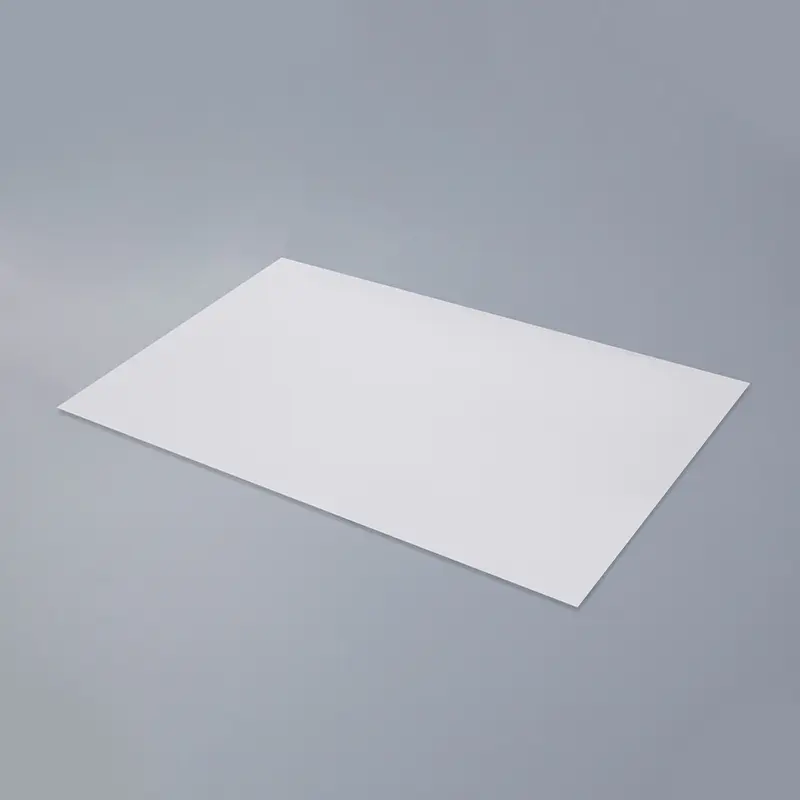
Yes. Sheet sizes include A4, A3, 20x30, 21x30, 24x36, 50cm x 70cm, 70cm x 100cm, and customized sizes. Sheet supply is useful for digital printing, offset printing, office labeling, and small-batch production.
Q10: What makes this product competitive?
The product is competitive because it combines high-visibility fluorescent paper, multiple adhesive choices, multiple liner options, roll and sheet supply, advanced gluing and laminating production, strong quality control, customization capability, and reliable international packaging. These advantages help customers reduce production risk and achieve stronger label performance.
Conclusion
Fluorescent paper in rolls is an effective self-adhesive material for customers who need bright appearance, strong visibility, practical printing compatibility, and flexible converting options. It is suitable for packaging, advertising, decoration, safety identification, barcode printing, trademark labeling, toys, gifts, and public-place applications. Compared with ordinary paper labels, it offers greater visual impact and faster recognition. Compared with many film labels, it can provide a more economical and printing-friendly solution for many short-term and medium-term applications.
The product’s value is strengthened by its customizable structure. With 80gsm fluorescent paper, waterbased adhesive as standard, multiple optional adhesives, various liner choices, jumbo roll widths, sheet sizes, and custom formats, it can be adapted to many industries. Adhesive options such as removable, anti-freeze, cryogenic, hotmelt, solvent, and tyre-grade rubber adhesive help customers solve specific bonding challenges.
Behind the material is a manufacturing system built on gluing, laminating, cutting, inspection, R&D, and large-scale production capacity. Suzhou Piaozhihua Composite Material Technology Co., Ltd. combines more than 20 years of OEM experience with advanced testing equipment, a professional R&D team, multiple patents, and global market service capability. Its focus on quality, innovation, responsibility, and sustainable development supports customers who need long-term supply reliability rather than only a simple label material purchase.
For printers, converters, packaging companies, safety product suppliers, advertising agencies, toy manufacturers, gift producers, and distributors, fluorescent paper in rolls offers a strong balance of visibility, processability, customization, and dependable supply. When selected according to the final surface, printing method, environment, and application life, it can become a high-performance label solution that improves both product appearance and communication efficiency.
References
1. Pressure-Sensitive Tape Council. Pressure Sensitive Adhesive Technology and Applications.
2. FINAT. Technical Handbook for Self-Adhesive Label Materials and Converting.
3. ASTM International. Standard Test Methods for Pressure-Sensitive Adhesive-Coated Tapes Used for Electrical and Electronic Applications.
4. AWA Alexander Watson Associates. Labeling and Product Decoration Market Studies.
5. Kipphan, H. Handbook of Print Media: Technologies and Production Methods.
6. Pizzi, A., and Mittal, K. L. Handbook of Adhesive Technology.