
 English
 Español
 русский
 Français
 عربى
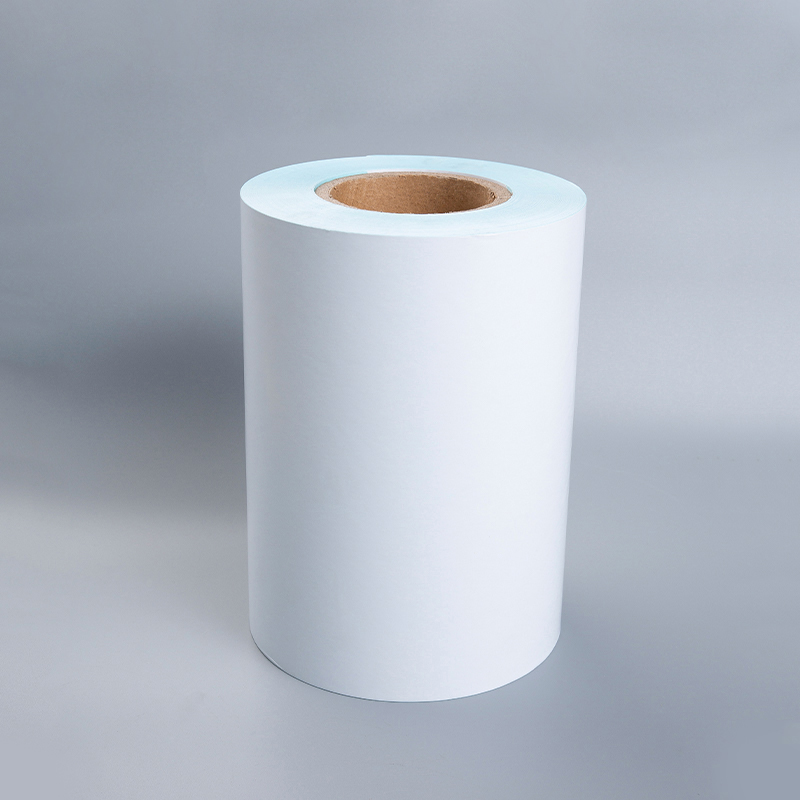
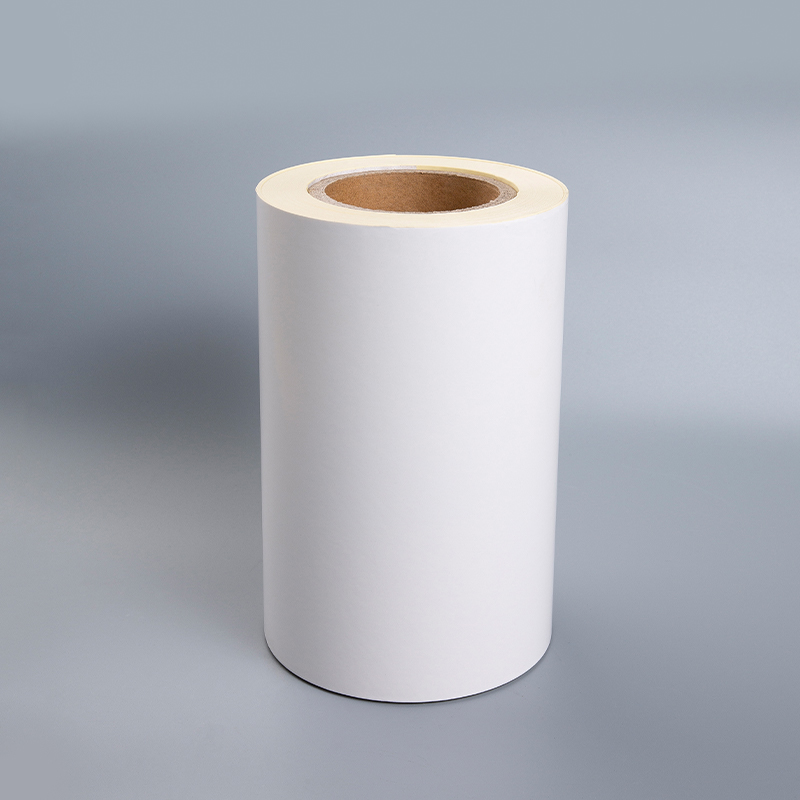
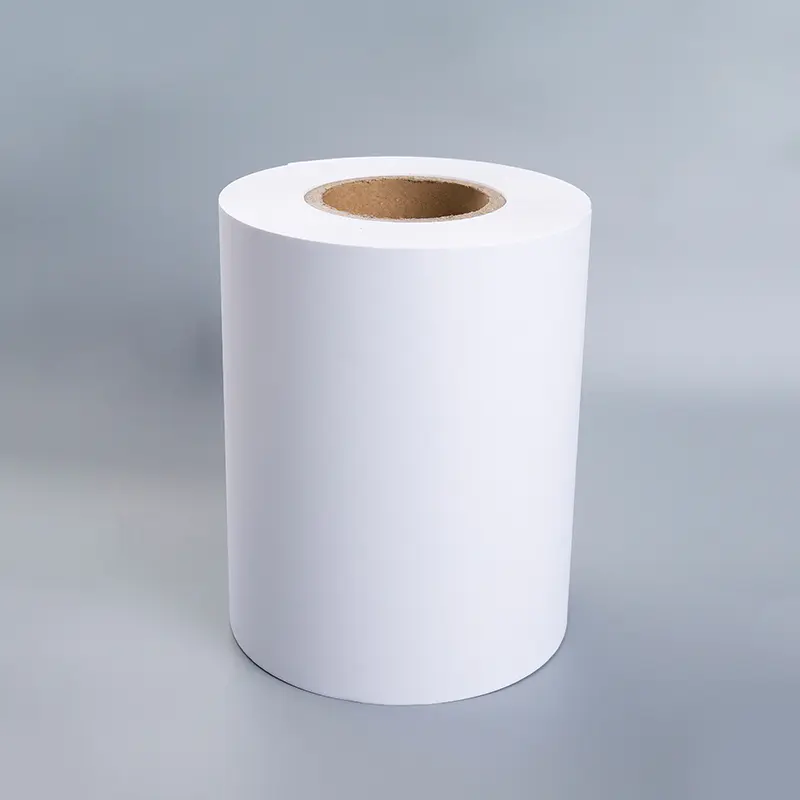
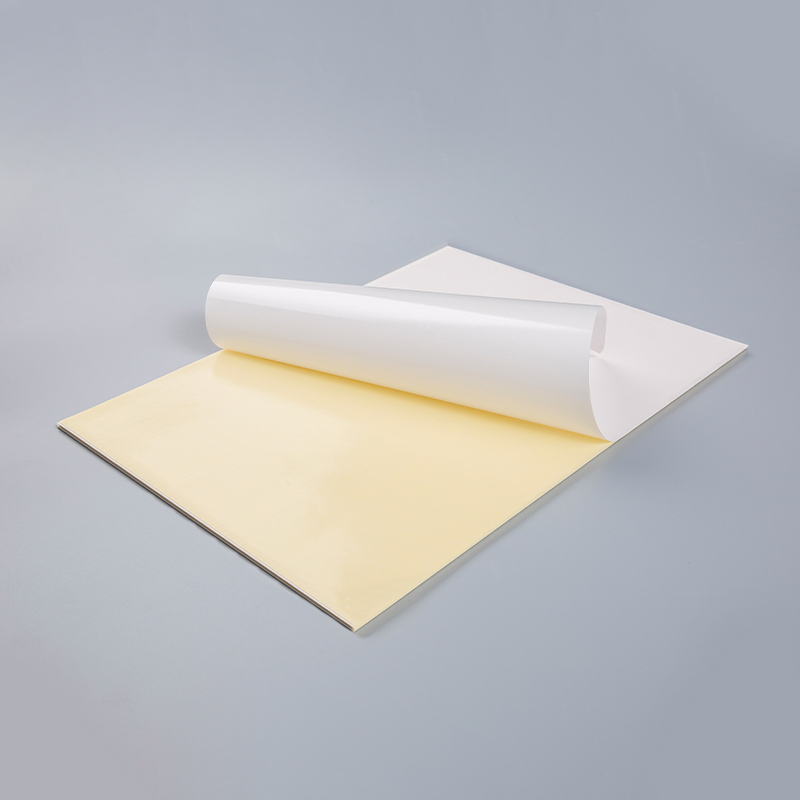
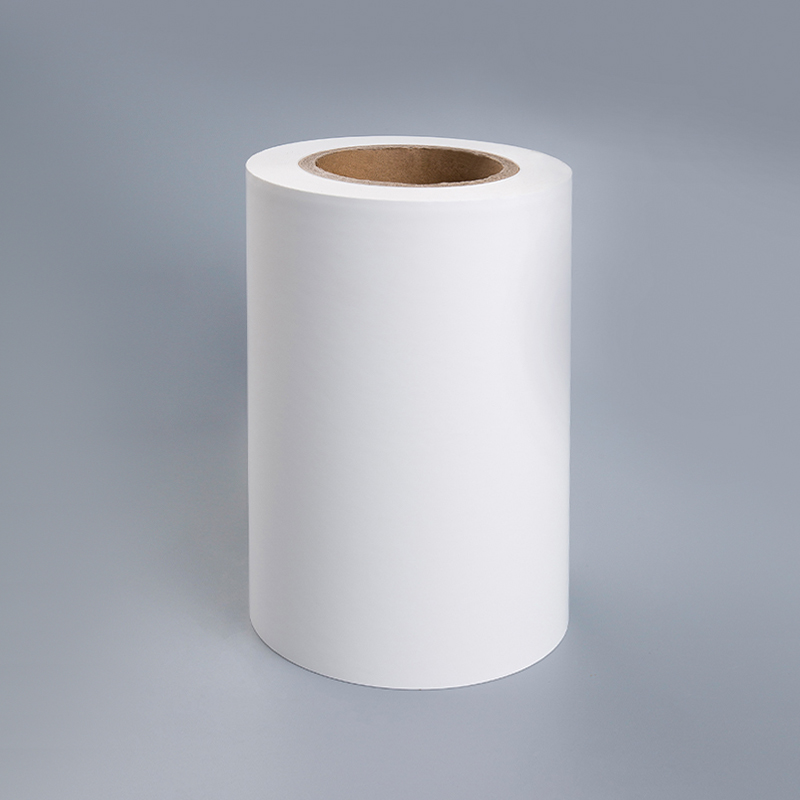
عربىCast coated self-adhesive paper with a white release liner is a high-value label material designed for brands, converters, printers, and packaging users that require a clean appearance, strong print performance, reliable converting efficiency, and stable adhesive behavior. It combines a smooth, bright cast coated face paper with a pressure-sensitive adhesive layer and a release liner engineered for controlled release during die-cutting, dispensing, labeling, and end-use application.
In the competitive label material market, performance is not determined by one layer alone. A premium label stock must balance the surface quality of the face material, the tack and cohesion of the adhesive, the release behavior of the liner, the dimensional stability of the laminate, and the consistency of manufacturing. When these elements work together, the result is a label material that supports beautiful printing, efficient production, dependable application, and long-term brand presentation.
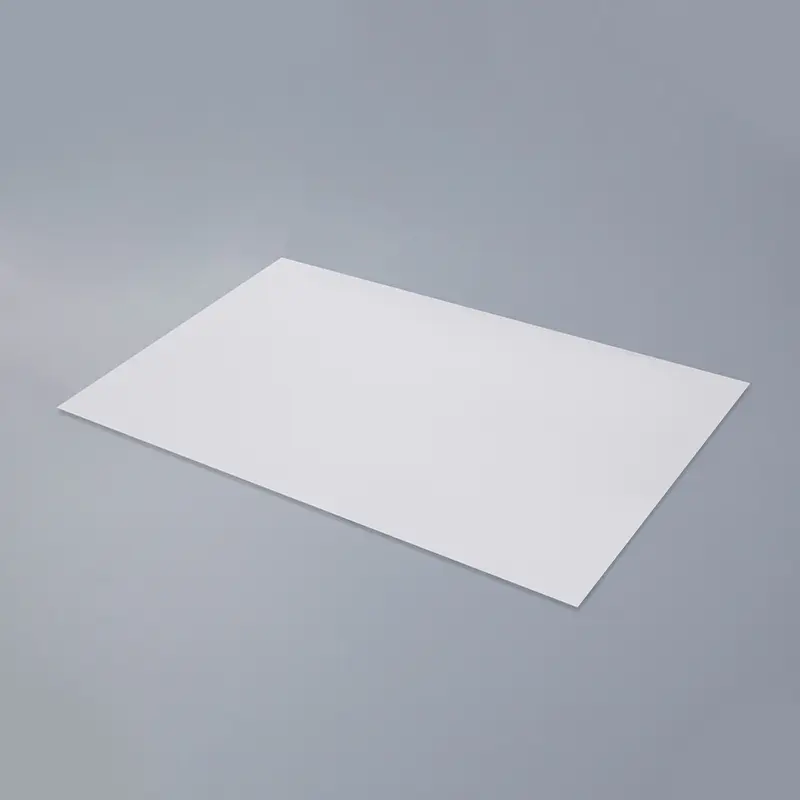
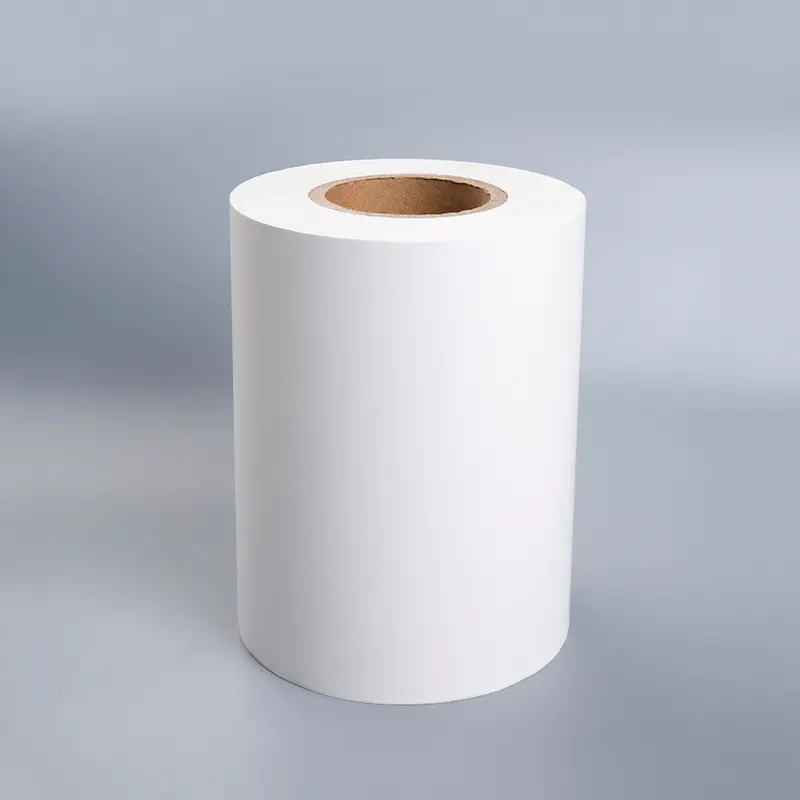
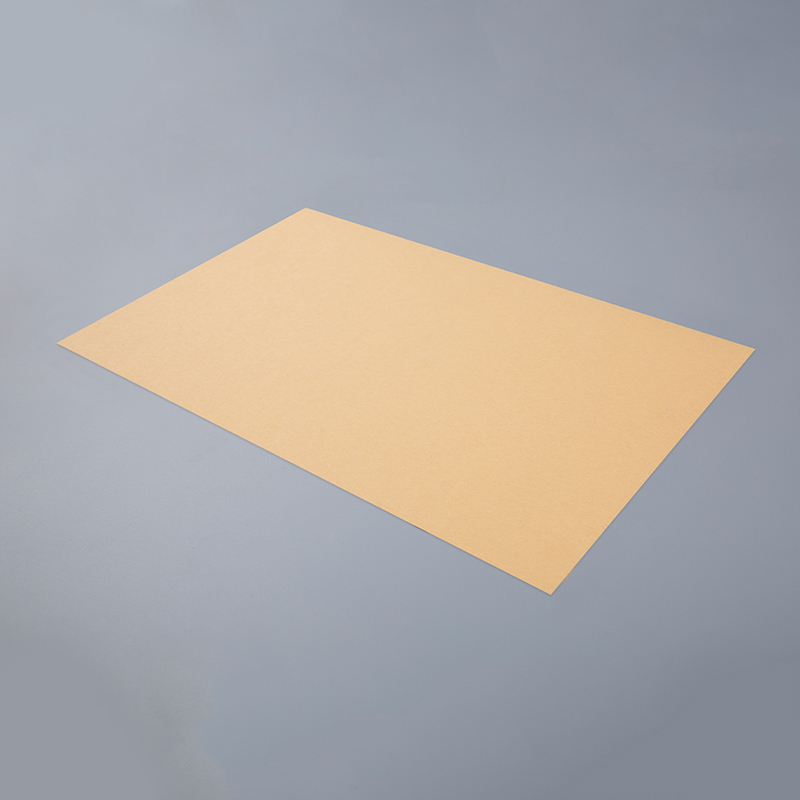
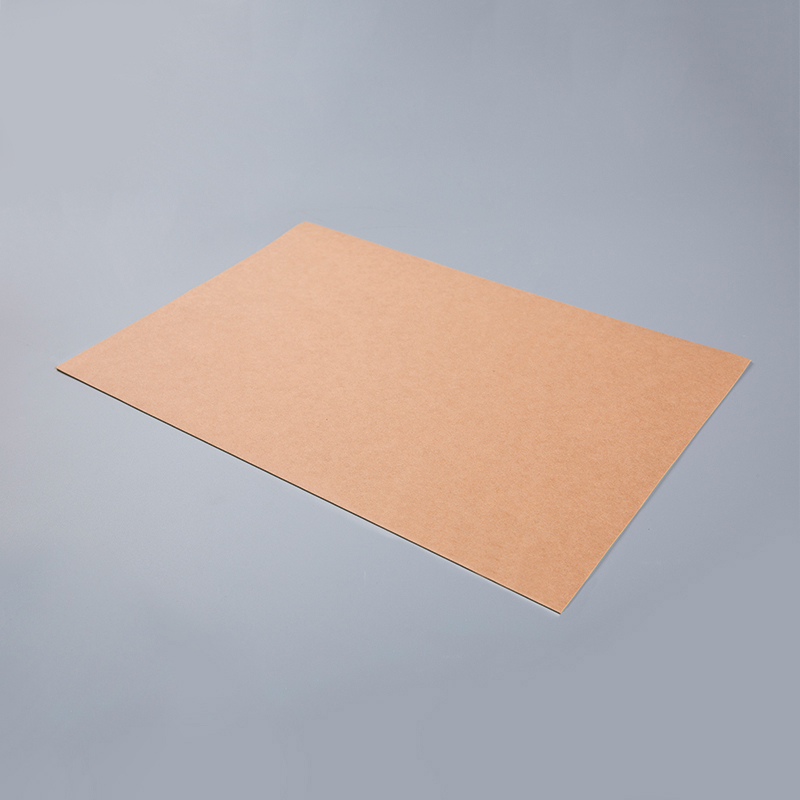
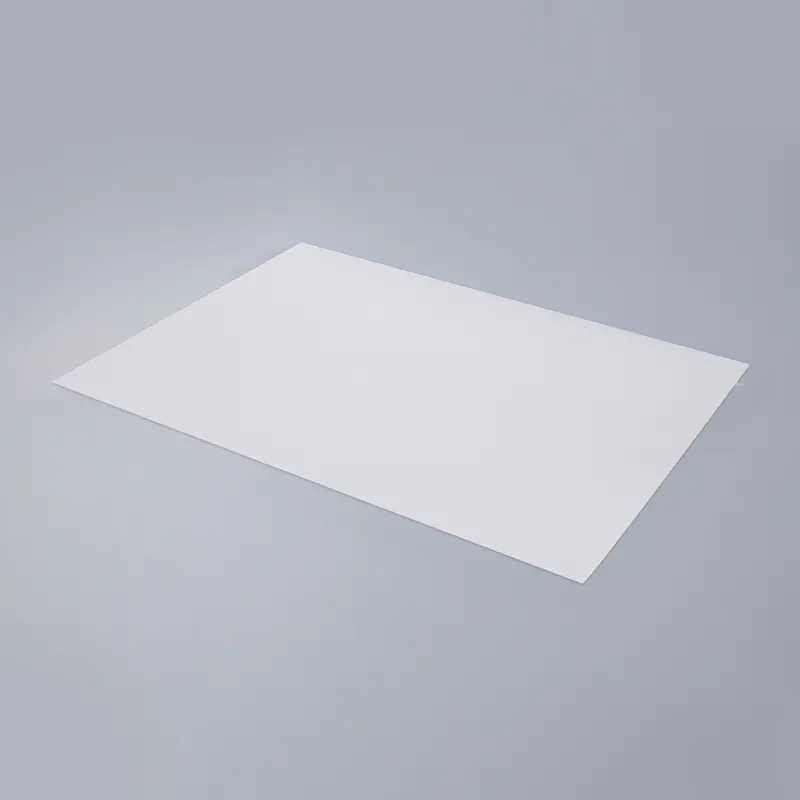
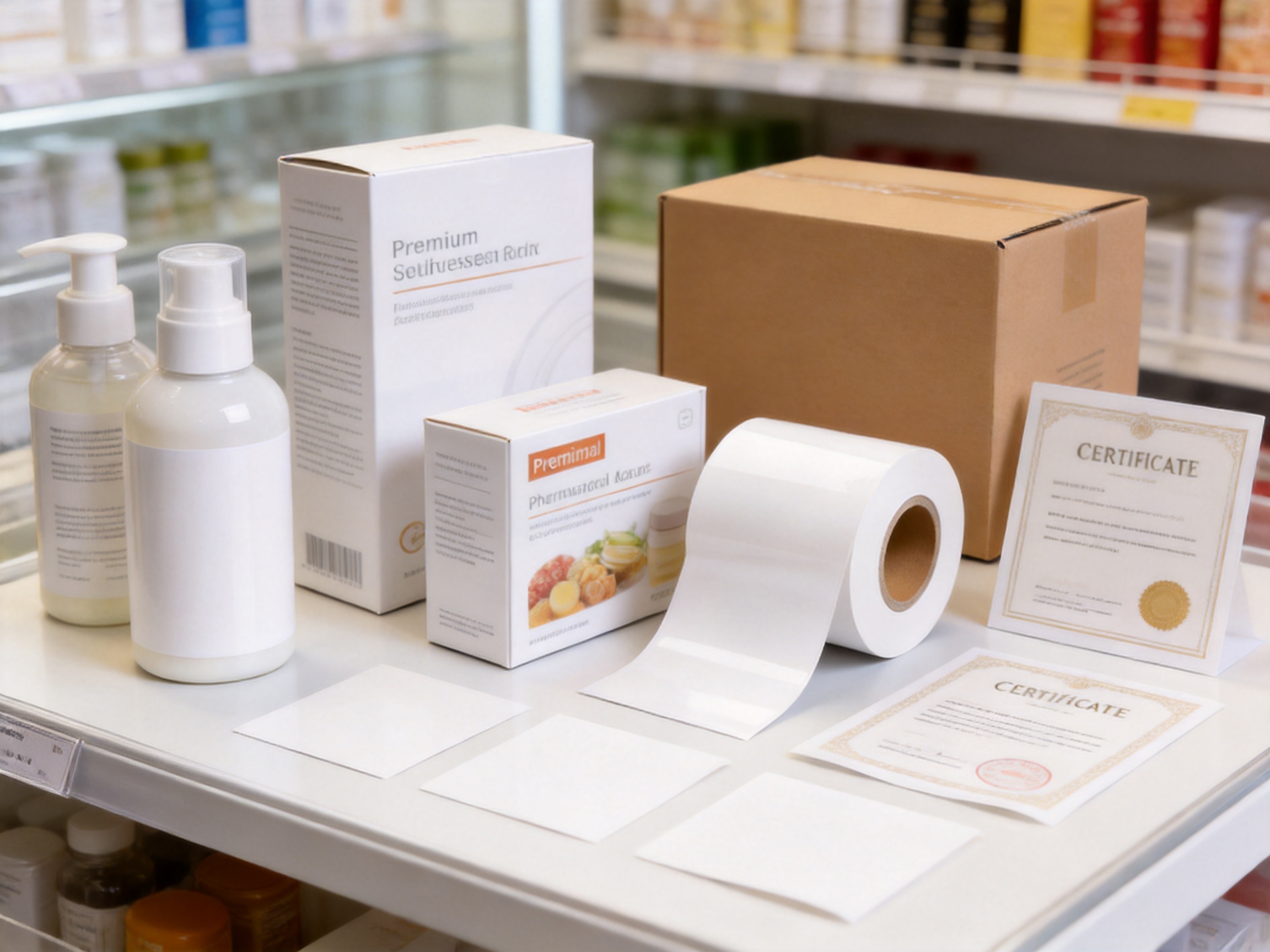
This product is especially suitable for cosmetics labels, pharmaceutical labels, food labels, promotional labels, carton stickers, shipping labels, certificate labels, and a wide range of general packaging labels. Its polished surface helps printed graphics appear crisp and attractive, while the release liner supports smooth handling in sheet-fed or roll-fed operations. For businesses that require flexible supply, the material can be delivered in jumbo rolls, customized rolls, or sheets such as A4, A3, 50 cm x 70 cm, 70 cm x 100 cm, and other requested formats.
Cast Coated Paper With White Release Liner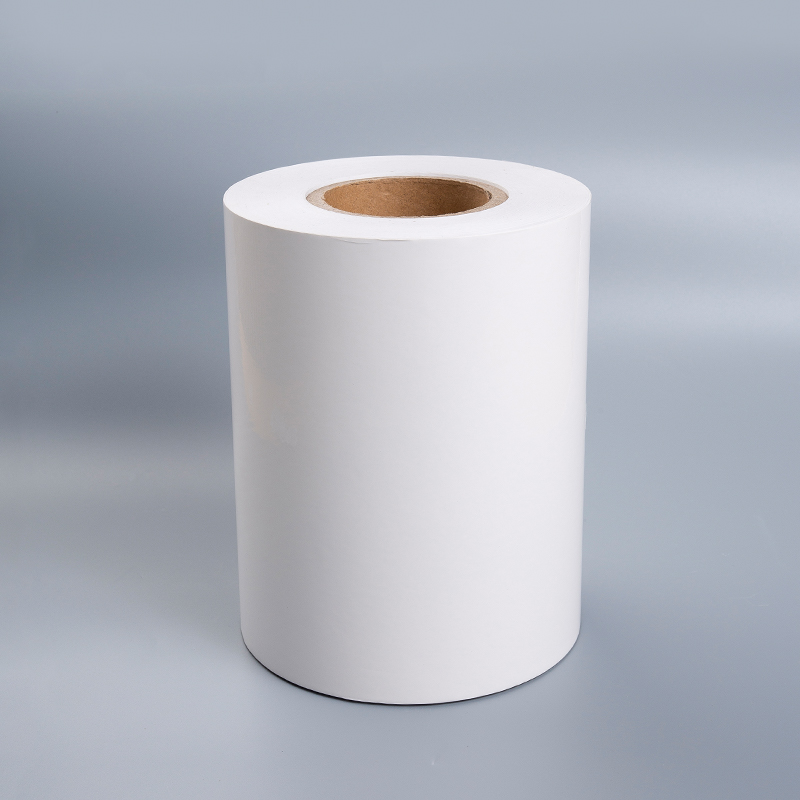
Content
- 1 Product Overview
- 2 Why Cast Coated Paper Matters in Label Production
- 3 Layer Structure and Functional Design
- 4 Technical Specifications
- 5 Key Advantages Over Conventional Label Materials
- 6 Applications Across Multiple Industries
- 7 Manufacturing Strengths Behind Product Quality
- 8 Advanced Production Process
- 9 Packaging and Delivery Protection
- 10 Customization Capabilities
- 11 How This Material Supports Printing and Converting Efficiency
- 12 Considerations for Adhesive Selection
- 13 Considerations for Liner Selection
- 14 Sustainability and Responsible Material Development
- 15 Quality Values and Service Strengths
- 16 Storage and Handling Recommendations
- 17 Why Choose This Product for Your Label Program
- 18 Q&A Section
- 18.1 What is cast coated self-adhesive paper with white release liner?
- 18.2 What applications is this product suitable for?
- 18.3 What makes cast coated paper different from ordinary label paper?
- 18.4 Which face paper weights are available?
- 18.5 What adhesive options are available?
- 18.6 How should I choose the right adhesive?
- 18.7 What liner types can be supplied?
- 18.8 Can the product be supplied in sheets and rolls?
- 18.9 Why is the release liner important?
- 18.10 Is this material suitable for premium packaging?
- 18.11 Can the material be customized for special applications?
- 18.12 How is the product packed for shipment?
- 18.13 What manufacturing strengths support product consistency?
- 18.14 How should the material be stored?
- 19 Conclusion
- 20 References
- 21 Product: Cast Coated Paper With White Release Liner
Product Overview
Cast coated paper is known for its high gloss, smooth feel, and excellent visual impact. Unlike ordinary uncoated or matte paper label stocks, cast coated paper is produced with a surface finish that gives it a refined, enamel-like appearance. This makes it a strong choice for labels that must attract attention on retail shelves, communicate a premium image, or carry detailed graphics and fine text.
When cast coated paper is combined with a pressure-sensitive adhesive and a white release liner, it becomes a ready-to-convert self-adhesive label material. The face paper receives printing. The adhesive provides bonding strength to the target surface. The release liner protects the adhesive until application and allows the label to be removed cleanly during dispensing. Each layer has a different function, but the quality of the final product depends on the precision of the entire composite structure.
The typical face material for this product is 75 gsm woodfree paper, with 78 gsm, 80 gsm, and 90 gsm options available depending on application requirements. The standard adhesive is water-based adhesive, while hotmelt adhesive, solvent adhesive, removable adhesive, anti-freeze adhesive, cryogenic adhesive, and tyre-grade rubber adhesive are also available. The liner can be customized with several options, including glassine paper, release paper, art paper, and CCK liner in different basis weights.
The result is a versatile self-adhesive paper that can be adapted for premium appearance, strong bonding, removable labeling, low-temperature application, industrial labeling, and carton or logistics use. This flexibility gives it a strong advantage over many standard label materials that offer only one adhesive type, one liner selection, or limited sizes.
Why Cast Coated Paper Matters in Label Production
In label printing, the face surface is the first element customers see. A label may carry branding, ingredients, regulatory details, batch codes, promotional messages, barcodes, or security information. If the surface is rough, uneven, or poorly coated, printing quality suffers. Ink may spread, color density may be reduced, fine text may lose sharpness, and the label may look less professional.
Cast coated paper provides a smoother and glossier surface than many conventional paper label materials. This supports enhanced color reproduction, improved contrast, clearer details, and stronger shelf appeal. For cosmetic labels, the glossy surface can communicate cleanliness and luxury. For pharmaceutical labels, the smooth surface helps support legibility and professional presentation. For food labels, it helps create attractive branding while maintaining an efficient converting platform.
Compared with ordinary self-adhesive paper, cast coated paper offers better visual depth and higher surface uniformity. Compared with some filmic label materials, it can offer a paper-based look, efficient print compatibility, and cost-effective performance for many indoor and general packaging uses. This makes it an excellent middle-ground solution for customers who need premium appearance without necessarily moving to synthetic films.
Layer Structure and Functional Design
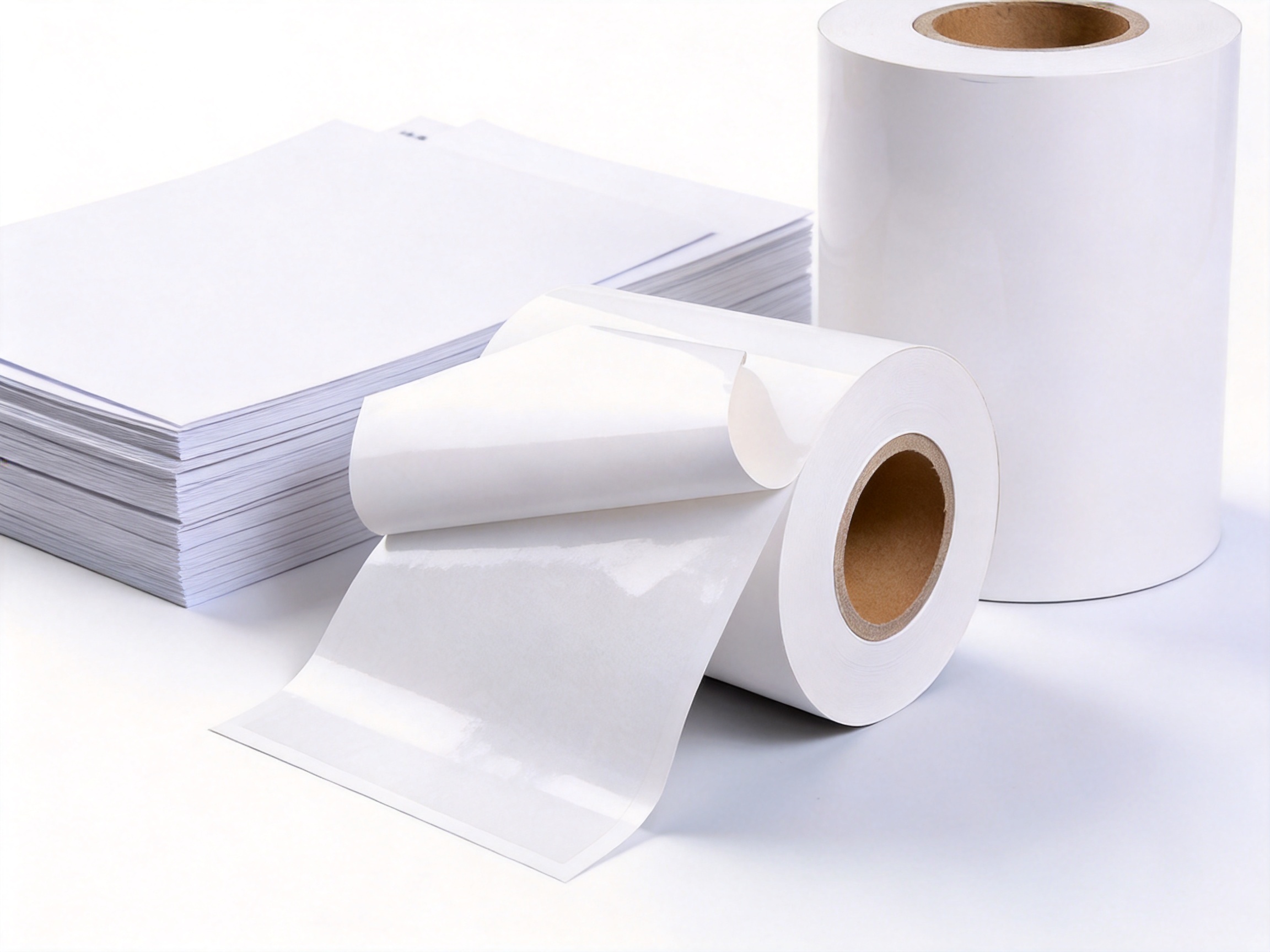
A self-adhesive label material is a composite product. Its performance depends on the compatibility of the face stock, adhesive, and liner. Cast coated paper with a white release liner is designed around this principle, offering a balanced structure for printing, converting, storage, transportation, and application.
Face Material
The face material is the printable layer. In this product, the standard face material is 75 gsm woodfree paper, with additional options such as 78 gsm, 80 gsm, and 90 gsm. The cast coated finish gives the face stock a clean and glossy surface suitable for high-quality graphics. It is well matched with applications where appearance and print sharpness are important.
The face paper must not only look good; it must also run well through printing and converting machines. A stable face material reduces curling, cracking, lifting, and registration problems. It should hold ink properly and remain compatible with printing technologies commonly used in label production. This material is designed to meet those practical requirements while maintaining an attractive finish.
Adhesive Layer
The adhesive layer determines how the label bonds to the surface. The standard option is water-based adhesive, which is widely used for general packaging and labeling applications because of its balanced tack, cohesion, and environmental profile. For more specialized needs, the product can be supplied with hotmelt adhesive, solvent adhesive, removable adhesive, anti-freeze adhesive, cryogenic adhesive, or tyre-grade rubber adhesive.
This adhesive flexibility is a major competitive advantage. Different industries require different adhesion behaviors. A promotional sticker may need to be removed without damaging the surface. A frozen food label may need to perform in low temperatures. A logistics label may require strong initial tack on carton surfaces. A tyre label requires special rubber adhesion. By offering multiple adhesive systems, the product can be customized instead of forcing customers to compromise with a one-size-fits-all material.
Release Liner
The release liner protects the adhesive before use and supports conversion efficiency. A white release liner provides a clean, professional backing and helps maintain material appearance during handling. It also contributes to stability during die-cutting, stripping, sheeting, and dispensing. Consistent release force is essential: if release is too tight, labels may not dispense smoothly; if it is too loose, labels may pre-release or shift during converting.
Available liner options include glassine paper in 50 gsm, 60 gsm, 80 gsm, 100 gsm, and 120 gsm; release paper in 60 gsm, 120 gsm, and 140 gsm; art paper in 140 gsm and 165 gsm; and CCK liner in 50 gsm, 80 gsm, 90 gsm, and 120 gsm. This range allows converters to select the right liner for automatic labeling, sheet labels, roll labels, die-cutting precision, or heavy-duty packaging applications.
Technical Specifications
The following table summarizes the main material choices and size options available for cast coated self-adhesive paper with release liner. Specifications can be adjusted according to order requirements, printing method, label format, target substrate, and end-use environment.
Item |
Specification |
Application Value |
Face Material |
75 gsm woodfree paper; 78 gsm, 80 gsm, and 90 gsm options available |
Provides a smooth printable surface for attractive labels and stable converting |
Surface Style |
Cast coated glossy paper surface |
Enhances color density, detail reproduction, and premium package appearance |
Standard Adhesive |
Water-based pressure-sensitive adhesive |
Suitable for general labels, packaging labels, promotional labels, and carton stickers |
Optional Adhesives |
Hotmelt adhesive, solvent adhesive, removable adhesive, anti-freeze adhesive, cryogenic adhesive, tyre-grade rubber adhesive |
Supports customized adhesion for cold chain, removable labels, industrial use, and difficult surfaces |
Release Liner Options |
Glassine paper, release paper, art paper, CCK liner, and other available basis weights |
Allows optimization for die-cutting, sheet labels, roll labels, and automatic labeling |
Jumbo Roll Width |
1000 mm, 1020 mm, 1080 mm, and 1530 mm |
Supports efficient slitting, converting, and large-volume production |
Sheet Size |
A4, A3, 20 x 30, 21 x 30, 24 x 36, 50 cm x 70 cm, 70 cm x 100 cm, and customized sizes |
Meets different printing, packaging, retail, office, and industrial requirements |
Packaging |
Roll or sheet packing; sea-transit-worthy poly-wood pallet packing and carton packing available |
Protects material during storage, domestic delivery, and international shipment |
Key Advantages Over Conventional Label Materials
Superior Visual Appeal
The cast coated surface offers a brighter and smoother presentation than many standard paper label stocks. This is especially important for consumer goods where the label must support shelf recognition and brand value. Cosmetic bottles, food packages, health products, gift packaging, and promotional stickers benefit from the clean gloss and refined surface.
Compared with ordinary woodfree self-adhesive paper, the cast coated version can make colors appear more vivid and printed images more attractive. It improves the perceived quality of the final package without requiring a complete redesign of the packaging system. For brands seeking better shelf impact at a practical cost, this is a significant advantage.
Reliable Printability
The uniform surface helps printers achieve sharper graphics and clearer text. For labels carrying small ingredients lists, pharmaceutical instructions, barcodes, QR codes, or certificate information, print clarity is essential. A stable surface reduces ink absorption variation and helps maintain consistent appearance across production batches.
Converters and printers also benefit from predictable material behavior. When the face paper, adhesive, and liner are consistent, printing registration becomes easier, waste is reduced, and job changeovers can be managed more efficiently. This consistency is often more valuable than a slightly lower purchase price because it reduces hidden production costs.
Flexible Adhesive Selection
Many competing label materials are supplied with limited adhesive options. This can create problems when customers need labels for cold environments, removable applications, uneven cartons, rubber surfaces, or demanding industrial use. Cast coated paper with white release liner can be paired with different adhesive systems to match these requirements.
Water-based adhesive is suitable for broad general use. Hotmelt adhesive can provide strong initial tack. Solvent adhesive can be selected for higher performance requirements. Removable adhesive is useful for temporary stickers, promotional labels, and applications where clean removal is valued. Anti-freeze and cryogenic adhesives support low-temperature labeling. Tyre-grade rubber adhesive is designed for demanding rubber-surface applications.
Customized Liner Choices
The release liner is often overlooked, but it plays a central role in converting efficiency. A poor liner can cause die-cutting problems, label edge lifting, difficult stripping, excessive release force, or dispensing failures. By offering glassine paper, release paper, art paper, and CCK liner options in different weights, the material can be tailored to different machines and label formats.
For roll labels and automatic dispensing, glassine liner may provide the smoothness and stability needed for high-speed operations. For sheet labels, heavier liners may help improve flatness and handling. For die-cut labels, liner strength and release uniformity can reduce waste and improve production speed. This liner flexibility gives the product an advantage in real-world converting conditions.
Wide Size Availability
Jumbo roll widths of 1000 mm, 1020 mm, 1080 mm, and 1530 mm provide efficient options for slitting and downstream converting. Sheet formats such as A4, A3, 50 cm x 70 cm, and 70 cm x 100 cm serve both commercial printing and customized label production. Custom sizes are also available, helping customers reduce trim waste and optimize production planning.
In comparison, suppliers with limited width or sheet-size capability may force customers to accept inefficient layouts, higher waste, or additional converting steps. Flexible sizing improves material utilization and supports better cost control.
Applications Across Multiple Industries
Cosmetics Labels
Cosmetics packaging often depends on a premium visual impression. Labels for skincare bottles, perfume boxes, haircare products, personal care items, and beauty gift sets need smooth graphics, clean typography, and a surface that communicates quality. The glossy cast coated surface enhances color and detail, helping cosmetic products stand out in retail and online distribution channels.
The material can be used for product identification labels, decorative labels, promotional stickers, and carton labels. Depending on the packaging substrate and required durability, the adhesive can be selected to balance tack, removability, and resistance to handling conditions.
Pharmaceutical Labels
Pharmaceutical labels require accuracy, readability, and professional appearance. They may include dosage information, batch numbers, expiry dates, regulatory marks, barcodes, and security elements. A smooth printable surface supports legible small text and clear codes. The stability of the release liner also helps maintain reliable label dispensing in production environments.
For pharmaceutical cartons, bottles, and secondary packaging, cast coated self-adhesive paper can provide a clean appearance while supporting efficient printing and conversion. When special temperature or adhesive requirements exist, customized adhesive selection can be considered.
Food Labels
Food labels must attract customers while carrying necessary product information. The glossy finish of cast coated paper helps food packaging appear fresh and appealing. It can be used for labels on dry food packages, confectionery boxes, beverage cartons, bakery packaging, takeaway packaging, and promotional food stickers.
For cold storage or frozen food applications, anti-freeze or cryogenic adhesive options may be selected. This flexibility helps ensure labels remain attached through storage, transportation, and display conditions.
Promotional Labels and Stickers
Promotional labels often need bright graphics and flexible application. They may be used for seasonal campaigns, discount stickers, gift labels, retail signs, membership cards, event stickers, and temporary product messages. Cast coated paper offers a strong visual platform for these labels, while removable adhesive can be used when clean removal is required.
Because promotional labels are often produced in different shapes and sizes, the availability of roll and sheet formats helps printers and converters respond quickly to market needs.
Carton Stickers and Shipping Labels
Carton stickers and shipping labels require practical adhesion and reliable handling. The label must bond to corrugated cartons or packaging surfaces, remain readable during transit, and support barcodes or identification information. Depending on the carton surface and logistics environment, water-based adhesive or hotmelt adhesive may be selected.
Although shipping labels are sometimes viewed as basic products, consistent release and printing performance remain important. Poor materials can cause barcode scanning failures, label peeling, and production interruptions. A reliable self-adhesive construction reduces these risks.
Certificate Labels
Certificate labels, warranty labels, inspection labels, and quality-control stickers must look professional and remain readable. The smooth surface helps improve printed text and line detail, while the adhesive system can be chosen based on whether permanent bonding or controlled removability is required.
Manufacturing Strengths Behind Product Quality
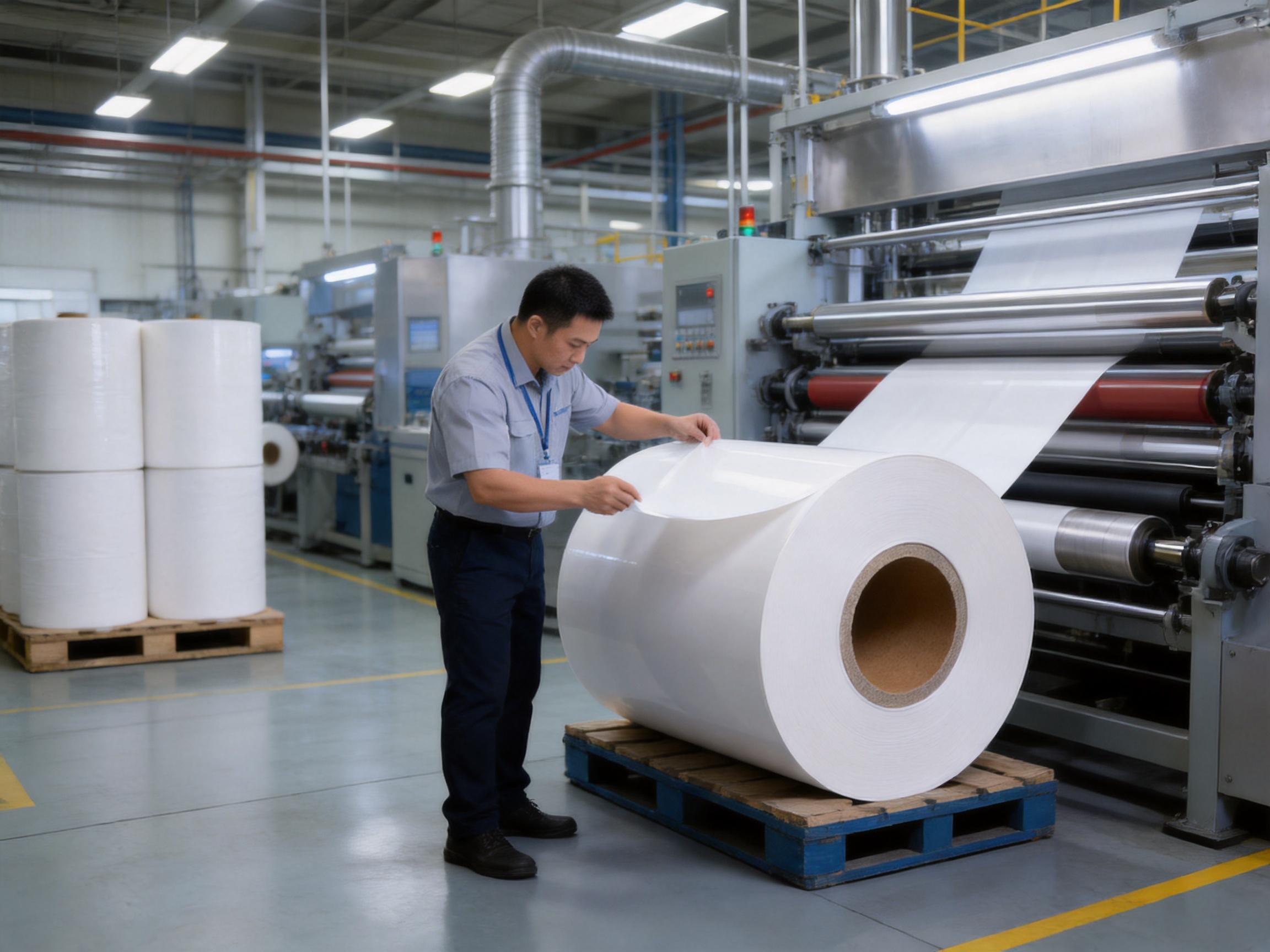
The performance of self-adhesive label materials depends heavily on manufacturing precision. Suzhou Piaozhihua Composite Material Technology Co., Ltd. specializes in high-grade self-adhesive label materials and integrates research and development, production, sales, and after-sales service. With production lines covering gluing, laminating, and cutting, the company is able to control key stages of the composite material process.
Advanced manufacturing capability allows better control of adhesive coating uniformity, laminate tension, surface consistency, release behavior, slitting accuracy, and final packaging quality. These factors directly influence how the material performs at the customer’s printing plant, converting workshop, or labeling line.
The company has an annual production capacity of more than 280 million square meters, demonstrating large-scale manufacturing capability and supply reliability. Large production capacity is important for customers who need stable delivery, repeat orders, seasonal production, and consistent specifications across different batches.
With more than 20 years of OEM manufacturing experience, the company can provide customized solutions based on customer drawings, samples, application conditions, and converting requirements. This experience is especially valuable in the self-adhesive industry, where small adjustments in adhesive, liner, face stock, or release force can significantly affect end-use performance.
Advanced Production Process
Material Selection and Incoming Inspection
Consistent label material begins with qualified raw materials. Face paper, adhesive, liner, silicone release coating, and packaging materials must meet defined standards before production. Incoming inspection helps reduce variation before the composite process begins. For cast coated paper, surface smoothness, gloss, basis weight, moisture level, and coating uniformity are important factors.
For liners, release coating quality and paper strength are critical. A liner that is too weak may break during converting. A liner with unstable release may cause dispensing issues. By controlling incoming materials, the manufacturer reduces the risk of defects that could later appear during printing or application.
Adhesive Preparation and Coating
The adhesive system must be prepared according to application requirements. Water-based adhesive, hotmelt adhesive, solvent adhesive, removable adhesive, anti-freeze adhesive, cryogenic adhesive, and rubber adhesive each have different coating conditions and performance targets. Coating weight must be controlled carefully because too little adhesive can cause poor bonding, while too much adhesive can cause oozing, edge bleeding, die-cutting difficulty, or blocking.
Advanced coating control helps achieve uniform adhesive thickness across the web. This improves tack consistency, reduces label lifting, and supports stable die-cutting. In high-volume label production, adhesive uniformity is one of the most important indicators of product quality.
Laminating
Laminating combines the face material, adhesive, and release liner into a stable composite structure. Proper web tension, alignment, pressure, and drying or curing conditions are necessary to avoid curling, wrinkling, bubbles, or delamination. A well-laminated self-adhesive material should remain flat, smooth, and consistent from edge to edge.
For cast coated paper, careful laminating is particularly important because the face surface is designed for premium visual quality. Any defect in tension control or adhesive distribution may affect appearance or converting behavior. Controlled laminating helps maintain the glossy surface while ensuring adhesive performance.
Slitting and Cutting
After lamination, the material can be slit into jumbo rolls, smaller rolls, or cut into sheets. Slitting accuracy affects roll edge quality, downstream die-cutting, printing registration, and material waste. Sheet cutting requires dimensional precision and clean edges. For products supplied in sheets such as A4, A3, 50 cm x 70 cm, or customized formats, cutting quality influences customer handling and printing stability.
Clean slitting and cutting also reduce dust, fiber contamination, and edge defects. This is especially important for labels used in pharmaceutical, cosmetics, food, and barcode printing applications.
Testing and Quality Control
A dedicated testing laboratory and advanced inspection equipment help ensure that products meet customer expectations. Quality control may include tests for basis weight, adhesive coat weight, release force, peel adhesion, tack, holding power, surface smoothness, moisture, roll appearance, sheet flatness, and dimensional accuracy.
Quality testing is not simply a final inspection activity. It supports continuous improvement, process adjustment, and batch consistency. For customers, this translates into fewer printing problems, lower converting waste, and more reliable label application.
Packaging and Delivery Protection
Self-adhesive materials must be protected during transportation and storage. Moisture, pressure, temperature changes, edge damage, and dust can affect label performance. This product is available with sea-transit-worthy poly-wood pallet packing and carton packing for both rolls and sheets from stock.
For sheet products, 100 sheets per ream can be packed with strong PE-coated kraft paper wrapper. Strong pallets can be wrapped with stretch film and fastened with plastic fastening belts. These packaging methods help protect the material during domestic and international shipping, especially for long-distance sea transit.
Effective packaging is a practical competitive advantage. Even high-quality label material can be damaged if packaging is weak. Strong palletizing, moisture protection, and secure fastening reduce the risk of edge deformation, sheet curling, roll shifting, and contamination. This helps customers receive material in usable condition and supports efficient warehouse handling.
Customization Capabilities
Different customers often have different performance priorities. Some need excellent gloss and premium appearance. Others need strong adhesion to cartons. Some require removable labels, while others need cold-temperature performance. Some customers need jumbo rolls for high-speed converting, while others require sheet packs for printing and manual use.
The product supports customization in face material weight, adhesive type, liner type, roll width, sheet size, and packaging method. OEM and ODM services allow production based on customer samples, drawings, and functional requirements. This is valuable for distributors, label converters, printing companies, packaging producers, and brand owners that need stable private-label or customized material solutions.
Customization also helps reduce total cost. A label material that is properly matched to the application can reduce waste, prevent over-engineering, improve production speed, and avoid complaints. For example, a removable promotional sticker does not require the same adhesive as a carton shipping label. A frozen food label should not use a standard adhesive if low-temperature performance is needed. By selecting the correct construction from the beginning, customers improve both performance and efficiency.
How This Material Supports Printing and Converting Efficiency
Printing and converting efficiency is one of the most important cost factors in label production. A low-cost material may appear attractive at purchase, but if it causes web breaks, poor registration, die-cutting issues, edge lifting, or waste, the real cost becomes higher. Cast coated self-adhesive paper with a controlled release liner is designed to support stable processing.
The smooth face surface helps maintain print consistency. The adhesive layer is selected for the target bonding requirement. The liner supports die-cutting and dispensing. Together, these elements reduce interruptions and improve production flow. For converters that handle many small orders, predictable material behavior helps shorten setup time. For large-volume jobs, consistency helps maintain speed and reduce waste over long runs.
Common converting processes may include printing, varnishing, lamination, die-cutting, waste stripping, slitting, sheeting, counting, and packing. Each step places stress on the material. A balanced self-adhesive construction helps the material pass through these steps without losing flatness, adhesion, release stability, or appearance.
Considerations for Adhesive Selection
Selecting the right adhesive is essential. The target surface, application temperature, service temperature, surface energy, label size, label shape, exposure conditions, and removability requirements should all be considered. A label applied to a smooth cosmetic bottle has different needs from a label applied to a corrugated carton, frozen package, or tyre surface.
Water-based adhesive is a strong choice for many general-purpose labels. It provides balanced performance for packaging, cartons, promotional labels, and common product labels. Hotmelt adhesive may be preferred when strong initial tack is required, especially on rougher surfaces. Solvent adhesive can be considered for demanding conditions where enhanced durability is needed.
Removable adhesive is useful when labels must be peeled away cleanly. Anti-freeze and cryogenic adhesives are suitable for low-temperature and cold-chain applications. Tyre-grade rubber adhesive is designed for challenging rubber surfaces where ordinary adhesives may fail. This wide adhesive selection gives customers greater confidence when developing labels for specialized markets.
Considerations for Liner Selection
The release liner should be selected based on converting method and application equipment. Glassine liner is commonly used in roll label production because of its smoothness and suitability for die-cutting and dispensing. Heavier release paper or art paper liners can offer stiffness and handling advantages for sheet products. CCK liners may be suitable where strength, stability, and specific release behavior are required.
Liner weight also matters. Lightweight liners may reduce material usage and support roll efficiency, while heavier liners may improve sheet flatness or machine handling. The best choice depends on label size, die-cut shape, automatic labeling speed, storage conditions, and customer equipment.
Sustainability and Responsible Material Development
Modern packaging customers increasingly consider sustainability, waste reduction, and responsible production. Paper-based self-adhesive materials can support sustainable packaging strategies when developed with careful attention to face material selection, adhesive design, liner choice, and production efficiency. The company emphasizes sustainable development and environmental protection, including eco-friendly solutions involving face materials, adhesives, and backing papers.
Water-based adhesive options can be attractive for customers seeking balanced performance with a more environmentally considerate profile compared with some traditional systems. Efficient production, accurate slitting, customized sizes, and stable quality also contribute to sustainability by reducing waste during printing and converting. Strong packaging prevents transit damage, which further reduces unnecessary material loss.
Sustainability is not only about one material claim. It involves the whole lifecycle of production, converting, transportation, use, and disposal. By offering customized constructions, the product can help customers avoid using heavier or more complex materials than necessary. Matching the material to the application is one of the most practical ways to reduce waste and improve environmental responsibility.
Quality Values and Service Strengths
In the self-adhesive label industry, suppliers must provide more than material. They must understand applications, support specification selection, maintain batch consistency, and respond to customer feedback. With integrated production, research and development, sales, and after-sales service, the manufacturer can support customers from product selection to delivery and technical improvement.
The company’s values include quality, integrity, innovation, win-win cooperation, and responsibility. These values are reflected in the focus on advanced production lines, testing capability, OEM and ODM service, customized products, and ongoing material development. For international customers, stable supply and professional communication are especially important because label material problems can disrupt packaging schedules and product launches.
The company has built sales networks in domestic and international markets, serving customers across Asia, Europe, the Americas, Africa, and other regions. This market experience helps it understand diverse labeling requirements and supply expectations. Customers can benefit from a supplier that combines manufacturing capacity with application flexibility.
Storage and Handling Recommendations
Proper storage helps preserve the performance of cast coated self-adhesive paper. Materials should be stored in a clean, dry, and ventilated environment, away from direct sunlight, excessive humidity, extreme temperature, and chemical vapors. Rolls should be stored upright or according to recommended handling methods to prevent deformation. Sheets should remain wrapped until use to reduce moisture absorption and curling.
Before printing or converting, materials should be conditioned to the production environment when necessary. Sudden changes in temperature and humidity can affect paper flatness and adhesive behavior. Printers and converters should also test the material under actual production conditions, especially for special adhesives, low-temperature applications, removable labels, or unusual substrates.
When applying labels, the target surface should be clean, dry, and free from oil, dust, frost, or contaminants unless the selected adhesive is specifically designed for such conditions. Application pressure is important because pressure-sensitive adhesive requires contact pressure to develop proper bonding. Curved surfaces, rough cartons, cold surfaces, and small-diameter containers may require special testing.
Why Choose This Product for Your Label Program
Cast coated self-adhesive paper with white release liner is a strong choice for customers who need a balance of appearance, printability, adhesive flexibility, liner reliability, size customization, and manufacturing consistency. It is not limited to one narrow use. Instead, it can be adapted for cosmetics, pharmaceuticals, food, promotions, cartons, shipping, certificates, and other label applications.
Its major advantages include a premium glossy surface, multiple adhesive options, diverse liner choices, roll and sheet availability, strong packaging protection, and support from an experienced manufacturer with large-scale production capacity. These advantages help customers reduce risk, improve production efficiency, and create labels that look professional in the market.
Compared with ordinary label paper, it offers stronger visual appeal. Compared with limited-specification materials, it offers better customization. Compared with suppliers that lack integrated production, it benefits from controlled gluing, laminating, cutting, testing, and packaging processes. This combination makes it a reliable material for both standard and customized label projects.
Q&A Section
What is cast coated self-adhesive paper with white release liner?
It is a composite label material made from glossy cast coated paper, a pressure-sensitive adhesive layer, and a release liner. The face paper is printed, the adhesive bonds the label to the target surface, and the liner protects the adhesive until application.
What applications is this product suitable for?
It is suitable for cosmetics labels, pharmaceutical labels, food labels, promotional labels, carton stickers, shipping labels, certificate labels, retail stickers, and general packaging labels.
What makes cast coated paper different from ordinary label paper?
Cast coated paper has a smoother and glossier surface, which helps improve print sharpness, color density, and premium visual appearance. It is often selected when labels need stronger shelf appeal and a refined finish.
Which face paper weights are available?
The standard material is 75 gsm woodfree paper. Other available options include 78 gsm, 80 gsm, and 90 gsm, depending on customer requirements and application needs.
What adhesive options are available?
The standard adhesive is water-based adhesive. Optional adhesives include hotmelt adhesive, solvent adhesive, removable adhesive, anti-freeze adhesive, cryogenic adhesive, and tyre-grade rubber adhesive.
How should I choose the right adhesive?
The correct adhesive depends on the target surface, application temperature, service temperature, removability requirement, label size, and end-use environment. For general labels, water-based adhesive is often suitable. For rough cartons, hotmelt adhesive may be considered. For temporary labels, removable adhesive may be preferred. For cold-chain labels, anti-freeze or cryogenic adhesive may be required.
What liner types can be supplied?
Available liner choices include glassine paper, release paper, art paper, and CCK liner in different basis weights. The liner can be selected based on die-cutting, dispensing, sheeting, and handling requirements.
Can the product be supplied in sheets and rolls?
Yes. It can be supplied in jumbo rolls, converted rolls, or sheets. Jumbo roll widths include 1000 mm, 1020 mm, 1080 mm, and 1530 mm. Sheet sizes include A4, A3, 20 x 30, 21 x 30, 24 x 36, 50 cm x 70 cm, 70 cm x 100 cm, and customized sizes.
Why is the release liner important?
The release liner protects the adhesive and controls how the label separates during converting and application. A stable liner improves die-cutting, waste stripping, dispensing, and sheet handling.
Yes. The glossy cast coated surface is well suited for premium labels, including cosmetics, health products, promotional packaging, food packaging, and retail goods where appearance matters.
Can the material be customized for special applications?
Yes. Customization can include face paper weight, adhesive type, liner type, roll width, sheet size, and packaging method. OEM and ODM services are available based on customer samples, drawings, and performance requirements.
How is the product packed for shipment?
Roll and sheet packing are available. Sea-transit-worthy poly-wood pallet packing and carton packing can be used. Sheet products can be packed as 100 sheets per ream with strong PE-coated kraft paper wrappers, then palletized with stretch film and fastening belts.
What manufacturing strengths support product consistency?
The manufacturer operates production lines for gluing, laminating, and cutting, with large annual capacity and quality inspection capability. Integrated manufacturing helps control adhesive coating, lamination stability, slitting accuracy, and final packaging quality.
How should the material be stored?
It should be stored in a clean, dry, and ventilated environment away from sunlight, high humidity, extreme temperatures, and contaminants. Rolls and sheets should remain protected until use to preserve flatness and adhesive performance.
Conclusion
Cast coated self-adhesive paper with white release liner is a versatile and professional label material designed for customers who require both premium appearance and practical converting performance. Its glossy cast coated face paper supports attractive printing, while its adhesive and liner options allow the material to be matched to many different applications.
The product stands out because it combines visual quality, adhesive flexibility, liner customization, multiple size formats, strong shipment protection, and reliable manufacturing support. These strengths make it suitable for cosmetics, pharmaceuticals, food packaging, promotional labels, carton stickers, shipping labels, certificate labels, and many other labeling uses.
Backed by advanced gluing, laminating, cutting, inspection, OEM, and ODM capabilities, the material offers a dependable solution for printers, converters, packaging companies, distributors, and brand owners. For businesses seeking label material that improves presentation while supporting efficient production, cast coated self-adhesive paper with white release liner is a strong and adaptable choice.
References
FINAT. Technical Handbook for Self-Adhesive Label Materials and Testing Methods.
Pressure Sensitive Tape Council. Pressure-Sensitive Adhesives and Label Performance Guidelines.
Smithers. The Future of Labels and Release Liners: Market and Technology Analysis.
International Organization for Standardization. Paper, Board and Pulps: Standard Conditioning and Testing Atmospheres.
ASTM International. Standard Test Methods for Pressure-Sensitive Adhesive Performance.