
 English
 Español
 русский
 Français
 عربى
عربىCoated art paper has become an essential material for modern label production, packaging conversion, adhesive protection, precision die-cutting, and specialty release applications. In industries where print quality, clean release behavior, dimensional stability, and production efficiency all matter at the same time, a reliable coated art paper can significantly improve downstream performance. It is not merely a paper substrate with a smooth surface; it is an engineered material designed to provide strength, moisture resistance, controlled coating uniformity, and dependable handling in high-speed manufacturing environments.
As demand rises for self-adhesive labels, release liners, food packaging liners, healthcare separation materials, and carriers for electronic component processing, buyers increasingly look for materials that combine printability, durability, cleanliness, and customization. Coated art paper is especially valuable because it offers a balanced structure: a paper base with good stiffness and toughness, a refined coated surface for ink adhesion and consistency, and adaptable performance for both sheet and roll applications. When produced with advanced coating, laminating, gluing, slitting, and inspection systems, it can support stable quality across large-volume production.
Suzhou Piaozhihua Composite Material Technology Co., Ltd. specializes in high-grade self-adhesive label materials and related composite products. With more than 20 years of OEM manufacturing experience, advanced production lines, an in-house testing laboratory, and an annual production capacity exceeding 280 million square meters, the company has built strong capabilities in material development, coating control, customization, and after-sales service. Its coated art paper offering reflects these strengths, serving customers who require dependable release performance, high-quality printing surfaces, stable packaging protection, and efficient industrial processing.
Content
- 1 Understanding Coated Art Paper as a Specialty Release and Label Material
- 2 Product Specifications and Customization Options
- 3 Superior Strength and Durability for High-Speed Processing
- 4 Advanced Moisture and Water Resistance
- 5 Smooth and Consistent Surface for Printing and Release Performance
- 6 Eco-Friendly and Safe Material Direction
- 7 Key Applications Across Multiple Industries
- 8 Advantages Over Competing Materials
- 9 Advanced Manufacturing Processes Behind Stable Quality
- 10 Packaging and Delivery Designed for International Transportation
- 11 Company Strengths Supporting Global Buyers
- 12 How Coated Art Paper Improves Customer Production Efficiency
- 13 Quality Factors Buyers Should Evaluate
- 14 Q&A: Common Questions About Coated Art Paper
- 14.1 What is coated art paper used for?
- 14.2 What basis weights are available?
- 14.3 Why is surface smoothness important?
- 14.4 How does moisture resistance benefit customers?
- 14.5 Can the paper be customized?
- 14.6 What makes this product different from ordinary paper?
- 14.7 Is coated art paper suitable for food and healthcare applications?
- 14.8 How does the manufacturer ensure stable quality?
- 14.9 Why is packaging important for coated art paper?
- 14.10 Who should consider using coated art paper?
- 15 Conclusion
- 16 References
Understanding Coated Art Paper as a Specialty Release and Label Material
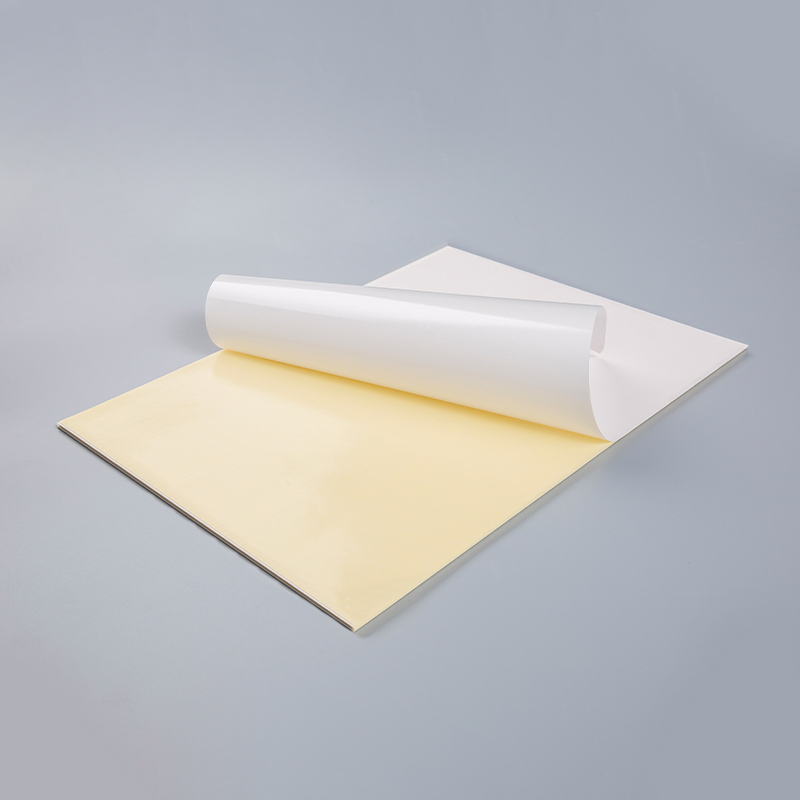
Coated art paper is produced by applying a refined coating layer onto art paper to create a smooth, consistent, and functional surface. Depending on the application, the coated surface may be optimized for printing, adhesive interaction, release behavior, lamination, or die-cutting support. In the context of self-adhesive label materials and special release papers, coated art paper can serve as a face material, a liner, a carrier, or a separation layer. Its versatility makes it useful across consumer packaging, industrial labeling, medical materials, electronics processing, and logistics identification.
The material begins with an art paper base, typically selected for smoothness, whiteness, density, and surface uniformity. Available basis weights such as 90 g, 120 g, 140 g, and 165 g provide different balances of flexibility, stiffness, opacity, and handling strength. Lighter grades may be suitable for flexible labels or economical printing projects, while heavier grades offer improved rigidity and resistance to deformation. This range gives converters and brand owners flexibility in matching the paper grade to application needs.
Unlike ordinary printing paper, coated art paper for release and adhesive applications must meet stricter requirements. The surface should allow clean ink transfer during printing, but it must also withstand mechanical stress during slitting, sheeting, die-cutting, lamination, roll handling, and packaging. It should resist tearing and cracking in fast-moving production lines. It should remain stable under humidity changes and during storage or ocean transportation. It should not create unnecessary friction that slows the production process. These requirements make manufacturing control a major factor in product performance.
The value of coated art paper lies in its ability to provide both surface quality and structural reliability. A smooth coating improves print definition, color uniformity, barcode readability, and adhesive compatibility. A strong base paper reduces web breaks and sheet edge damage. Moisture-resistant properties help prevent curling, warping, and delamination. A consistent coating profile improves release and converting behavior across the full width of jumbo rolls or customized sheets. Together, these properties help customers reduce waste, improve output, and maintain stable product quality.
Product Specifications and Customization Options
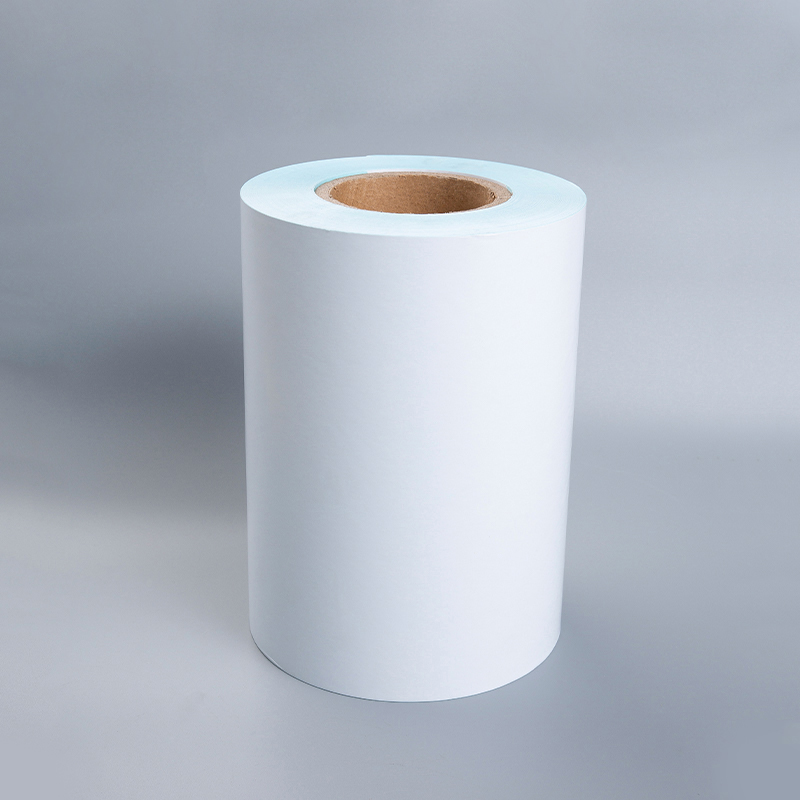
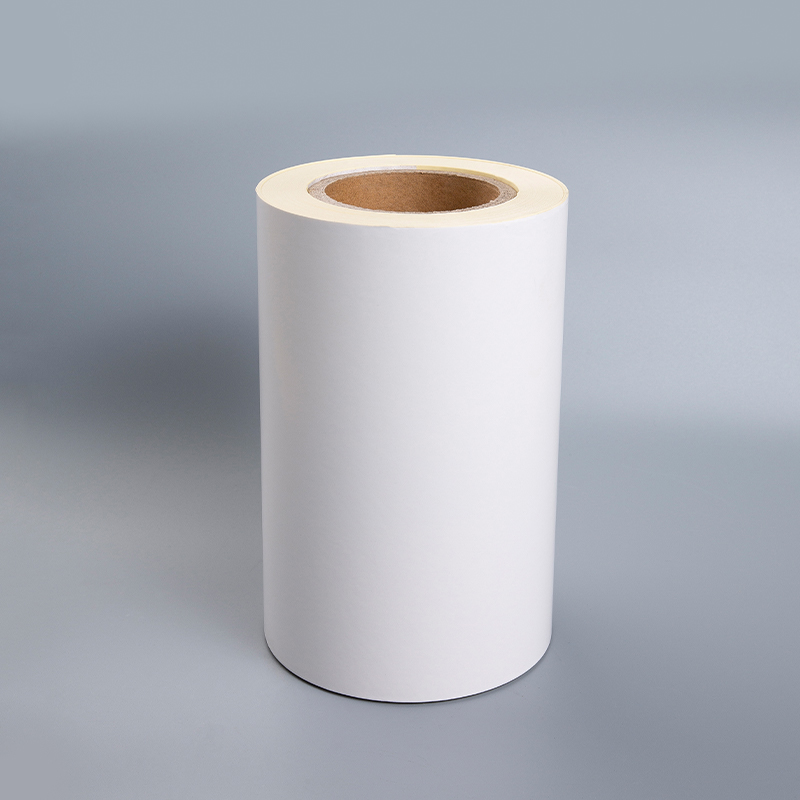
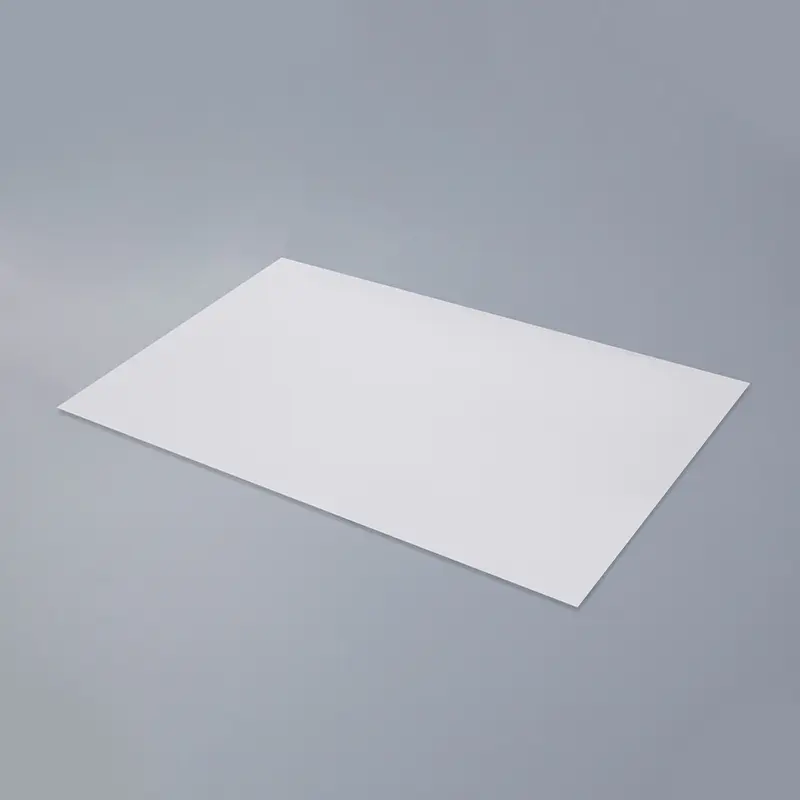
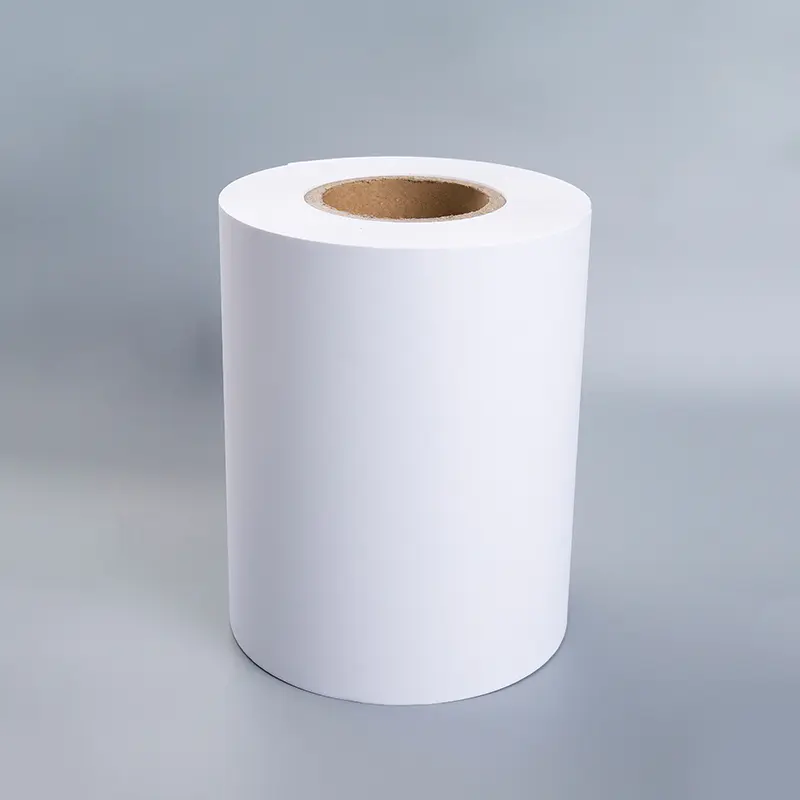
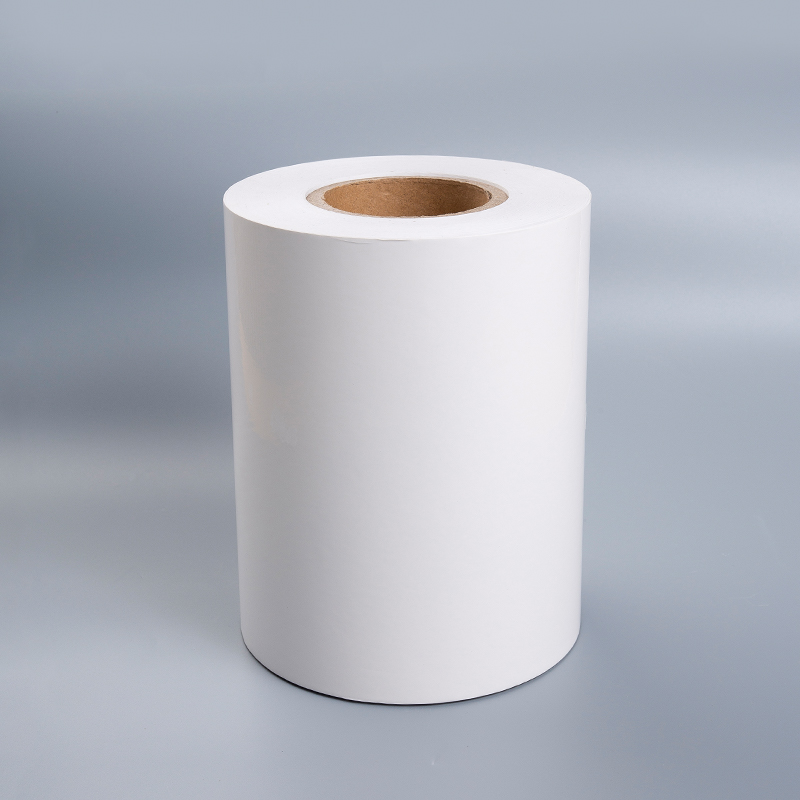
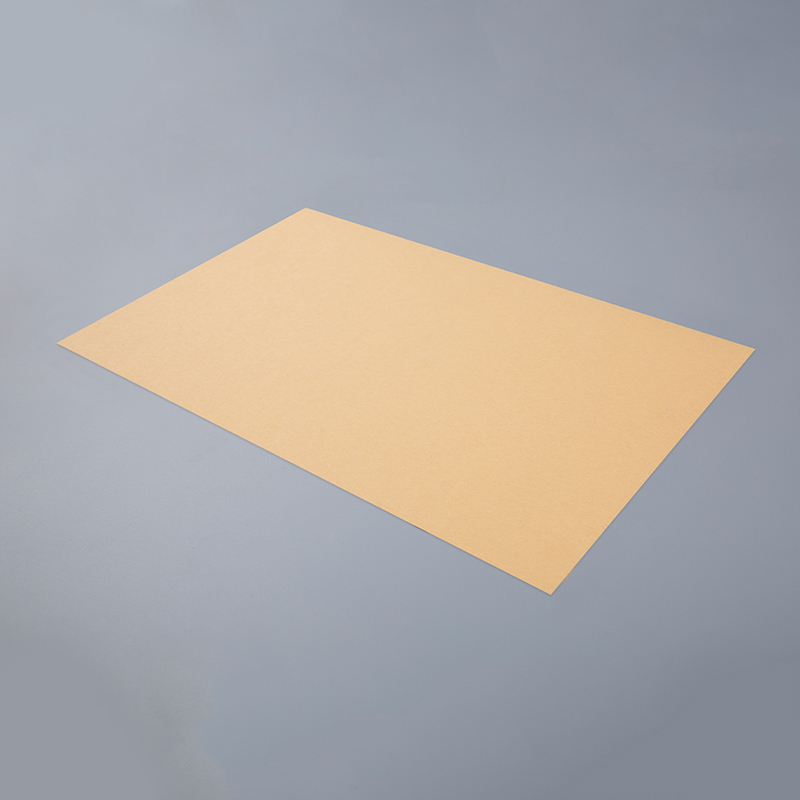
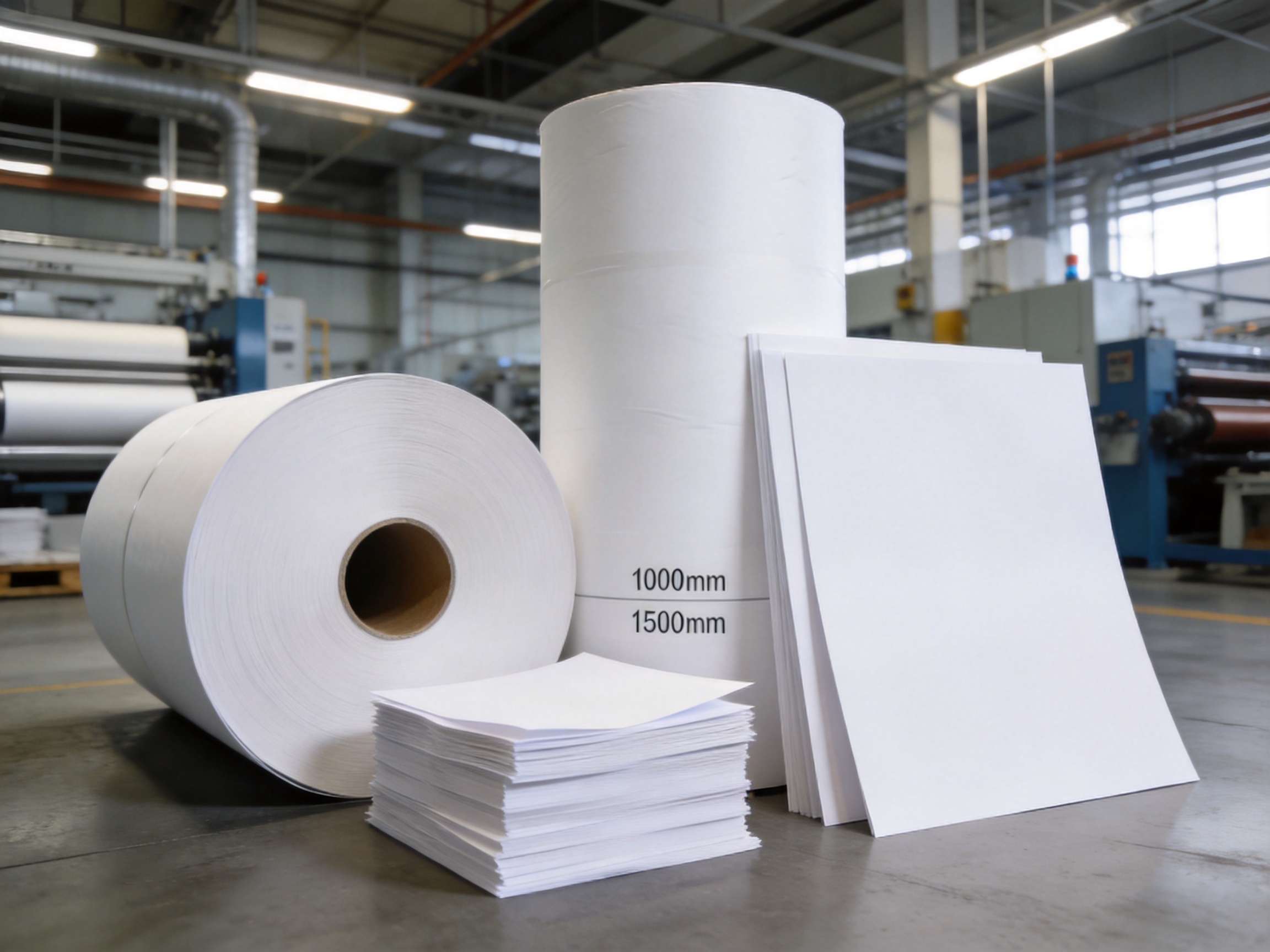
Coated art paper can be supplied in jumbo roll widths and sheet sizes to meet different converting and end-use requirements. Jumbo rolls are widely used by label converters, laminators, printers, and industrial processors who need continuous feeding into coating, printing, slitting, or die-cutting equipment. Sheet formats are suitable for printing houses, packaging producers, sample preparation, and applications that require direct sheet handling.
| Item | Specification | Benefit for Customers |
| Material | Art paper, available in 90 g, 120 g, 140 g, and 165 g grades | Allows selection of flexibility, stiffness, opacity, and durability based on application needs |
| Color | White | Provides a clean appearance, excellent print contrast, and professional label presentation |
| Jumbo Roll Width | 1000 mm, 1020 mm, 1080 mm, 1530 mm | Supports efficient converting, printing, laminating, and slitting workflows |
| Sheet Size | A4, A3, 20 x 30, 21 x 30, 24 x 36, 50 cm x 70 cm, 70 cm x 100 cm | Suitable for commercial printing, packaging, sampling, and specialty sheet applications |
| Customization | Custom sheet size and roll specifications available | Reduces downstream trimming waste and improves compatibility with customer equipment |
| Application Direction | Label printing, food packaging liners, healthcare separation, electronic die-cutting, flexible circuit board processing | Supports a broad range of industrial and packaging requirements with one adaptable material platform |
Customization is one of the most important advantages for industrial buyers. Many customers operate unique printing presses, slitting machines, die-cutting lines, laminators, or packaging systems. Standard sizes may not always deliver the best efficiency. By offering both common and customized dimensions, the manufacturer helps customers reduce trimming loss, simplify feeding, improve machine utilization, and align paper specifications with final product design.
Basis weight selection also plays a critical role. A 90 g paper may be chosen when flexibility and lower material consumption are priorities. A 120 g grade can provide a balanced solution for general labels, tags, and release applications. A 140 g or 165 g paper may be selected when higher stiffness, improved handling, or stronger dimensional stability is required. The ability to choose among these options allows customers to balance cost, performance, and processing needs without changing the entire material system.
Superior Strength and Durability for High-Speed Processing
One of the major advantages of coated art paper is its superior strength and durability. In modern converting plants, materials often run through production lines at high speeds. During printing, coating, laminating, slitting, rewinding, and die-cutting, the paper is exposed to tension, bending, compression, and repeated contact with rollers and blades. If the material is weak, it may tear, crack, delaminate, or generate dust. These failures can cause machine downtime, waste, quality complaints, and delivery delays.
High toughness allows coated art paper to maintain its structure even under demanding mechanical stress. A durable paper base reduces the risk of web breaks in continuous processing. Strong edge integrity helps prevent tearing during slitting and sheeting. Crack resistance supports applications where the material may be folded, stacked, wound, or transported over long distances. For industrial customers, this durability translates into lower operating risk and higher production efficiency.
Compared with ordinary paper materials, coated art paper designed for release and label applications provides better resistance to handling damage. Ordinary paper may have acceptable printability but insufficient tensile strength or surface bonding for adhesive and release environments. In contrast, a purpose-developed coated art paper can offer stronger internal bonding, better coating adhesion, and more stable performance during repeated conversion steps. This is especially important in applications such as electronic die-cutting, where even small substrate defects can affect precision and yield.
The durability of coated art paper also contributes to better storage and transportation performance. Rolls and sheets may be stored in warehouses, moved by forklift, loaded into containers, shipped by sea, and handled multiple times before reaching the final converting line. A paper that resists deformation and surface damage helps preserve product quality from factory to customer. The use of properly designed pallets, protective corner guards, stretch film wrapping, and moisture-protective ream packaging further enhances the material’s ability to arrive in good condition.
Advanced Moisture and Water Resistance
Moisture stability is a critical factor for paper-based materials. Paper naturally absorbs and releases moisture depending on environmental conditions. Without proper coating control and packaging protection, this can lead to curling, warping, dimensional changes, loss of flatness, or reduced converting accuracy. Coated art paper addresses these risks by providing improved resistance against humidity, water splashes, and mild chemical exposure.
In humid production or storage environments, moisture-resistant coated art paper helps maintain consistent performance. It reduces the likelihood of edge waving, sheet distortion, and roll deformation. This is valuable for label printing, where registration accuracy and flatness influence final appearance. It is also important for food packaging liners, where exposure to refrigerated, frozen, or moisture-sensitive conditions may occur. For medical and healthcare products, stability under controlled storage conditions helps protect hygienic separation and packaging reliability.
Water resistance does not mean that the paper is intended for unlimited immersion or harsh chemical environments. Instead, it means the material is engineered to provide practical protection against common moisture challenges found in industrial and packaging operations. The coated layer helps slow moisture penetration, while the paper structure maintains sufficient integrity for handling and conversion. When combined with moisture-protective packaging, the product can better withstand long-term storage and international transportation.
Compared with lower-grade papers, this moisture resistance provides a competitive advantage. A material that curls during storage can cause feeding problems on printing presses. A liner that warps during shipping may create waste before it ever reaches production. A substrate that absorbs moisture unevenly may show inconsistent release behavior or surface appearance. By emphasizing moisture stability, coated art paper helps customers improve process predictability and reduce hidden quality costs.
Smooth and Consistent Surface for Printing and Release Performance
The surface quality of coated art paper is one of its most important features. A smooth and consistent surface supports precise ink adhesion, uniform color reproduction, clean barcode printing, and professional packaging appearance. For labels and tags, visual clarity is essential because printed information often includes product names, safety instructions, traceability codes, batch numbers, shipping details, or branding elements. A poor surface can lead to feathering, mottling, weak contrast, or inconsistent ink density.
Coated art paper provides a refined printing surface that can help improve print definition across multiple technologies, including conventional printing, digital printing, and label printing systems. Its white color provides strong contrast and clean appearance. The uniform coating helps ink remain controlled on the surface instead of penetrating unevenly into the paper fibers. This improves image sharpness, text readability, and overall presentation.
In release and adhesive-related applications, surface consistency also affects functional performance. A paper used as a liner or carrier must interact predictably with adhesives, films, tapes, foams, and other converted materials. If the surface has uneven coating weight or inconsistent texture, release force may vary across the web. This can cause labels to lift too easily in some areas and release poorly in others. Such inconsistency can slow automatic labeling, create defects, or increase waste.
The smoothness of the coated surface also minimizes friction during die-cutting and lamination. Reduced friction supports cleaner travel through rollers and cutting stations. It can help improve edge definition and reduce dust generation. In high-speed converting, even small reductions in friction and surface inconsistency can have a meaningful effect on production efficiency. A stable material helps operators maintain line speed with fewer adjustments.
Eco-Friendly and Safe Material Direction
Environmental responsibility has become a central requirement in the paper, label, and packaging industries. Customers increasingly ask for materials that support sustainability goals without sacrificing performance. Coated art paper provides an important advantage because it is paper-based, recyclable in appropriate waste streams depending on coating and adhesive combinations, and suitable for responsible manufacturing strategies. It can help reduce reliance on fully synthetic materials in applications where paper performance is sufficient.
The product is designed to comply with relevant food-grade and medical safety expectations for suitable applications. This makes it valuable for direct contact or separation uses where cleanliness, safety, and material reliability are important. For food packaging liners, the paper can help preserve freshness and protect moisture-sensitive products such as frozen foods and baked goods. For healthcare products, it can safely isolate medical tapes, wound dressings, and sterile packaging components when properly specified for the intended application.
Sustainability is not only about the final material; it also depends on production efficiency, waste reduction, energy management, and quality control. A material with consistent quality generates less scrap during conversion. Stronger paper reduces roll breaks and damaged sheets. Accurate sizing reduces trimming waste. Reliable packaging lowers shipping damage. Together, these factors support more sustainable manufacturing by improving the total resource efficiency of the supply chain.
Suzhou Piaozhihua Composite Material Technology Co., Ltd. has developed its brand positioning around sustainable development and environmental protection. The company works on eco-friendly solutions including face materials, adhesives, and backing papers to meet customers’ sustainable product needs. This approach aligns with the increasing market demand for responsible materials that can support packaging, labeling, and industrial applications while helping customers pursue environmental targets.
Key Applications Across Multiple Industries
Coated art paper is valuable because it serves many industries with different performance requirements. Its combination of strength, smoothness, moisture resistance, and custom format availability allows it to function in label printing, food packaging, healthcare products, electronic die-cutting, and flexible circuit board manufacturing. This broad application range is one reason coated art paper is often preferred by customers seeking a versatile specialty paper solution.
Label Printing
Label printing is one of the most common uses for coated art paper. The paper is ideal for adhesive labels, barcodes, packaging tags, shipping labels, retail identification, and information labels. Its smooth coated surface supports sharp printing and clear contrast, which is essential for barcodes and QR codes. A label with poor print quality can create scanning failures, logistics errors, and customer dissatisfaction. By providing a stable print-ready surface, coated art paper helps ensure reliable communication throughout the supply chain.
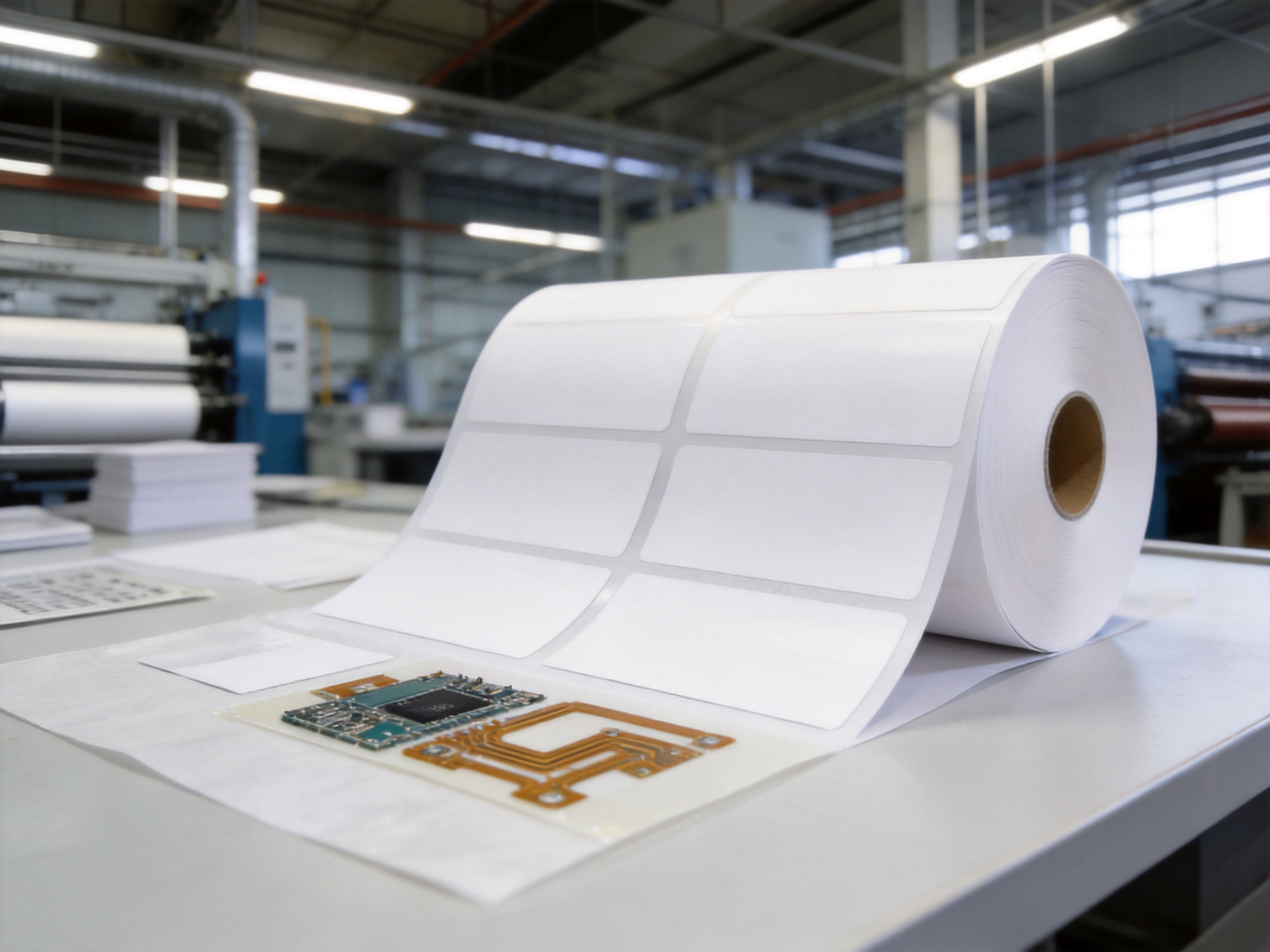
For self-adhesive labels, the material may be used in combination with adhesives and release liners to create finished labelstock. The company’s expertise in gluing, laminating, and cutting gives it an advantage in producing label materials with consistent adhesive application, surface bonding, and roll quality. This helps converters and end users achieve stable labeling performance.
Food Packaging
In food packaging, coated art paper can be used as a liner or separation material for moisture-sensitive products. Frozen foods, baked goods, and packaged items that require clean separation can benefit from a paper that resists humidity and maintains shape. The material helps protect product presentation and can contribute to freshness preservation by reducing direct contact and surface contamination risks when used appropriately.
Food packaging materials must be selected with careful attention to safety, regulatory expectations, and end-use conditions. Coated art paper that complies with suitable food-grade standards can serve as a practical and economical option for many liner applications. Its white, clean surface also supports attractive packaging presentation.
Healthcare Products
Healthcare applications require cleanliness, stable separation, and reliable release behavior. Coated art paper can be used to isolate medical tapes, wound dressings, sterile packaging components, and related products. The material provides a hygienic separation layer that supports product handling and protection before use. In healthcare manufacturing, consistency is essential because small variations can affect user experience, package integrity, or production yield.
Compared with ordinary paper, specialty coated art paper offers better controlled surface properties and improved stability. This is beneficial when the material must work with medical adhesives or sensitive product structures. The company’s inspection equipment and laboratory testing capabilities help verify key parameters before shipment.
Electronic Die-Cutting
Electronic die-cutting requires precision. Films, foams, tapes, insulation materials, and circuit board components may be cut into very small or complex shapes. A carrier or protective paper must remain stable during cutting while preventing scratches, contamination, and displacement. Coated art paper can protect delicate components during precision cutting and handling.
The material’s smooth surface minimizes friction and reduces the chance of surface damage. Its strength helps it withstand cutting pressure and repeated mechanical movement. Dimensional stability supports accurate registration and consistent finished parts. For electronics manufacturers, these benefits can reduce rejects and support high-yield production.
Flexible Circuit Board Processing
Flexible circuit boards require clean, stable carrier materials during manufacturing. Coated art paper can act as a stable carrier layer, helping protect surfaces from scratches and deformation. Its smoothness, stiffness options, and handling strength make it suitable for processes where delicate components require support.
As electronic products become thinner, lighter, and more complex, processing materials must meet higher standards. A stable paper carrier can contribute to cleaner surfaces, improved dimensional control, and reduced handling damage. This makes coated art paper a practical supporting material in advanced electronics production.
Advantages Over Competing Materials
Coated art paper competes with ordinary paper, uncoated release paper, plastic films, and other specialty liners. Each material has its place, but coated art paper offers a unique combination of cost efficiency, printability, structural strength, and sustainable direction. For many applications, it delivers an optimal balance rather than focusing on only one performance feature.
Compared with ordinary uncoated paper, coated art paper provides a much smoother and more consistent surface. This improves printing quality and supports better release or adhesive interaction. Ordinary paper may be cheaper at the point of purchase, but it can generate higher downstream costs through printing defects, curling, dust, tearing, and poor converting stability. In high-speed industrial operations, a small difference in substrate quality can translate into significant production savings.
Compared with low-grade release papers, coated art paper can offer improved strength, cleaner appearance, and more reliable performance under humidity and mechanical stress. Low-grade release materials may show unstable release force, inconsistent coating, or weak dimensional stability. These problems may not be obvious during initial inspection but can become serious during production. Coated art paper produced under controlled manufacturing conditions reduces these risks.
Compared with plastic films, coated art paper offers stronger printability and a more paper-based sustainability profile. Plastic films can provide excellent moisture resistance and transparency in some applications, but they may not be necessary where paper performance is sufficient. Coated art paper may offer lower cost, easier printing, better stiffness options, and a more familiar handling profile for label and packaging converters. It also supports customers seeking alternatives to fully synthetic materials.
Another competitive advantage is customization. Many suppliers can offer standard paper grades, but not all can provide integrated material development, coating, gluing, laminating, cutting, and inspection. A manufacturer with full production capabilities can respond more effectively to customer drawings, samples, special dimensions, and performance targets. This is particularly valuable for OEM and ODM projects where the material must fit a specific final product design.
Advanced Manufacturing Processes Behind Stable Quality
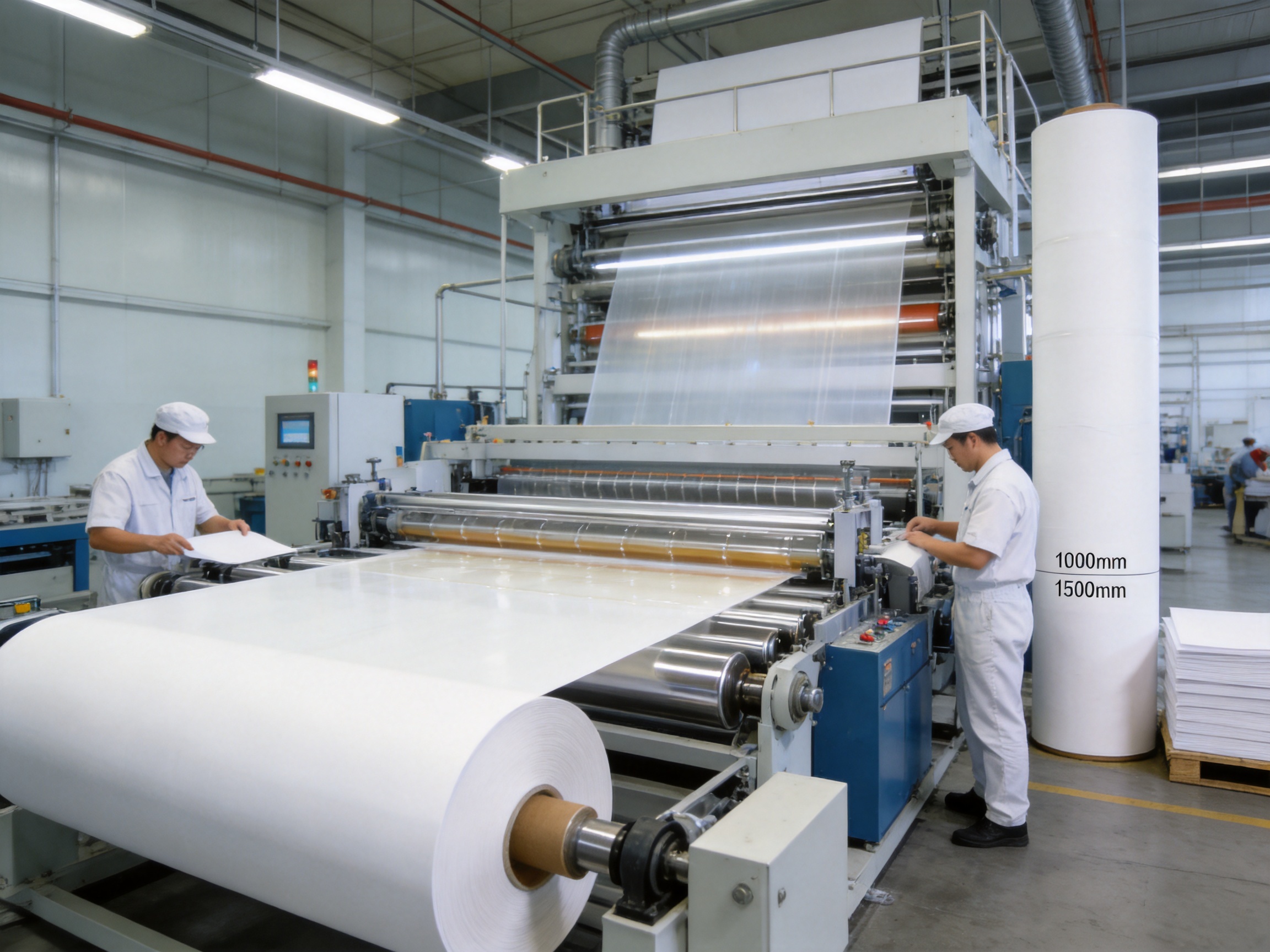
The performance of coated art paper depends heavily on manufacturing control. Even high-quality raw paper cannot deliver reliable results if coating, laminating, slitting, and packaging are not precisely managed. Suzhou Piaozhihua Composite Material Technology Co., Ltd. operates a full range of production lines, including gluing, laminating, and cutting, which allows the company to manage product quality from raw material input to finished roll or sheet output.
Raw Material Selection
Stable production begins with careful material selection. The company chooses art paper grades according to basis weight, whiteness, smoothness, tensile strength, density, moisture content, and surface cleanliness. Raw paper must be suitable for coating and conversion, because defects in the base material can appear later as printing flaws, coating streaks, release inconsistency, or roll deformation. By controlling raw material quality, the manufacturer creates a reliable foundation for finished performance.
Coating Control
Coating is one of the most important process steps. The coating must be applied uniformly across the full web width and along the machine direction. Uneven coating can cause differences in surface gloss, ink absorption, release behavior, friction, and moisture resistance. Advanced coating control helps ensure consistent surface properties, which are essential for label printing and specialty release applications.
During coating, parameters such as viscosity, coating weight, drying temperature, web tension, line speed, and surface contact must be carefully adjusted. The goal is to create a smooth, well-bonded coating layer without defects such as pinholes, streaks, bubbles, rough spots, or weak adhesion. Consistent coating improves both appearance and function.
Gluing and Laminating Expertise
The company’s gluing and laminating capabilities are particularly important for self-adhesive label materials and composite structures. Adhesive coating requires precise control of coat weight, adhesive uniformity, bonding strength, and drying conditions. Laminating requires accurate web alignment, stable pressure, and controlled tension to avoid wrinkles, bubbles, or delamination.
These processes support the production of materials that combine face paper, adhesive, backing paper, and release layers. Because coated art paper often works as part of a larger adhesive or release system, integrated expertise in these processes gives the company a strong advantage. It can design materials not only as individual sheets or rolls but as components within a complete label or industrial converting solution.
Cutting, Slitting, and Sheeting
After coating or lamination, precise cutting is necessary to produce jumbo rolls, narrow rolls, or sheets. Slitting quality affects edge smoothness, roll tightness, dust generation, and feeding performance. Poorly slit edges can tear during printing or create contamination in sensitive applications. Accurate sheeting is equally important because sheet size errors can cause printing misalignment and packaging inefficiency.
The company’s cutting capabilities allow it to supply standard and customized formats. Whether customers need 1000 mm, 1020 mm, 1080 mm, or 1530 mm jumbo roll widths, or sheet sizes such as A4, A3, 50 cm x 70 cm, and 70 cm x 100 cm, precision cutting supports downstream efficiency. Custom sizes can also reduce customer waste and improve production planning.
Inspection and Laboratory Testing
Quality assurance is one of the company’s strongest capabilities. Its own testing laboratory and advanced inspection equipment help ensure that products meet technical requirements before shipment. Testing may include basis weight, thickness, moisture content, tensile strength, tear resistance, surface smoothness, coating uniformity, release force, adhesive compatibility, dimensional stability, and visual appearance.
Laboratory testing supports both standard production and customized development. When a customer provides drawings, samples, or special requirements, test data helps engineers adjust formulation, coating parameters, adhesive selection, or paper grade. This reduces trial-and-error and helps customers receive a more reliable solution. Inspection also supports traceability and consistent batch-to-batch quality.
Packaging and Delivery Designed for International Transportation
Reliable product quality does not end at the production line. Paper materials must be protected during storage, handling, and transportation. International sea shipping can expose rolls and sheets to humidity changes, vibration, stacking pressure, container movement, and long transit times. Proper packaging is essential to prevent deformation, edge damage, moisture exposure, and contamination.
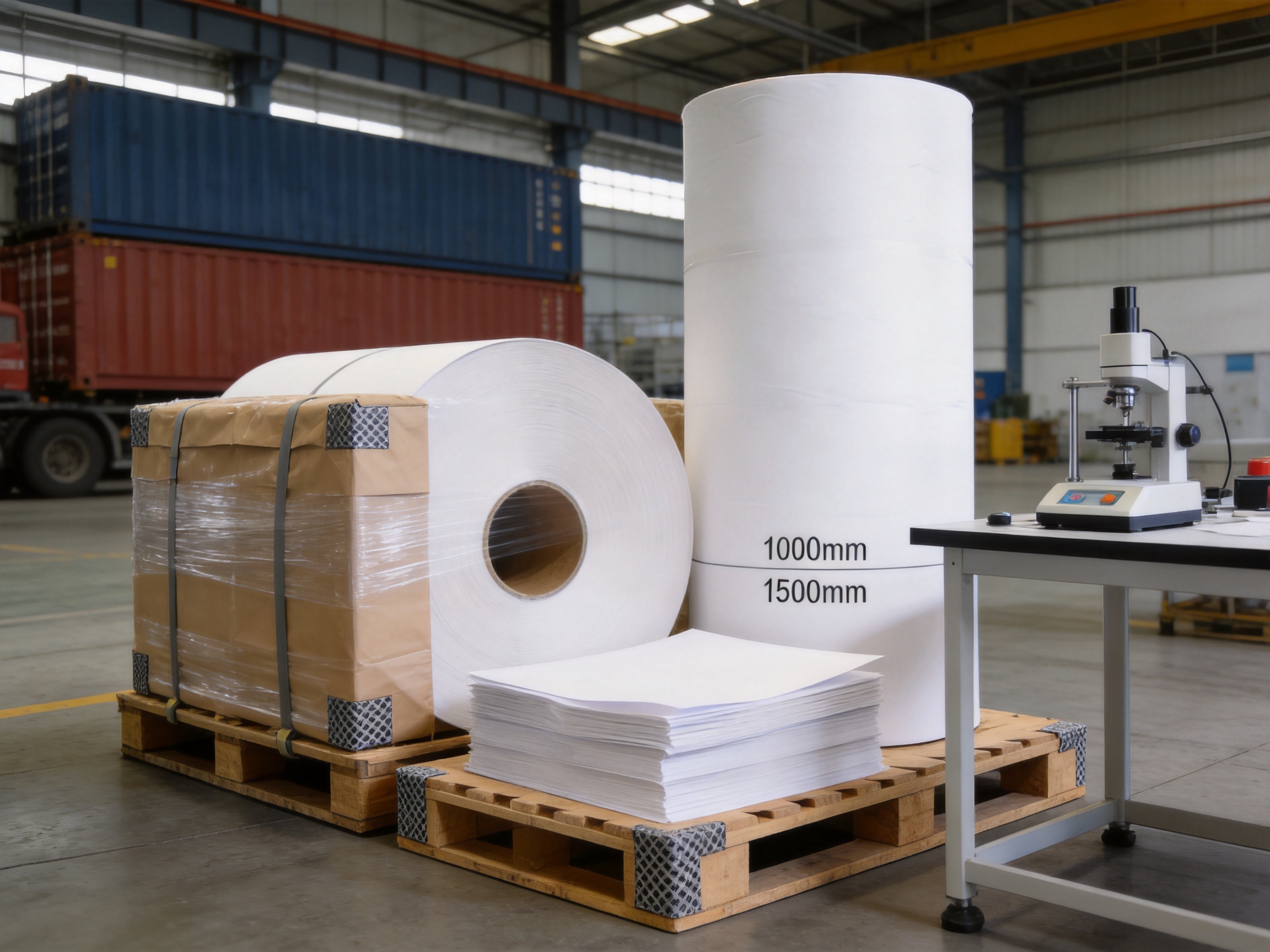
For sea transportation, the company uses fumigation-treated recycled wooden pallets that comply with global standards. These pallets provide strong insect and mold resistance, supporting international shipping requirements. The pallet design optimizes stacking stability and ensures even weight distribution to prevent roll deformation. Protective corner guards are embedded, and pallets are tightly wrapped with stretch film to secure the cargo.
Standardized forklift slots improve logistics efficiency and reduce handling damage. This may seem like a small detail, but industrial buyers understand that poor pallet design can cause serious problems. If forklift entry is difficult, operators may damage rolls, puncture wrapping, or shift stacked goods. Efficient pallet handling protects the product and speeds warehouse operations.
For ream packaging, each ream typically contains 100 sheets. Each ream is fully sealed with PE-coated kraft paper to protect against moisture and dust. Reinforced edges minimize damage during movement. Multiple reams are stacked on pallets and secured with high-strength stretch film and anti-slip plastic straps to prevent shifting during transit. This packaging system helps ensure that sheets remain clean, flat, and ready for use when they arrive at the customer’s facility.
Company Strengths Supporting Global Buyers
Suzhou Piaozhihua Composite Material Technology Co., Ltd. is located in Taicang City, Suzhou City, Jiangsu Province, China. The company is a private enterprise specializing in the production of high-grade self-adhesive labels and composite materials, integrating research and development, production, sales, and after-sales service. This integrated model allows the company to respond quickly to customer needs and maintain control over quality, delivery, and technical support.
With a full range of production lines and an annual capacity of more than 280 million square meters, the company ranks among the leading self-adhesive product enterprises in China. Large production capacity is important for customers who require stable long-term supply. It reduces the risk of shortages and supports large-scale purchasing programs, seasonal demand, and international distribution.
The company has developed sales networks across China, including major cities such as Shanghai, Ningbo, Hangzhou, Chengdu, Harbin, Wuhan, Chongqing, Guangzhou, Changsha, and Beijing, as well as franchise chains. Internationally, it has built a marketing network in regions including the United States, Germany, Japan, South Korea, Brazil, Mexico, Russia, and the Middle East, covering Asia, Europe, the Americas, Africa, and other regions. This global market experience helps the company understand different packaging standards, logistics requirements, and customer expectations.
More than 20 years of OEM manufacturing experience gives the company practical knowledge of diverse customer needs. OEM and ODM services are especially valuable for customers who need products manufactured according to drawings, samples, technical specifications, or performance targets. The company’s professional research and development team and multiple patents support continuous innovation. Its after-sales service helps customers solve application challenges and optimize material use.
The company’s core values include quality, integrity, innovation, win-win cooperation, and responsibility. These values are reflected in its manufacturing philosophy and customer service approach. For coated art paper buyers, this means the supplier is not only offering a commodity paper product but also a technically supported material solution.
How Coated Art Paper Improves Customer Production Efficiency
Production efficiency is often determined by material consistency. A printing press, die-cutting machine, laminator, or packaging line can only perform well when the input material behaves predictably. Coated art paper contributes to efficiency in several ways. First, its strength reduces breaks and tears. Second, its smooth surface supports stable feeding and printing. Third, its moisture resistance reduces curling and dimensional variation. Fourth, its customized sizes reduce trimming and preparation work.
For label converters, fewer web breaks mean higher machine uptime. Improved surface quality means fewer rejected labels. Stable release behavior means smoother dispensing and die-cutting. For packaging producers, flat sheets and clean surfaces reduce feeding problems and improve finished package appearance. For electronics processors, dimensional stability and surface protection support precision and yield.
Material reliability also reduces operator workload. When paper properties vary, operators must constantly adjust tension, speed, temperature, blade pressure, or feeding settings. These adjustments slow production and increase the risk of error. A consistent coated art paper allows more stable machine settings, shorter setup time, and better repeatability from batch to batch.
Another efficiency benefit comes from packaging integrity. If rolls or sheets arrive damaged, production schedules may be disrupted. The company’s use of strong pallets, corner protection, stretch wrapping, and sealed ream packaging reduces the risk of transit damage. This protects not only the material but also the customer’s production planning.
Quality Factors Buyers Should Evaluate
When selecting coated art paper, buyers should evaluate both technical properties and supplier capabilities. Technical properties include basis weight, thickness, surface smoothness, whiteness, tensile strength, tear resistance, moisture content, release performance, coating uniformity, and dimensional stability. These factors determine how the paper will perform in printing, conversion, packaging, and end use.
Supplier capabilities are equally important. A reliable supplier should have strong production control, testing equipment, customization ability, stable capacity, packaging expertise, and responsive technical service. For customers purchasing internationally, logistics experience and export packaging are also critical. A low-cost material may become expensive if it causes downtime, waste, or shipment damage.
Buyers should also consider whether the supplier can support application development. For example, a customer producing medical tapes may need different release characteristics than a customer producing barcode labels. A customer working with flexible circuit boards may require cleaner surfaces and tighter dimensional stability than a customer using general packaging tags. A supplier with R&D capability and OEM/ODM experience can help match the material to the application.
Coated art paper should not be judged only by appearance. A smooth white surface is important, but hidden performance characteristics often determine success. Testing and trial production are useful steps for confirming compatibility with adhesives, inks, machines, storage conditions, and final product requirements.
Q&A: Common Questions About Coated Art Paper
What is coated art paper used for?
Coated art paper is used for label printing, adhesive labels, barcodes, packaging tags, food packaging liners, healthcare separation materials, electronic die-cutting carriers, and flexible circuit board processing. Its smooth surface, strength, and moisture resistance make it suitable for both printing and industrial conversion.
What basis weights are available?
The material is available in 90 g, 120 g, 140 g, and 165 g art paper grades. Different basis weights provide different balances of flexibility, stiffness, opacity, and durability. Customers can choose the grade that best matches their production and application needs.
Why is surface smoothness important?
Surface smoothness improves printing quality, ink adhesion, barcode readability, and release consistency. A smooth coated surface also reduces friction during die-cutting and lamination, helping improve production efficiency and reduce defects.
How does moisture resistance benefit customers?
Moisture resistance helps prevent warping, curling, delamination, and dimensional instability during storage, transport, and use. This is especially important for humid environments, food packaging applications, and long-distance sea transportation.
Can the paper be customized?
Yes. The product can be supplied in standard jumbo roll widths such as 1000 mm, 1020 mm, 1080 mm, and 1530 mm, as well as sheet sizes such as A4, A3, 50 cm x 70 cm, and 70 cm x 100 cm. Custom sizes can also be produced to match customer equipment and reduce trimming waste.
What makes this product different from ordinary paper?
Ordinary paper may provide basic printing performance, but coated art paper offers improved smoothness, coating consistency, strength, moisture resistance, and release-related functionality. These advantages reduce production risks and support more demanding industrial applications.
Is coated art paper suitable for food and healthcare applications?
The material is designed to meet relevant safety expectations for suitable food-grade and medical-related applications. It can be used as a liner or separation material when properly specified according to the end-use requirements and applicable standards.
How does the manufacturer ensure stable quality?
The manufacturer uses controlled raw material selection, coating processes, gluing, laminating, cutting, laboratory testing, and inspection equipment. Quality checks may include basis weight, moisture content, tensile strength, surface smoothness, coating uniformity, and release performance.
Why is packaging important for coated art paper?
Packaging protects rolls and sheets from moisture, dust, edge damage, deformation, and shifting during transport. Fumigation-treated recycled wooden pallets, corner guards, stretch film, PE-coated kraft ream packaging, and anti-slip straps help ensure the product arrives in stable condition.
Who should consider using coated art paper?
Label converters, printing companies, food packaging producers, medical product manufacturers, electronics processors, adhesive material suppliers, and industrial die-cutting companies should consider coated art paper when they need a smooth, strong, moisture-resistant, and customizable paper-based material.
Conclusion
Coated art paper is a high-value material for customers who need more than ordinary paper performance. It combines a smooth and consistent printing surface, strong paper structure, moisture resistance, clean handling, and broad customization options. These characteristics make it suitable for adhesive labels, packaging tags, food liners, healthcare separation materials, electronic die-cutting carriers, and flexible circuit board processing.
Its advantages over competing materials come from balance. It offers better printability and surface control than ordinary paper, more stable industrial performance than low-grade liners, and a more paper-based sustainability direction than many plastic alternatives. When manufactured through advanced coating, gluing, laminating, cutting, and testing processes, it can improve customer production efficiency, reduce waste, and support high-quality finished products.
Suzhou Piaozhihua Composite Material Technology Co., Ltd. strengthens this product value through more than 20 years of OEM experience, integrated production lines, advanced inspection equipment, a professional research and development team, large annual capacity, and global market service. Its ability to provide customized coated art paper in multiple basis weights, roll widths, and sheet sizes helps customers match material performance with real production needs.
For buyers seeking a dependable paper-based solution for printing, release, packaging, healthcare, or electronics applications, coated art paper offers a practical and performance-oriented choice. With the right supplier, it becomes not only a material but also a foundation for stable converting, professional presentation, and long-term manufacturing success.
References
1. Paper and Paperboard Packaging Technology, edited by Mark J. Kirwan.
2. Handbook of Pressure Sensitive Adhesive Technology, edited by Donatas Satas.
3. TAPPI Technical Information Papers on paper coating, converting, and release liner performance.
4. Fundamentals of Paper Drying: Theory and Application from Industrial Papermaking Literature.
5. ISO standards related to paper grammage, tensile properties, moisture content, and sampling procedures.
6. Industry guidance on release liner converting, labelstock production, and self-adhesive material quality control.