
 English
 Español
 русский
 Français
 عربى
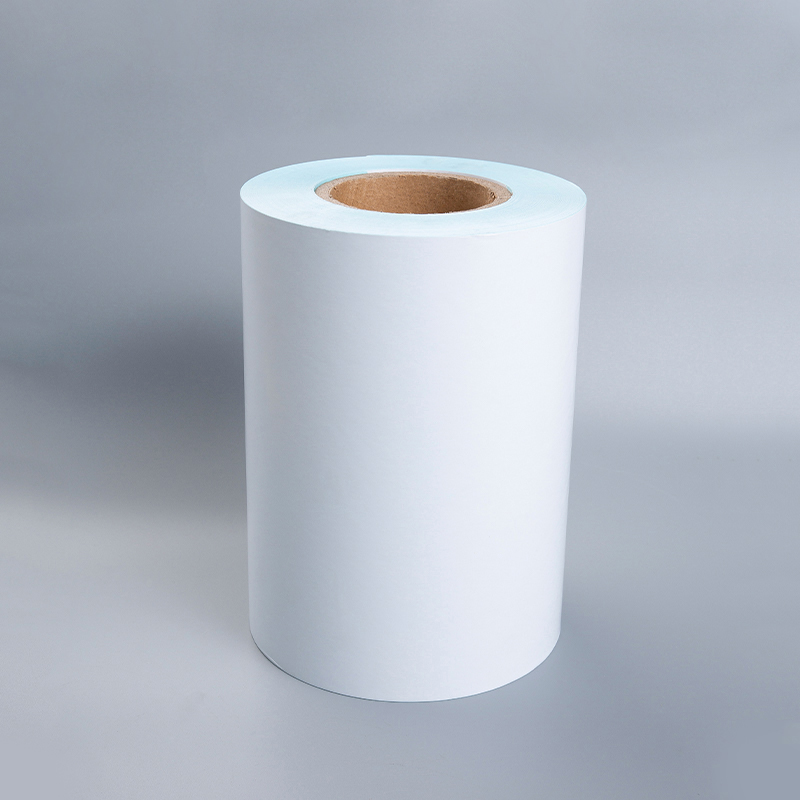
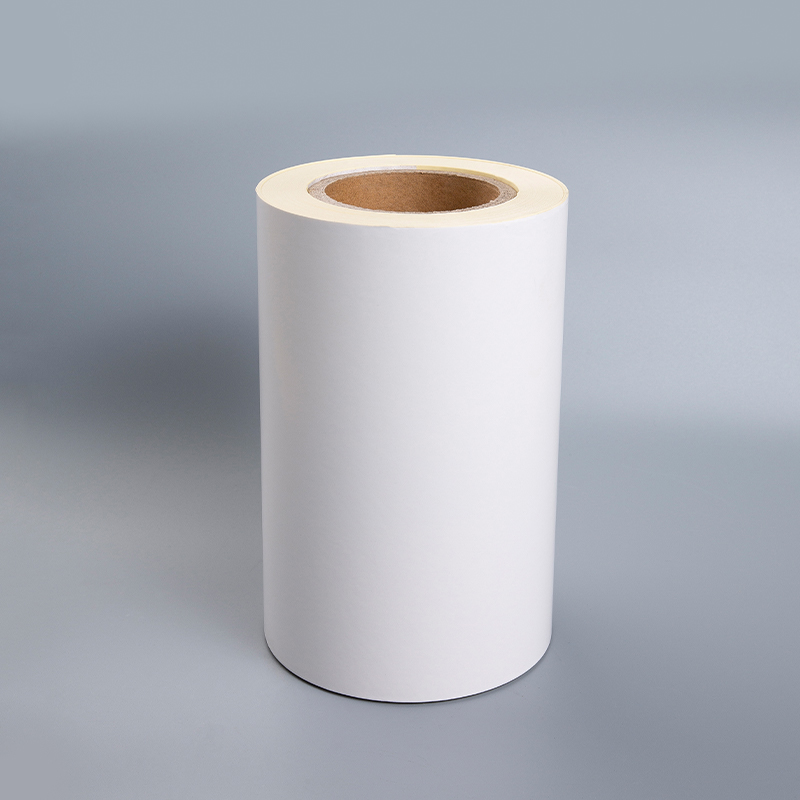
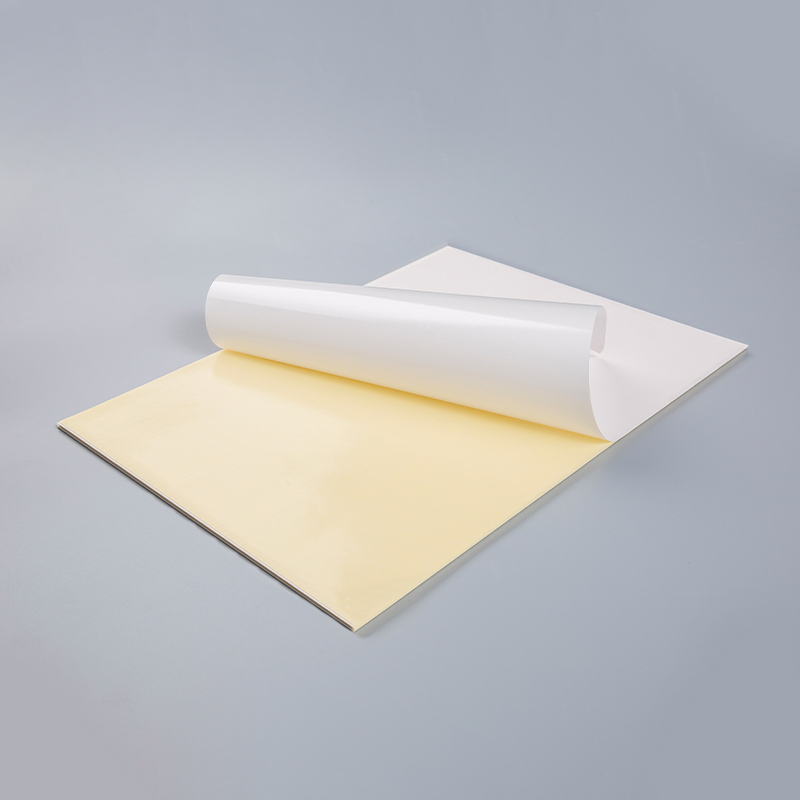
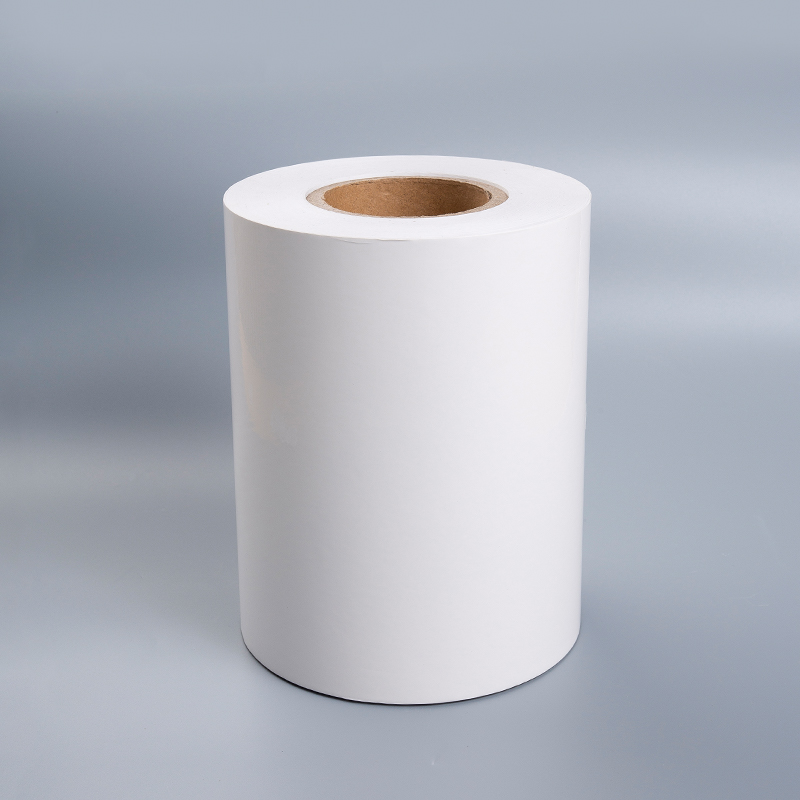
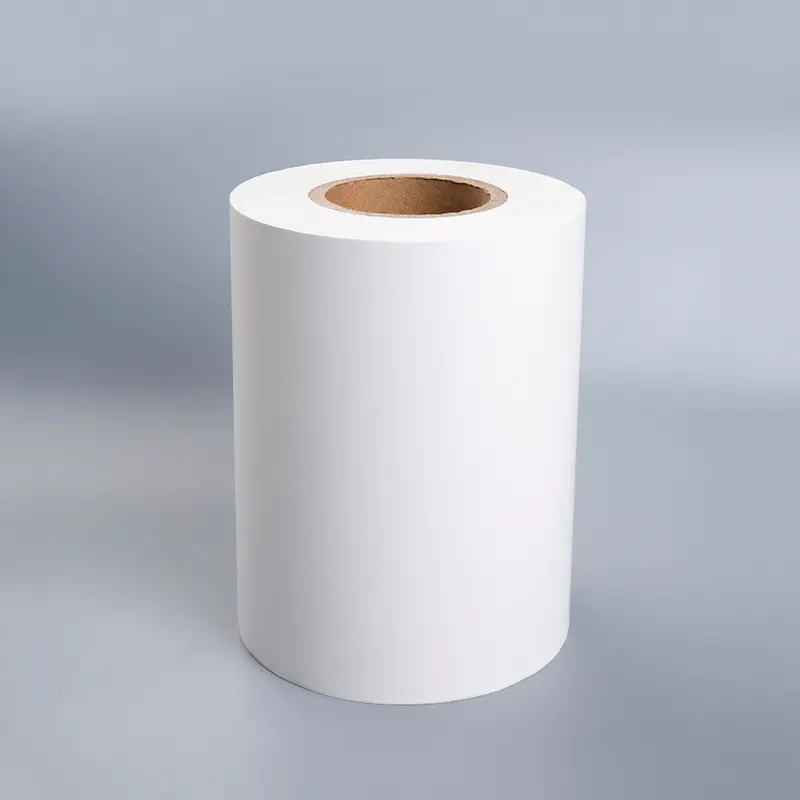
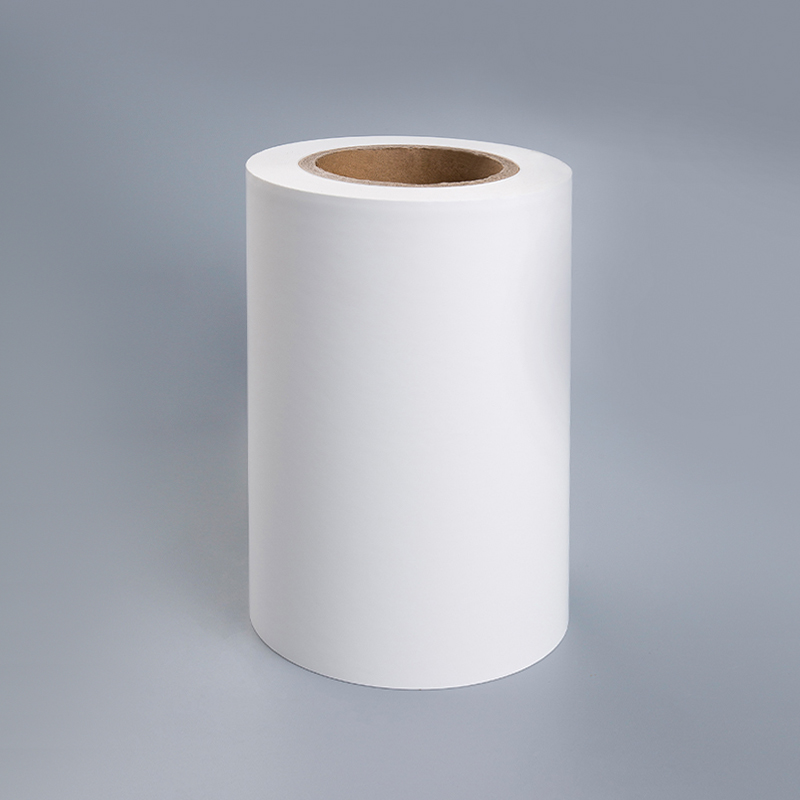
عربىWoodfree paper with a white release liner is a practical, versatile, and high-value self-adhesive label material designed for everyday labeling environments where printability, adhesion, clean converting, and reliable release performance all matter. It is especially suitable for stores, supermarkets, warehousing and logistics, medical supplies, outer box stickers, daily office use, inventory identification, and general commercial labeling. Built with a printable woodfree paper face stock, a uniform adhesive layer, and a stable white release liner, this material provides a balanced solution for users who need dependable label stock that can be converted into rolls or sheets and used across a wide range of end applications.
The product structure is simple but technically important: the surface paper must accept printing clearly, the adhesive must bond evenly without easy degluing, and the liner must release smoothly during label dispensing or manual application. When these three layers are engineered and manufactured correctly, the result is a label material that performs consistently during printing, die-cutting, slitting, packaging, transportation, storage, and final application.
Suzhou Piaozhihua Composite Material Technology Co., Ltd. manufactures this product with more than 20 years of experience in self-adhesive label materials. The company integrates research and development, production, sales, and after-sales service, with full production processes including gluing, laminating, and cutting. With an annual production capacity of more than 280 million square meters and a broad product portfolio covering self-adhesive paper, self-adhesive film, special label materials, and silicone release paper, the company is positioned to supply both standard and customized label material solutions for domestic and international markets.
Woodfree Paper With White Release Liner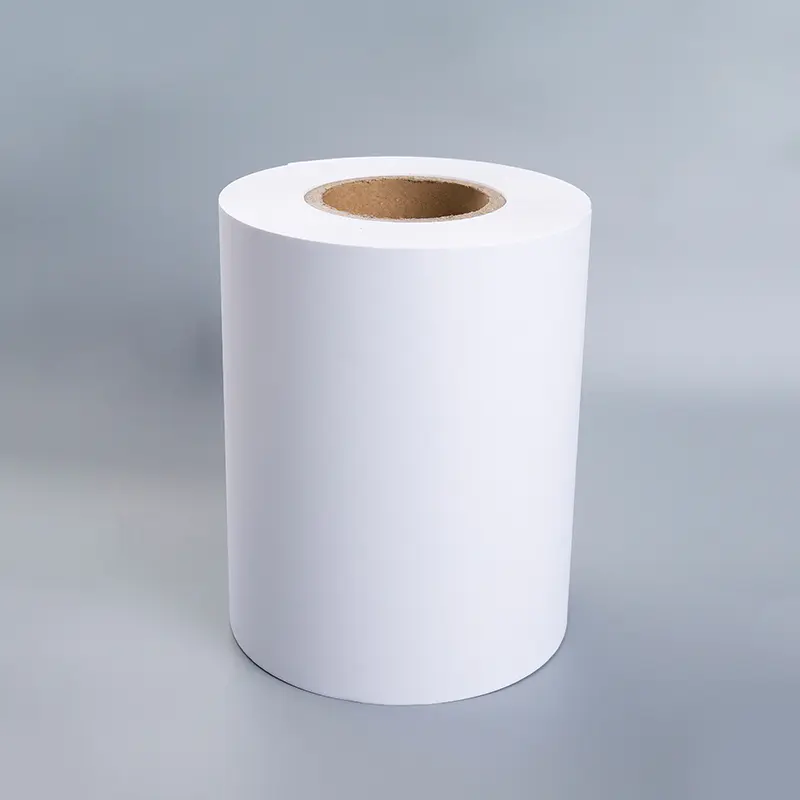
Content
- 1 Product Overview
- 2 Key Product Specifications
- 3 Why Woodfree Paper Matters in Label Performance
- 4 Adhesive Advantages: Uniform Glue and High Adhesion
- 5 The Role of the White Release Liner
- 6 Applications Across Retail, Logistics, Medical Supplies, and Office Use
- 7 Advantages Over Ordinary Competitor Materials
- 8 Advanced Manufacturing Processes
- 9 Quality Control and Testing Strengths
- 10 Customization for OEM and ODM Projects
- 11 Roll and Sheet Supply Flexibility
- 12 Packaging and Delivery Reliability
- 13 Sustainability and Responsible Material Development
- 14 Technical Considerations for Selecting the Right Construction
- 15 Printing and Converting Performance
- 16 Company Manufacturing Strengths
- 17 Domestic and International Market Support
- 18 Recommended Storage and Handling Practices
- 19 Common Use Scenarios
- 20 Q&A
- 20.1 What is woodfree paper with white release liner?
- 20.2 What is the standard construction of this product?
- 20.3 What applications is it suitable for?
- 20.4 Why is the adhesive performance important?
- 20.5 Can the adhesive be customized?
- 20.6 What liner options are available?
- 20.7 Can this product be supplied in sheets?
- 20.8 Can this product be supplied in jumbo rolls?
- 20.9 How does this material compare with ordinary competitor products?
- 20.10 What manufacturing strengths support product quality?
- 21 Conclusion
- 22 References
- 23 Product: Woodfree Paper With White Release Liner
Product Overview
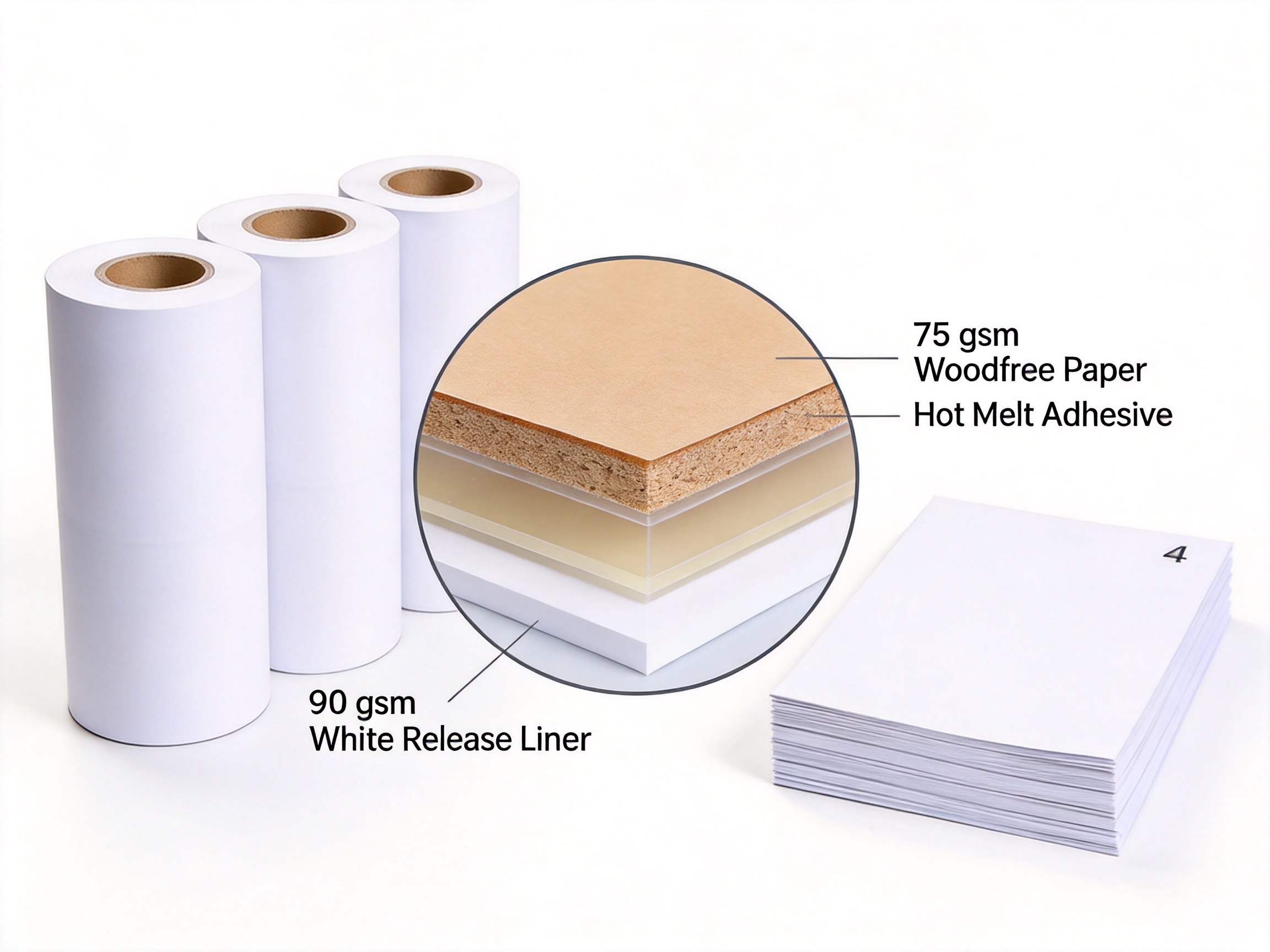
Woodfree paper with white release liner is a self-adhesive paper label material made for users who require strong adhesive performance, smooth printing, and reliable backing release. The standard construction uses 75 gsm woodfree paper as the face material, hot melt adhesive as the bonding layer, and 90 gsm white release paper as the liner. Depending on customer requirements, the product can also be customized with different face paper weights, adhesive systems, liner types, and sheet or roll sizes.
The woodfree paper face stock provides a clean and stable printing surface. It is suitable for text, barcodes, graphics, price tags, shipping information, product labels, office labels, and identification labels. Compared with lower-grade paper surfaces, woodfree paper generally offers better visual quality, smoother printing, and more professional label appearance. This makes it suitable for labels that must be both functional and visually acceptable.
The adhesive layer is one of the most important parts of the product. The standard hot melt adhesive offers high tack, strong adhesion, and reliable bonding for many common surfaces. It helps prevent edge lifting and label detachment during storage, handling, and transportation. For customers with special requirements, water-based adhesive, solvent adhesive, removable adhesive, anti-freeze adhesive, cryogenic adhesive, and tyre-grade rubber adhesive options are also available. This flexibility allows the same general product family to be adapted to different climates, surfaces, storage conditions, and industry needs.
The white release liner provides support during coating, printing, die-cutting, slitting, sheeting, storage, and final label application. A stable liner is essential because it affects converting speed, label waste stripping, flatness, and release behavior. The standard 90 gsm white release paper offers good stiffness and handling strength, while alternative liners such as glassine paper, release paper, art paper, and CCK liner can be selected for different converting systems or end-use requirements.
Key Product Specifications
Item |
Standard Specification |
Available Options |
Face Material |
75 gsm woodfree paper |
70 gsm, 80 gsm, 100 gsm, 120 gsm, and 140 gsm woodfree paper |
Adhesive |
Hot melt adhesive |
Water-based adhesive, solvent adhesive, removable adhesive, anti-freeze adhesive, cryogenic adhesive, tyre-grade rubber adhesive |
Liner |
90 gsm white release paper |
50 gsm, 60 gsm, 80 gsm, 100 gsm, and 120 gsm glassine paper; 60 gsm, 120 gsm, and 140 gsm release paper; 140 gsm and 165 gsm art paper; 50 gsm, 80 gsm, 90 gsm, and 120 gsm CCK liner |
Jumbo Roll Width |
1000 mm, 1020 mm, 1080 mm, and 1530 mm |
Customized roll widths may be discussed according to order requirements |
Sheet Size |
A4, A3, 20 x 30, 21 x 30, 24 x 36, 50 cm x 70 cm, and 70 cm x 100 cm |
Customized sheet sizes are available |
Packaging |
Sea-transit-worthy poly-wood pallet packing and carton packing |
Roll or sheet packing according to stock and customer requirements |
Why Woodfree Paper Matters in Label Performance
Woodfree paper is widely used in label materials because it offers a favorable combination of printability, appearance, cost efficiency, and converting stability. For many paper labels, the face stock must do much more than carry printed information. It must pass through printing equipment, withstand die-cutting, remain flat enough for application, and deliver acceptable appearance after bonding to a package, carton, file, shelf, or product surface.
A good woodfree paper face provides clarity for printed characters and barcodes. This is important in logistics, retail, warehouse management, medical supply labeling, and office organization, where information must remain readable. Clear printing reduces scanning errors, improves inventory control, and supports smoother internal operations. In supermarkets and retail stores, better print appearance can also improve shelf presentation and customer confidence.
Woodfree paper is also a cost-effective choice when compared with many filmic label materials. Film labels may be necessary for outdoor exposure, chemical resistance, or waterproof requirements, but for general indoor and carton labeling, woodfree paper often provides the best balance between function and cost. This allows businesses to label more products efficiently without paying for features they do not need.
Compared with lower-quality paper label materials, a carefully selected woodfree paper face can offer better surface uniformity and more stable printing results. Poor paper quality may create dust, uneven ink absorption, rough graphics, or unstable die-cutting edges. In contrast, a well-made woodfree paper label stock is designed to support consistent converting and application performance.
Adhesive Advantages: Uniform Glue and High Adhesion
The product is designed with uniform glue coating, high adhesion, and resistance to easy degluing. These characteristics directly affect label reliability. Even if a label looks good at the moment of application, its real value depends on whether it remains attached during transportation, storage, shelf display, and use. A label that peels too early can cause barcode loss, inventory confusion, rejected cartons, damaged branding, or compliance problems.
Uniform adhesive coating is an important manufacturing advantage. If adhesive thickness is uneven, some areas may bond too strongly while others bond too weakly. This can lead to curling, bubbling, edge lifting, adhesive bleed, inconsistent die-cutting, or unstable release. A uniform adhesive layer helps labels bond smoothly across the entire surface and contributes to predictable converting behavior.
The standard hot melt adhesive provides strong initial tack, which is useful for carton labeling, retail stickers, and logistics applications where labels must grip quickly after application. In fast-paced environments, operators do not have time to press each label repeatedly. A high-tack adhesive reduces application difficulty and improves productivity.
The availability of multiple adhesive systems gives the product a strong competitive advantage. Water-based adhesive can support certain environmental and processing preferences. Solvent adhesive may be selected for demanding bonding situations. Removable adhesive can be used when labels need to be removed without excessive residue. Anti-freeze and cryogenic adhesive options help support cold-chain or low-temperature applications. Tyre-grade rubber adhesive can be used for specialized difficult surfaces where ordinary adhesives may fail.
This level of adhesive customization makes the product more adaptable than many commodity self-adhesive papers that are offered with only one adhesive type. Instead of forcing customers to adjust their processes around a fixed product, the material can be engineered to better match the application surface, temperature, storage time, labeling method, and performance expectation.
The Role of the White Release Liner
The release liner is sometimes overlooked because it is removed before final label use, but it is essential to the success of the whole label material. During production and converting, the liner supports the adhesive-coated face material. It protects the adhesive, maintains web stability, supports cutting accuracy, and enables smooth label release. A poor liner can cause major converting and application problems even if the face paper and adhesive are good.
The standard 90 gsm white release paper offers strength and stability for many roll and sheet applications. Its white appearance also gives the material a clean and professional look during handling, storage, and printing preparation. The liner must release with controlled force: too tight and labels are difficult to peel or dispense; too loose and labels may lift prematurely during converting or storage. Proper release performance is therefore a key indicator of manufacturing quality.
Alternative liners provide additional flexibility. Glassine liners are often selected when a dense, smooth liner is needed for high-speed converting and roll label production. CCK liners can provide good dimensional stability and layflat properties. Art paper liners may be selected for specific sheet label constructions or premium requirements. Different liner grammages allow customers to balance cost, stiffness, release performance, and converting needs.
The ability to supply different liners is especially valuable for label converters. A converter producing A4 sheet labels may require different liner behavior from a converter producing narrow rolls for automatic dispensing. By offering a range of liner choices, the manufacturer helps customers reduce waste, improve productivity, and achieve more stable finished label quality.
Applications Across Retail, Logistics, Medical Supplies, and Office Use
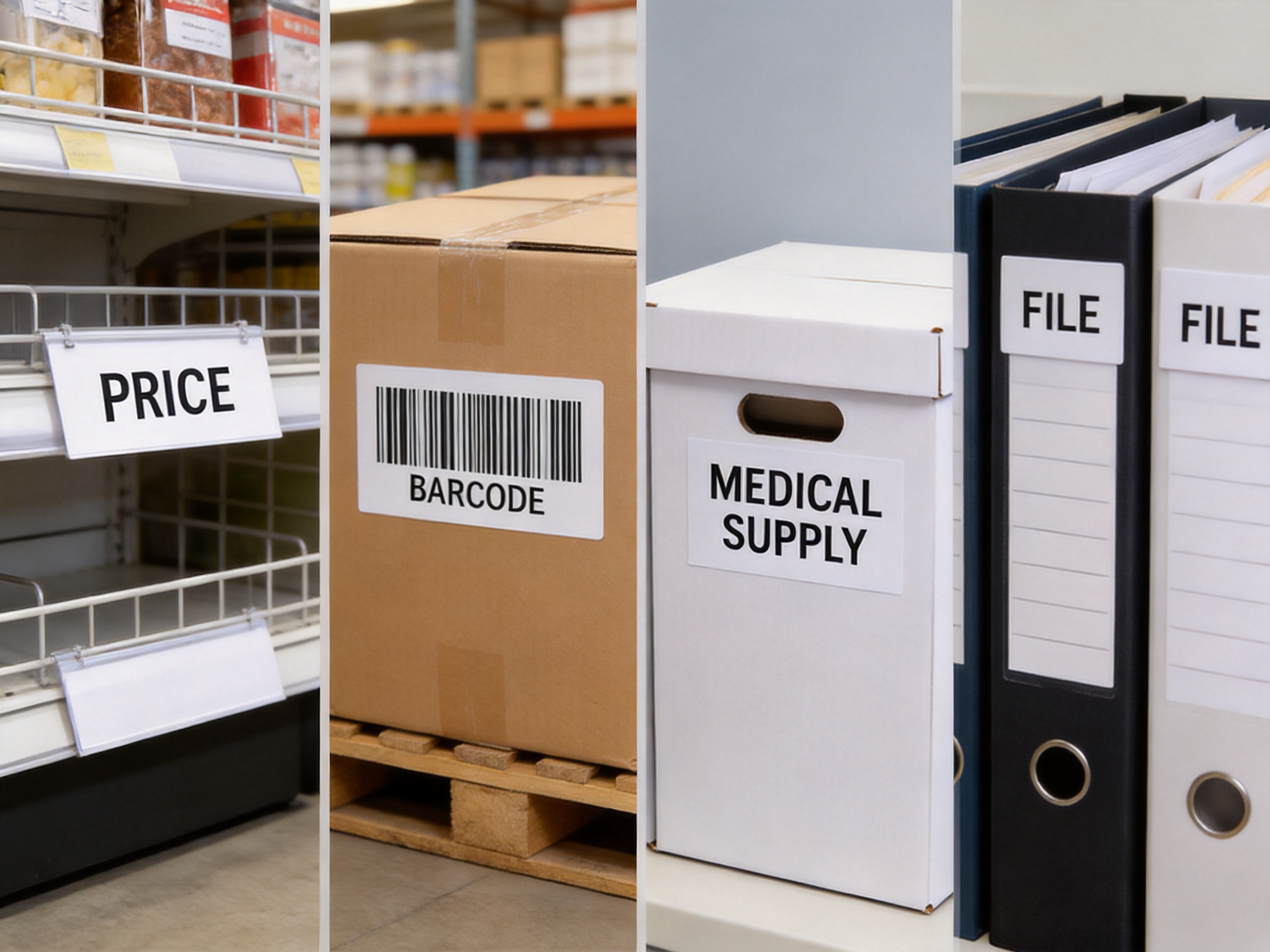
Woodfree paper with white release liner is suitable for a wide range of daily labeling applications. In stores and supermarkets, it can be converted into price labels, promotional stickers, shelf labels, product identification labels, and internal management labels. Retail environments demand labels that are easy to print, easy to apply, and stable enough to remain in place during handling and display.
In warehousing and logistics, labels are often used for cartons, pallets, inventory bins, shipment tracking, and storage identification. Adhesion is especially important in this field because packages may be stacked, moved, scanned, and transported through different environments. A label that detaches from a carton can interrupt the entire tracking process. The strong adhesive performance of this material helps support stable identification from dispatch to delivery.
For medical supplies, labels may be used for outer packaging, storage boxes, internal management, or general identification. Clear printing and reliable bonding are important because information must be readable and traceable. While specific medical applications may require additional qualification depending on regulations and conditions, the material provides a dependable base for general medical supply labeling needs.
For daily office use, the material can be made into file labels, address labels, name stickers, inventory tags, document labels, and organizational stickers. In this setting, convenience and print quality are important. A label that prints neatly, peels easily, and sticks securely can improve office efficiency and reduce waste.
Outer box stickers represent another major application. Cartons and outer boxes are commonly used in manufacturing, distribution, e-commerce, and export shipping. They require identification labels, shipping labels, barcodes, warning stickers, and batch labels. A strong paper-based self-adhesive material is ideal for many carton surfaces, particularly when the application does not require waterproof film labels.
Advantages Over Ordinary Competitor Materials
The product offers several advantages over ordinary competitor materials in the self-adhesive paper label market. The first advantage is the balance between printability and adhesion. Some low-cost label stocks may provide acceptable printing but weak adhesive performance, while others may bond well but create printing or converting issues. This material is designed to deliver stable performance across the full chain: printing, cutting, peeling, application, and final use.
The second advantage is adhesive diversity. Many commodity products are sold with a single standard adhesive, which limits their application range. In contrast, this product can be supplied with hot melt, water-based, solvent, removable, anti-freeze, cryogenic, and tyre-grade rubber adhesive options. This makes it possible to serve normal room-temperature labels, low-temperature labels, removable labels, difficult-surface labels, and specialized industrial applications from one experienced manufacturing source.
The third advantage is liner flexibility. Competitor materials may offer only one or two liner options, which can create problems for converters using different machinery or formats. This product can be matched with white release paper, glassine paper, release paper, art paper, or CCK liner in different grammages. Such flexibility helps improve die-cutting quality, waste stripping, sheet flatness, roll stability, and label dispensing behavior.
The fourth advantage is manufacturing scale and process integration. Suzhou Piaozhihua Composite Material Technology Co., Ltd. operates full production lines including gluing, laminating, and cutting. Integrated production improves control over quality, delivery, and customization. A supplier that controls multiple key processes can respond more effectively to customer requirements than a trading-only supplier or a factory with limited processing capability.
The fifth advantage is experience. With more than 20 years of OEM manufacturing experience, the company understands the technical and commercial needs of label converters, printers, packaging companies, distributors, and end users. Experience matters because self-adhesive materials are sensitive to small changes in coating, paper moisture, release force, winding tension, storage conditions, and packaging. A mature manufacturer can identify potential issues early and help customers choose more suitable specifications.
The sixth advantage is quality assurance. The company has its own testing lab and advanced inspection equipment to support product quality. This helps verify important performance factors such as adhesive behavior, material appearance, coating consistency, release characteristics, dimensional stability, and finished roll or sheet quality. Better inspection reduces risk for customers and supports more stable repeat orders.
Advanced Manufacturing Processes
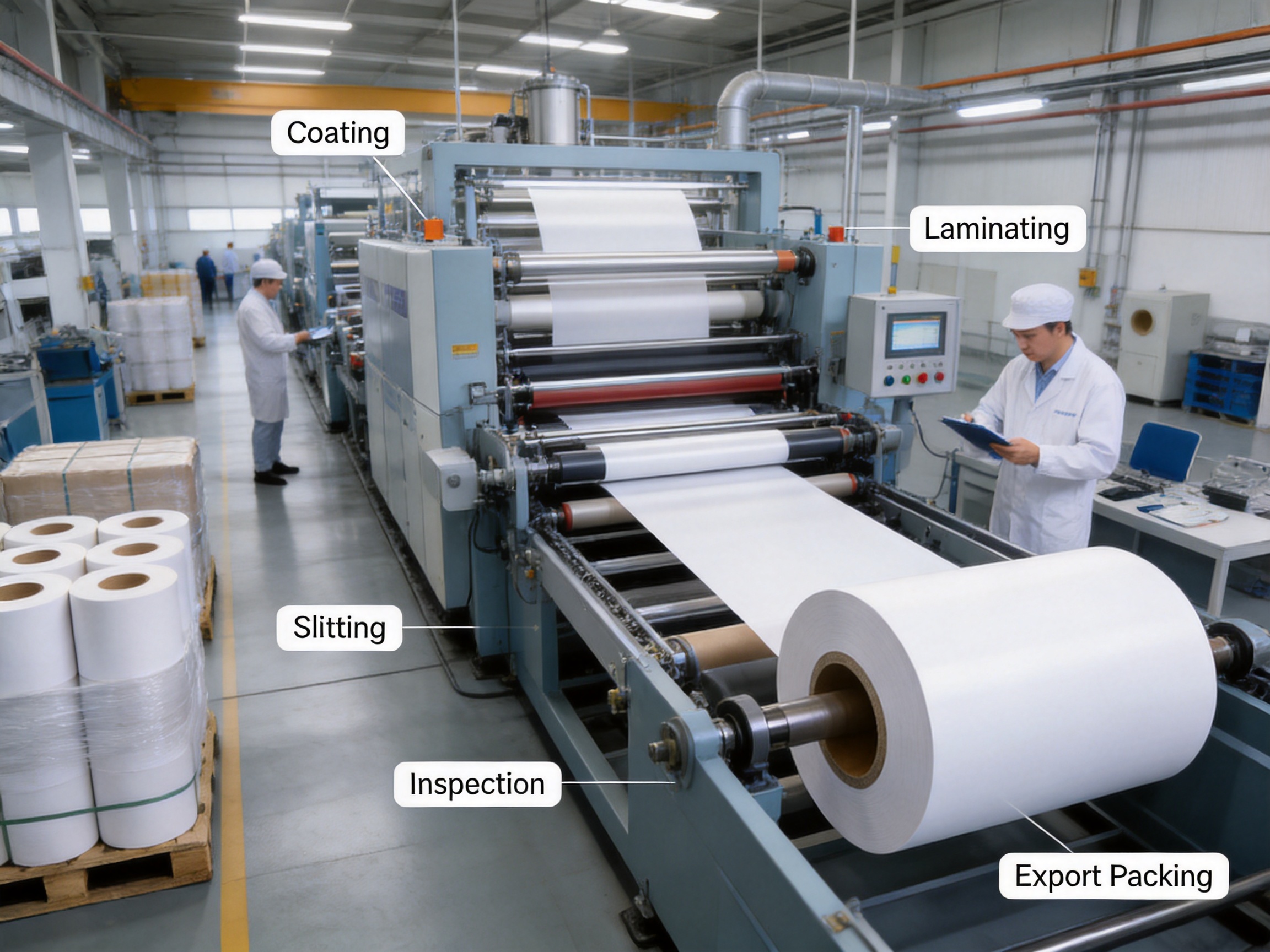
The manufacturing of self-adhesive paper is a technical process that requires control over raw materials, coating, drying or setting, lamination, winding, aging, slitting, sheeting, and packaging. Each stage affects final performance. A small deviation in adhesive coating weight, liner release treatment, moisture balance, or winding tension can create problems during printing or application. Therefore, advanced process control is a major strength of a professional manufacturer.
The gluing process is central to product performance. Adhesive must be applied evenly across the web, with controlled thickness and stable distribution. Uniform glue is one of the product’s key features, and it depends on equipment accuracy, adhesive preparation, line speed control, temperature management, and operator experience. Good gluing reduces defects such as dry spots, adhesive streaks, wrinkles, bubbles, or excessive adhesive flow.
Laminating combines the face paper, adhesive, and release liner into a stable composite structure. During lamination, pressure, web alignment, and tension must be controlled. Poor lamination can cause wrinkles, curling, misalignment, or unstable release. Professional laminating equipment and experienced process management help ensure that the face paper and liner remain properly combined throughout the roll.
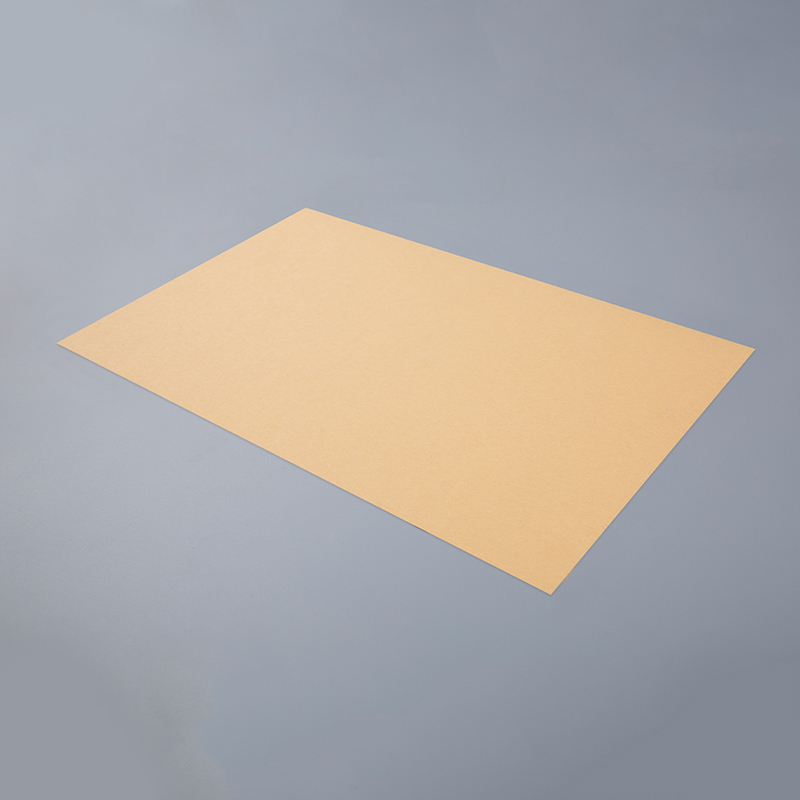
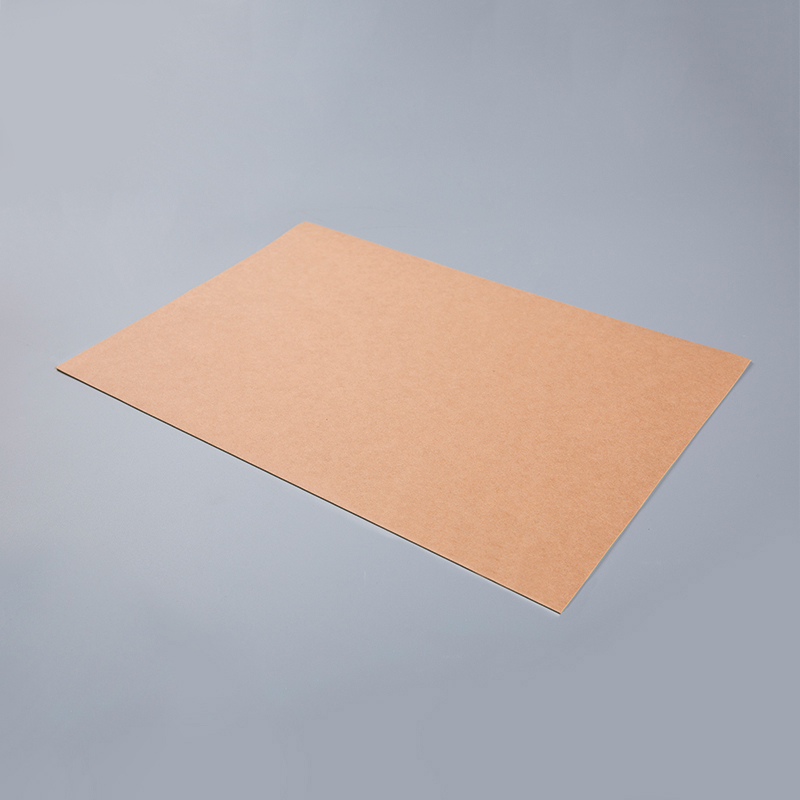
Cutting and finishing are also important. Jumbo rolls may be slit into smaller rolls or converted into sheets such as A4, A3, 50 cm x 70 cm, or 70 cm x 100 cm. Clean edges, accurate dimensions, and controlled winding are essential for downstream printing and converting. If rolls are wound too tightly or too loosely, they may telescope, deform, or create feeding problems. If sheets are cut inaccurately, printers and die-cutters may encounter registration problems.
Packaging is part of manufacturing quality as well. The product can be packed in sea-transit-worthy poly-wood pallets or cartons, depending on roll or sheet form and customer requirements. For sheet products, 100 sheets per ream can be packed with strong PE coated kraft paper wrappers, and pallets can be wrapped with stretch film and fastened with plastic belts. Proper packaging protects the material against moisture, dust, impact, and transportation stress.
Quality Control and Testing Strengths
Reliable self-adhesive label material requires consistent quality from batch to batch. Customers often use the same label material in printing machines, die-cutting systems, barcode printers, sheet printers, or automatic labeling systems. If the material changes unexpectedly, it may cause downtime, waste, rework, or customer complaints. For this reason, quality control is not only a factory procedure; it is a direct value to the customer.
The company’s own testing lab and advanced inspection equipment support quality control throughout production. Testing can help evaluate raw materials, adhesive characteristics, release performance, appearance quality, and finished product consistency. Inspection can identify coating defects, surface problems, contamination, wrinkles, or cutting issues before products are shipped.
Adhesion testing is especially important. The label must bond firmly to intended surfaces and maintain adhesion during handling. Depending on the adhesive type and application, tests may consider initial tack, peel strength, holding power, and performance under different temperatures. For cold-chain or freezer applications, anti-freeze or cryogenic adhesive options require attention to low-temperature bonding behavior.
Release testing is also important. If the release force is too high, labels may be hard to peel, causing operator fatigue or machine dispensing problems. If the release force is too low, labels may lift during printing, die-cutting, rewinding, or storage. Controlled release helps converters achieve stable production and helps users apply labels efficiently.
Visual inspection supports customer confidence. Label materials should be free from obvious defects such as stains, holes, streaks, wrinkles, uneven coating, excessive dust, or damaged edges. Clean material improves printing quality and reduces waste. For customers producing branded labels or retail stickers, appearance quality is directly connected to product presentation.
Customization for OEM and ODM Projects
One of the strongest advantages of this product is its suitability for OEM and ODM customization. Customers may require different face paper weights, adhesives, liners, roll widths, sheet sizes, packaging formats, or performance features. With strong manufacturing capability and an experienced R&D team, the company can produce products based on customer drawings or samples and provide customized solutions for different market needs.
For example, a logistics label converter may prefer 75 gsm woodfree paper with hot melt adhesive and a liner suitable for roll die-cutting. A stationery brand may require A4 sheets with a liner that provides good flatness for laser or inkjet printing. A cold-chain distributor may need anti-freeze adhesive to support labeling at lower temperatures. A customer working with difficult surfaces may require a stronger rubber-based adhesive option. These different needs can be addressed through material engineering rather than a one-size-fits-all approach.
Customization also supports regional market differences. Customers in humid climates, cold regions, or high-volume retail environments may have different priorities. Some may value stronger adhesion, while others may prioritize removable performance, sheet flatness, or printing smoothness. The ability to adjust materials helps customers compete more effectively in their own markets.
OEM and ODM capability is also important for distributors and private-label customers. A distributor may want a stable supply of standard paper label stock under its own product system. A label converter may need a custom specification for a long-term end user. A packaging company may require special sheet sizes or roll widths to improve production efficiency. A manufacturer with full-process capability can support these commercial models more effectively.
Roll and Sheet Supply Flexibility
The product can be supplied in jumbo rolls, rolls, or sheets, depending on customer requirements. Jumbo roll widths include 1000 mm, 1020 mm, 1080 mm, and 1530 mm. These widths are practical for converters who will slit, print, die-cut, or laminate the material further. Supplying jumbo rolls allows customers to optimize production according to their own machinery and finished label dimensions.
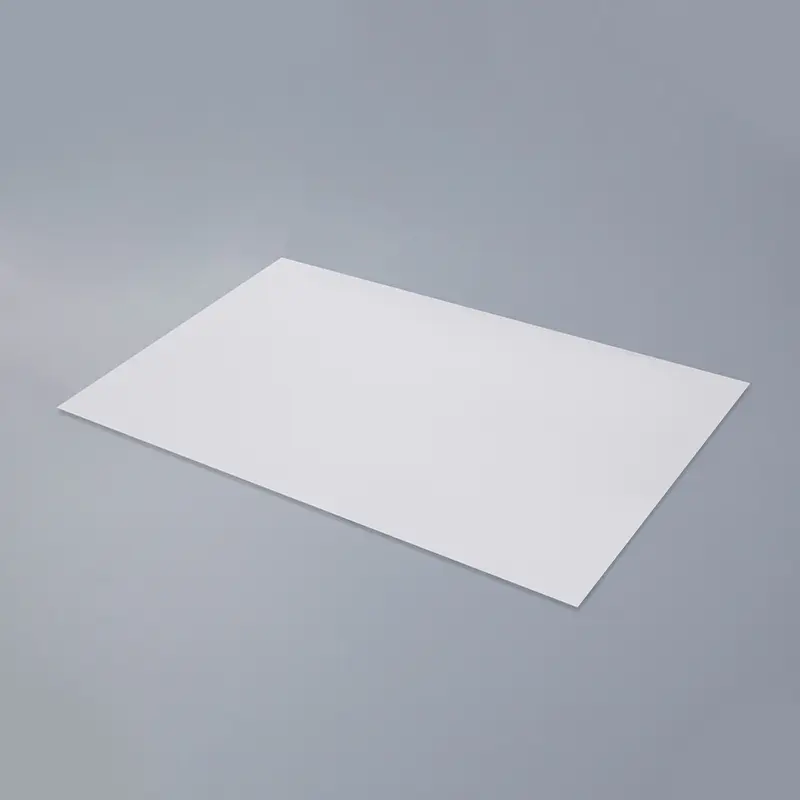
Sheet sizes include A4, A3, 20 x 30, 21 x 30, 24 x 36, 50 cm x 70 cm, and 70 cm x 100 cm. Custom sheet sizes are also available. Sheet supply is useful for office labels, digital printing, small-format printing, stationery products, and commercial sheet-fed applications. Accurate sheeting and stable flatness are important for smooth printer feeding and final label quality.
Roll supply is useful for label converters and automatic labeling applications. Roll labels are common in warehousing, logistics, retail, manufacturing, and packaging. The base material must support smooth unwinding, stable die-cutting, clean matrix removal, and consistent label release. A well-produced roll material helps reduce downtime and improves production yield.
The ability to offer both rolls and sheets gives customers more purchasing flexibility. A large converter may buy jumbo rolls, while a distributor may need sheet stock. A printing company may require standard sheet sizes for digital printing, while a warehouse label supplier may need rolls for barcode labels. One material platform can serve many channels.
Packaging and Delivery Reliability
Packaging is essential for protecting self-adhesive materials, especially during export transportation. Paper-based label stock can be affected by moisture, pressure, dust, and physical damage. Poor packaging may lead to curled sheets, crushed roll edges, contaminated surfaces, or unstable printing performance. Therefore, professional packaging is a practical advantage.
The product can be supplied with sea-transit-worthy poly-wood pallet packing and carton packing for rolls or sheets from stock. Sheet products can be packed as 100 sheets per ream, with reams wrapped in strong PE coated kraft paper. Pallets can be wrapped with stretch film and fastened with plastic belts. This packaging method helps protect products from shifting, moisture exposure, and transportation stress.
For international customers, stable packaging reduces the risk of arrival damage and improves warehouse handling. It also supports easier inventory management because goods are packed in organized units. For customers who distribute sheet labels or convert rolls, receiving materials in good condition is essential for maintaining production schedules.
Sustainability and Responsible Material Development
Sustainability is increasingly important in label materials. Customers are paying more attention to environmental impact, responsible sourcing, waste reduction, and material efficiency. Paper-based self-adhesive labels can offer advantages in applications where film labels are unnecessary, because they can reduce reliance on plastic face materials. Selecting the right material for the actual use case is one way to support more responsible packaging decisions.
The company’s brand positioning emphasizes sustainable development and environmental protection, including the development of eco-friendly solutions involving face materials, adhesives, and backing papers. This direction reflects the market trend toward greener packaging and labeling. While performance remains essential, customers increasingly want suppliers who can help them explore more responsible material choices.
Waste reduction is also part of sustainability. A label material that converts cleanly, prints reliably, and adheres properly reduces rejected labels, reprinted batches, and discarded packages. Consistent quality is therefore not only an economic benefit but also an environmental benefit. Fewer defects mean less material waste across the supply chain.
Customization can also support sustainability. By choosing an appropriate face weight, liner type, adhesive system, and roll width, customers can reduce over-engineering and material waste. For example, a general carton label may not need a heavy film face, while a standard indoor office label may not require an expensive specialty adhesive. Matching the material to the application helps conserve resources.
Technical Considerations for Selecting the Right Construction
When selecting woodfree paper with white release liner, customers should consider the surface to be labeled, the printing method, the converting method, the application temperature, storage conditions, and expected service life. A label for a supermarket shelf may require different performance from a label for a refrigerated carton or a rough shipping box. Proper selection improves performance and reduces cost.
The face paper weight should match printing and handling needs. A 75 gsm woodfree paper is suitable for many general applications because it balances printability, flexibility, and cost. Heavier options such as 100 gsm, 120 gsm, or 140 gsm may be selected when a thicker label feel, higher stiffness, or more premium appearance is desired. Lighter options may support cost efficiency or specific converting requirements.
The adhesive should be selected based on the application surface and environment. Hot melt adhesive is a strong general option for high tack and secure bonding. Removable adhesive is suitable when labels must be peeled away. Anti-freeze or cryogenic adhesive should be considered for low-temperature applications. Tyre-grade rubber adhesive can support specialized surfaces where ordinary label adhesives may not provide enough grip.
The liner should match the converting and application process. A 90 gsm white release paper provides good general handling. Glassine may be preferred for certain roll label converting applications. CCK liner may be chosen for dimensional stability and layflat needs. The correct release force and liner strength can improve die-cutting, peeling, and dispensing.
Printing and Converting Performance
Printing performance is a major reason customers choose woodfree paper label materials. The surface must accept ink or toner evenly, allowing text, graphics, and barcodes to remain clear. In retail and logistics, barcode readability is especially important. A poor printing surface can cause broken lines, unclear characters, or scanner errors. A suitable woodfree paper face helps maintain clean print output.
Converting performance is equally important. Many customers will slit, die-cut, sheet, or print the material before final use. During die-cutting, the blade must cut through the face paper and adhesive without cutting too deeply into the liner. A stable liner and consistent adhesive layer help maintain proper cutting depth and clean label edges. If coating thickness varies, die-cutting may become unstable.
Matrix removal is another key step in roll label converting. After die-cutting, waste material around the labels must be stripped away cleanly. If adhesive is too aggressive in the wrong way, if the liner release is unstable, or if the face paper tears easily, matrix removal can fail. A well-balanced self-adhesive construction improves production speed and reduces waste.
Sheet-fed printing requires good flatness. Curled sheets can jam printers or create misregistration. The combination of face paper, adhesive, and liner must maintain dimensional stability. Proper packaging also helps maintain sheet quality before printing.
Company Manufacturing Strengths
Suzhou Piaozhihua Composite Material Technology Co., Ltd. is a private company specializing in high-grade self-adhesive labels and related composite materials. The company integrates R&D, production, sales, and after-sales service, which gives customers support from product development to final delivery. This integrated model is especially useful for customers who need technical guidance, customized specifications, and stable long-term supply.
The company has full production lines, including gluing, laminating, and cutting. This process coverage supports better control over product consistency. Instead of relying entirely on outsourced processing, the company can manage key manufacturing steps internally, improving responsiveness and quality control. For customers, this means better communication, faster problem solving, and stronger customization capability.
With annual production capacity exceeding 280 million square meters, the company can support both large-volume orders and long-term supply programs. Production scale is important in the label material industry because customers often need stable repeat supply. A small or unstable supplier may struggle with lead times, batch consistency, or sudden demand increases. A large-capacity manufacturer is better positioned to serve distributors, converters, and international buyers.
The company has more than 20 years of OEM manufacturing experience. This experience allows it to understand the requirements of different markets, machinery types, packaging formats, and performance standards. Experienced production teams are more capable of identifying potential risks, maintaining process discipline, and developing practical solutions for customer needs.
The company’s R&D capability and multiple patents support ongoing innovation. Label materials continue to evolve as customers demand better adhesion, more sustainable constructions, improved print compatibility, and specialty performance. A professional R&D team helps the company move beyond basic commodity production and offer higher-value solutions.
Domestic and International Market Support
The company has established sales outlets across many major cities in China and has developed marketing networks in countries and regions including the United States, Germany, Japan, South Korea, Brazil, Mexico, Russia, and the Middle East. Its market coverage extends across Asia, Europe, the Americas, Africa, and other regions. This broad market presence reflects both production capability and customer trust.
International customers benefit from suppliers who understand export packaging, communication requirements, quality consistency, and long-term cooperation. Self-adhesive materials are not simple one-time purchases for many customers; they are part of ongoing production. A stable supplier relationship helps customers reduce sourcing risk and maintain reliable inventory.
The company’s after-sales service is also important. If customers encounter printing, converting, or application issues, technical support can help determine whether the cause is material selection, storage, machinery adjustment, adhesive choice, or application condition. Responsive after-sales service protects customer productivity and supports continuous improvement.
Recommended Storage and Handling Practices
To achieve the best performance from woodfree paper with white release liner, users should store the material in a clean, dry, and stable environment. Paper-based label materials can be affected by humidity and temperature changes. Excessive moisture may cause curling, waviness, or printing problems. Very dry conditions may affect paper behavior and static. Stable warehouse conditions help preserve product quality.
Materials should remain in original packaging until use. Protective wrapping helps prevent dust, moisture, and edge damage. Rolls should be stored properly to avoid deformation, and sheets should be kept flat. Before printing or converting, materials may need to acclimate to the production environment, especially if they have been stored or transported through different temperatures.
Users should also match labels to suitable surfaces. Dusty, oily, wet, or rough surfaces can reduce adhesion. For best results, application surfaces should be clean and dry unless a special adhesive has been selected for difficult conditions. Pressure should be applied evenly during labeling to ensure full adhesive contact.
Common Use Scenarios
A supermarket may use this material for promotional stickers, shelf labels, and product identification labels. The woodfree paper face supports clear printing, while the adhesive provides secure bonding to packaging or display surfaces. The material can be supplied in sheet or roll form depending on the store’s printing and labeling workflow.
A warehouse may use it for carton labels, bin labels, and shipping identification. Strong adhesion reduces the risk of labels falling off during movement. Clear barcode printing supports scanning and inventory control. Roll formats can be used for high-volume label printing and application.
A medical supply distributor may use it for outer box identification and internal management labels. The material’s print clarity helps maintain readable information, while stable adhesion supports handling and storage. For special storage temperatures, adhesive selection can be adjusted.
An office supply brand may convert it into A4 label sheets, file labels, address labels, or multipurpose stickers. Sheet size customization allows the material to fit different printing templates and retail product formats.
Q&A
What is woodfree paper with white release liner?
It is a self-adhesive label material made with a woodfree paper face stock, an adhesive layer, and a white release liner. The face paper is printed or written on, the adhesive bonds the label to a surface, and the liner protects the adhesive before application.
What is the standard construction of this product?
The standard construction uses 75 gsm woodfree paper, hot melt adhesive, and 90 gsm white release paper. Other face weights, adhesives, liners, roll widths, and sheet sizes are available according to customer requirements.
What applications is it suitable for?
It is suitable for stores, supermarkets, warehousing and logistics, medical supply outer packaging, outer box stickers, daily office labels, inventory labels, price labels, and general commercial paper labels.
Why is the adhesive performance important?
Adhesive performance determines whether the label stays attached after application. High adhesion and uniform glue coating help reduce peeling, edge lifting, and label loss during storage, transportation, and use.
Can the adhesive be customized?
Yes. Available adhesive options include hot melt adhesive, water-based adhesive, solvent adhesive, removable adhesive, anti-freeze adhesive, cryogenic adhesive, and tyre-grade rubber adhesive. This allows the material to be adapted to different surfaces and environments.
What liner options are available?
The standard liner is 90 gsm white release paper. Other available options include different grammages of glassine paper, release paper, art paper, and CCK liner. The liner can be selected based on converting method, release requirements, and finished label format.
Can this product be supplied in sheets?
Yes. Sheet sizes include A4, A3, 20 x 30, 21 x 30, 24 x 36, 50 cm x 70 cm, and 70 cm x 100 cm. Customized sheet sizes are also available.
Can this product be supplied in jumbo rolls?
Yes. Jumbo roll widths include 1000 mm, 1020 mm, 1080 mm, and 1530 mm. Roll formats are suitable for label converters, printers, and customers who need further slitting or die-cutting.
How does this material compare with ordinary competitor products?
It offers a strong balance of printability, adhesion, liner stability, customization, and manufacturing reliability. The wide selection of adhesives and liners gives it more application flexibility than many standard commodity label papers.
What manufacturing strengths support product quality?
The manufacturer has integrated production lines for gluing, laminating, and cutting, more than 20 years of OEM experience, an annual production capacity of more than 280 million square meters, its own testing lab, advanced inspection equipment, and strong R&D and customization capabilities.
Conclusion
Woodfree paper with white release liner is a dependable self-adhesive material for customers who need printable, adhesive-backed paper labels for retail, logistics, medical supply packaging, office use, and general carton labeling. Its standard construction of 75 gsm woodfree paper, hot melt adhesive, and 90 gsm white release paper provides a practical combination of print quality, adhesion, release performance, and converting stability.
The product’s greatest value lies in its balance and flexibility. It is not limited to one fixed specification. Customers can choose from different face paper weights, adhesive systems, liner materials, roll widths, and sheet sizes. This makes it suitable for converters, distributors, printers, packaging companies, and end users with varied production and application needs.
Compared with ordinary competitor materials, it offers stronger customization, more adhesive choices, broader liner options, and the support of an experienced manufacturer with integrated processes. Suzhou Piaozhihua Composite Material Technology Co., Ltd. strengthens the product with advanced gluing, laminating, cutting, inspection, R&D, OEM, and ODM capabilities. Its large production capacity and international market experience further support stable supply and long-term cooperation.
For businesses seeking a reliable paper-based label material that can be used across multiple industries while still allowing technical customization, woodfree paper with white release liner is a highly practical choice. It supports efficient printing, clean converting, secure application, and professional label performance from production to final use.
References
1. Pressure Sensitive Tape Council. Pressure Sensitive Adhesive Products: Technical Guide and Performance Concepts.
2. FINAT. Technical Handbook for Self-Adhesive Label Materials and Converting.
3. ASTM International. Standard Test Methods for Pressure-Sensitive Adhesive-Coated Materials.
4. Holik, H. Handbook of Paper and Board. Wiley-VCH.
5. Benedek, I. Pressure-Sensitive Adhesives and Applications. CRC Press.
6. Smithers. Label Materials Market and Technology Trends in Pressure-Sensitive Labeling.