
 English
 Español
 русский
 Français
 عربى
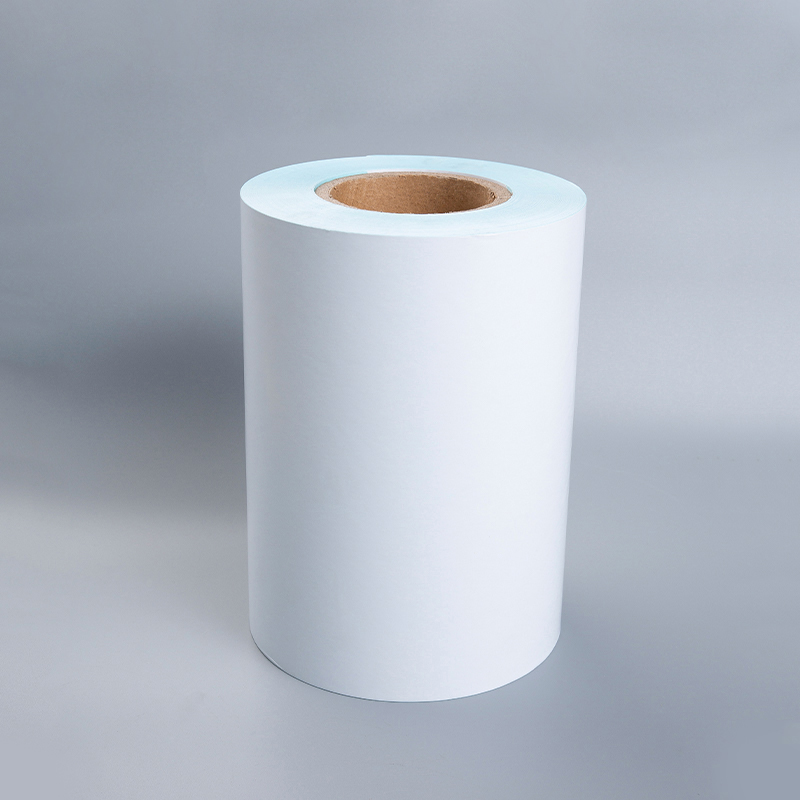
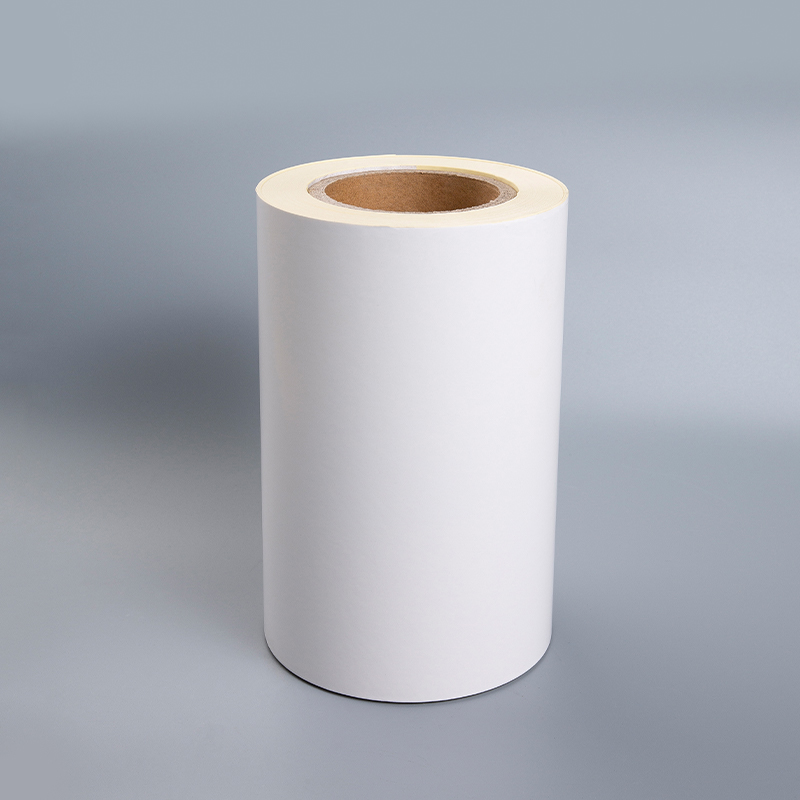
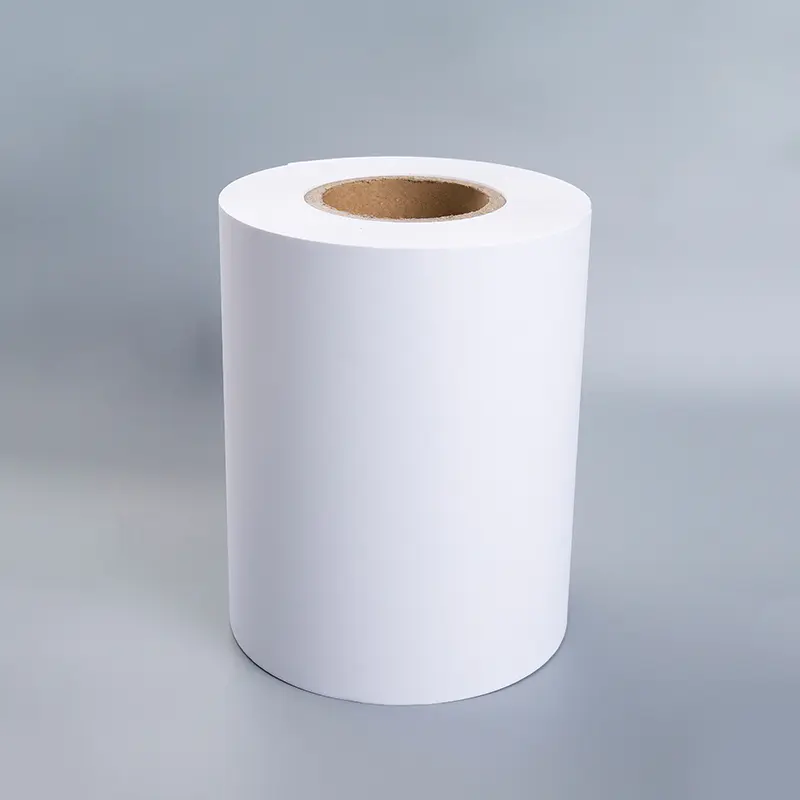
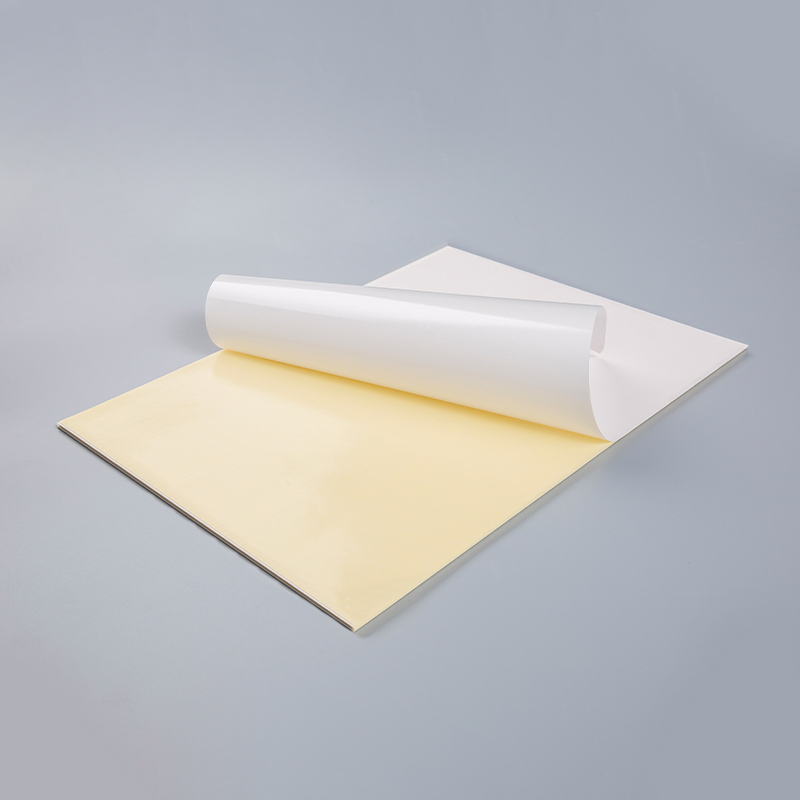
عربىYellow glassine paper is a precision release-base material designed for demanding label, tape, packaging, and self-adhesive applications. It combines smoothness, density, dimensional stability, and reliable release performance in a form that supports high-speed converting and automatic labeling. In modern production environments, where efficiency, clean die-cutting, and stable material behavior directly influence profitability, yellow glassine paper has become a preferred choice for manufacturers of bar code labels, self-adhesive labels, specialty tapes, double-sided tapes, and release liners.
This product is especially suitable for rotary die-cutting and flat-bed die-cutting, where paper uniformity and surface consistency are essential. Its compact fiber structure, smooth surface, and controlled caliper help reduce web breaks, label edge lifting, adhesive contamination, and inconsistent peeling. Compared with many ordinary release papers, yellow glassine paper provides stronger converting reliability, better machine adaptability, and a more professional appearance for downstream products.
As part of a broader material portfolio covering self-adhesive paper, self-adhesive film, special label materials, and silicone release paper, yellow glassine paper plays an important supporting role in label and adhesive product systems. It serves not merely as a backing material but as a functional engineering layer that protects adhesive, enables clean separation, supports accurate cutting, and improves the final user experience.
Content
- 1 Understanding Yellow Glassine Paper
- 2 Core Product Specifications
- 3 Why Yellow Glassine Paper Matters in Self-Adhesive Systems
- 4 Advantages Over Ordinary Release Papers
- 5 Applications in Food Packaging
- 6 Applications in Medicine and Healthcare Packaging
- 7 Applications in Industrial Adhesive Products
- 8 High-Speed Automatic Labeling Performance
- 9 Rotary and Flat-Bed Die-Cutting Suitability
- 10 Manufacturing Strength Behind the Product
- 11 Advanced Production Processes
- 12 Quality Control as a Competitive Advantage
- 13 Customization and OEM/ODM Capability
- 14 Sustainable Development and Environmental Responsibility
- 15 Packaging and Delivery Protection
- 16 International Supply Capability
- 17 How Yellow Glassine Paper Improves Converter Efficiency
- 18 Comparison With Alternative Liner Materials
- 19 Recommended Selection Considerations
- 20 Q&A Section
- 20.1 What is yellow glassine paper mainly used for?
- 20.2 Why is glassine paper preferred for release liner applications?
- 20.3 What makes the yellow color useful?
- 20.4 Is yellow glassine paper suitable for high-speed automatic labeling?
- 20.5 Can the product be used for rotary and flat-bed die-cutting?
- 20.6 What basis weights are available?
- 20.7 Can sizes be customized?
- 20.8 How does this material compare with ordinary release paper?
- 20.9 What manufacturing strengths support product quality?
- 20.10 Is the product suitable for international shipment?
- 21 Conclusion
- 22 References
Understanding Yellow Glassine Paper
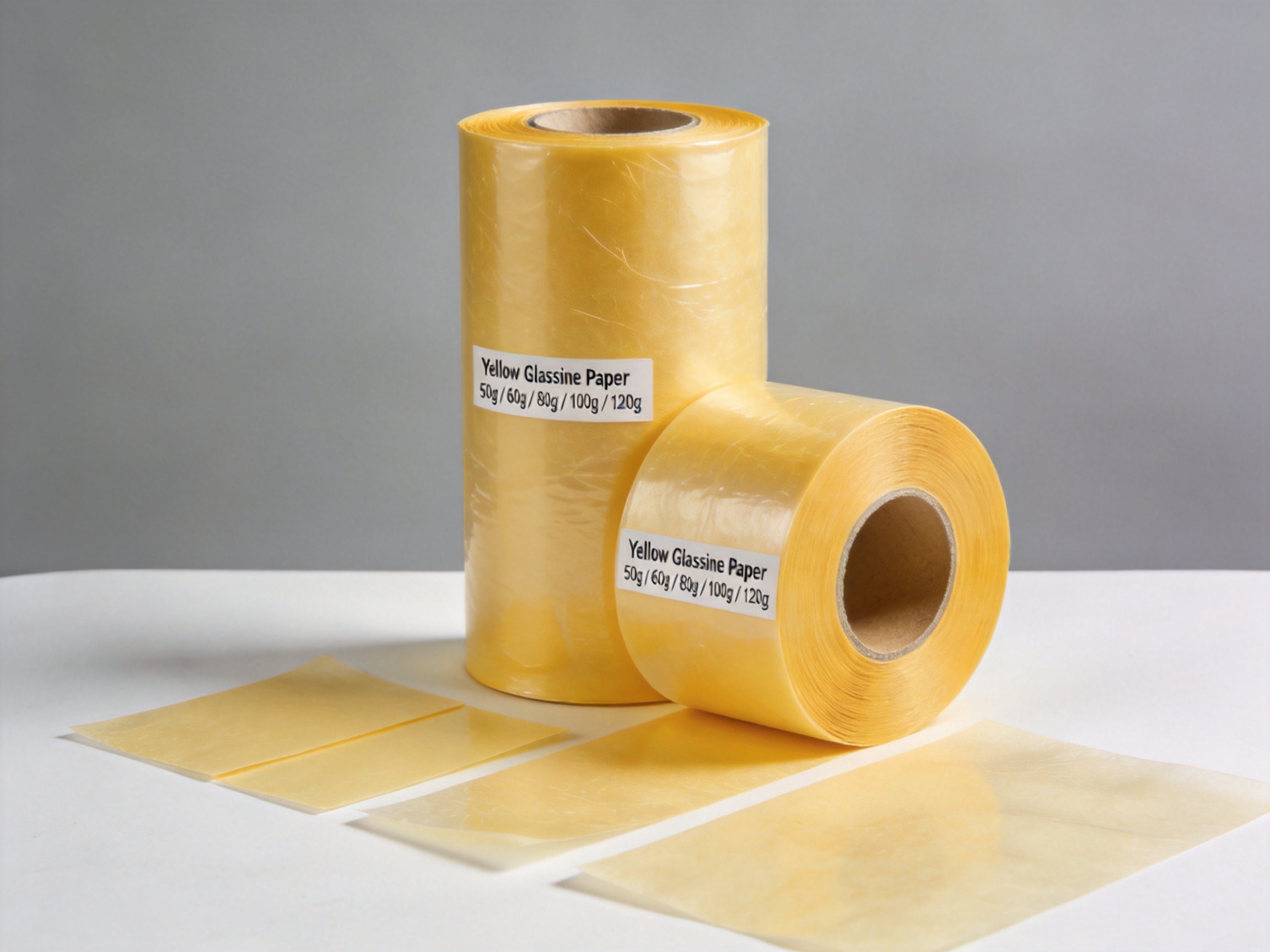
Glassine paper is a highly refined, dense, and smooth paper manufactured through specialized papermaking and finishing processes. It is typically supercalendered to achieve high transparency or translucency, excellent smoothness, and a compact structure. Yellow glassine paper refers to glassine paper produced in a yellow shade, which may be selected for identification, contrast, customer preference, process control, or product differentiation.
In release applications, glassine paper is often coated with silicone or used as a base for silicone release treatment. The resulting material can act as a release liner for labels, tapes, medical packaging, food packaging components, industrial adhesive products, and other pressure-sensitive systems. The liner protects the adhesive before use and allows the label or adhesive layer to be peeled away smoothly when required.
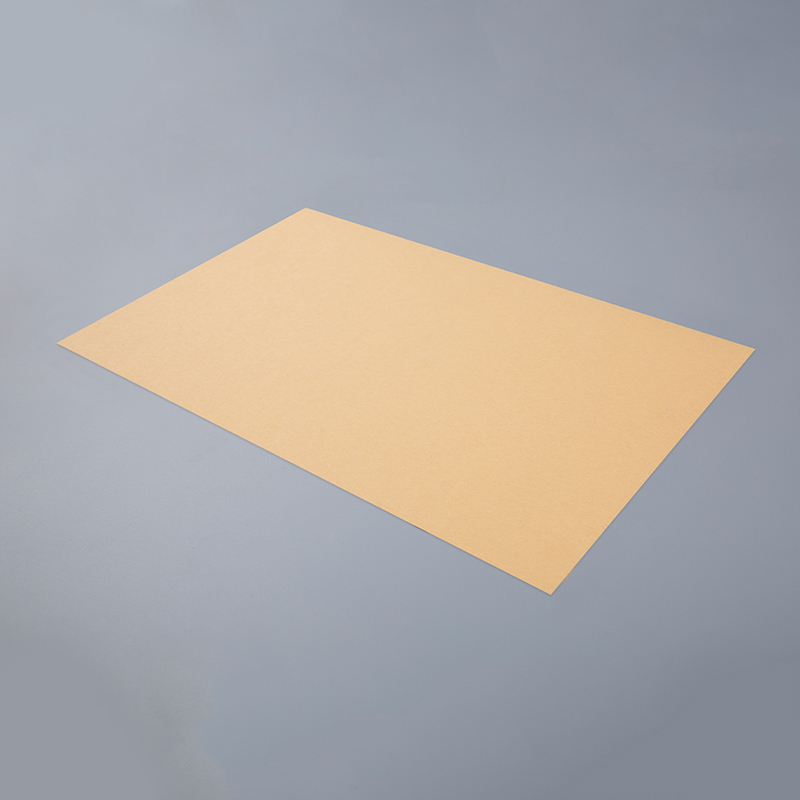
The yellow color offers practical value in production and logistics. It makes the liner easy to identify during converting, inspection, and application. In automated label operations, contrast between the face material and the release liner can assist operators in detecting web alignment, edge quality, and separation behavior. In warehouses, yellow liners also help distinguish specific product grades, release forces, or customer specifications.
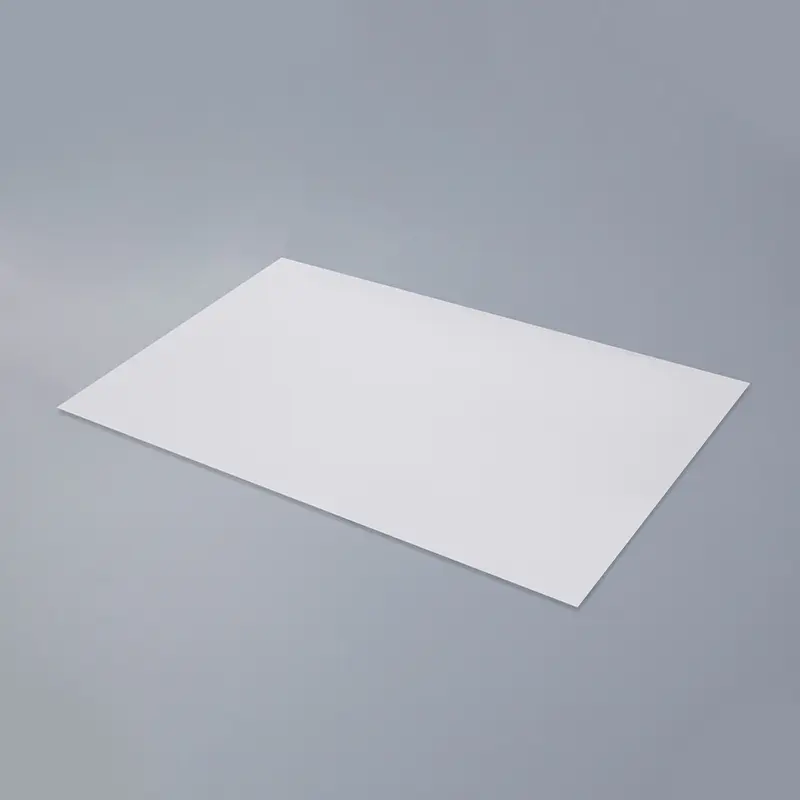
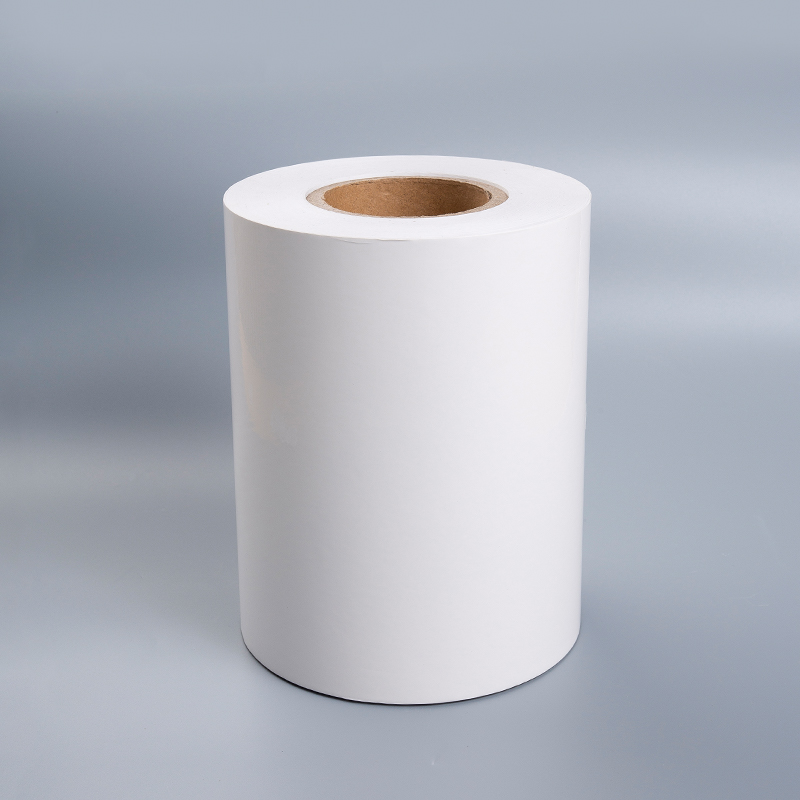
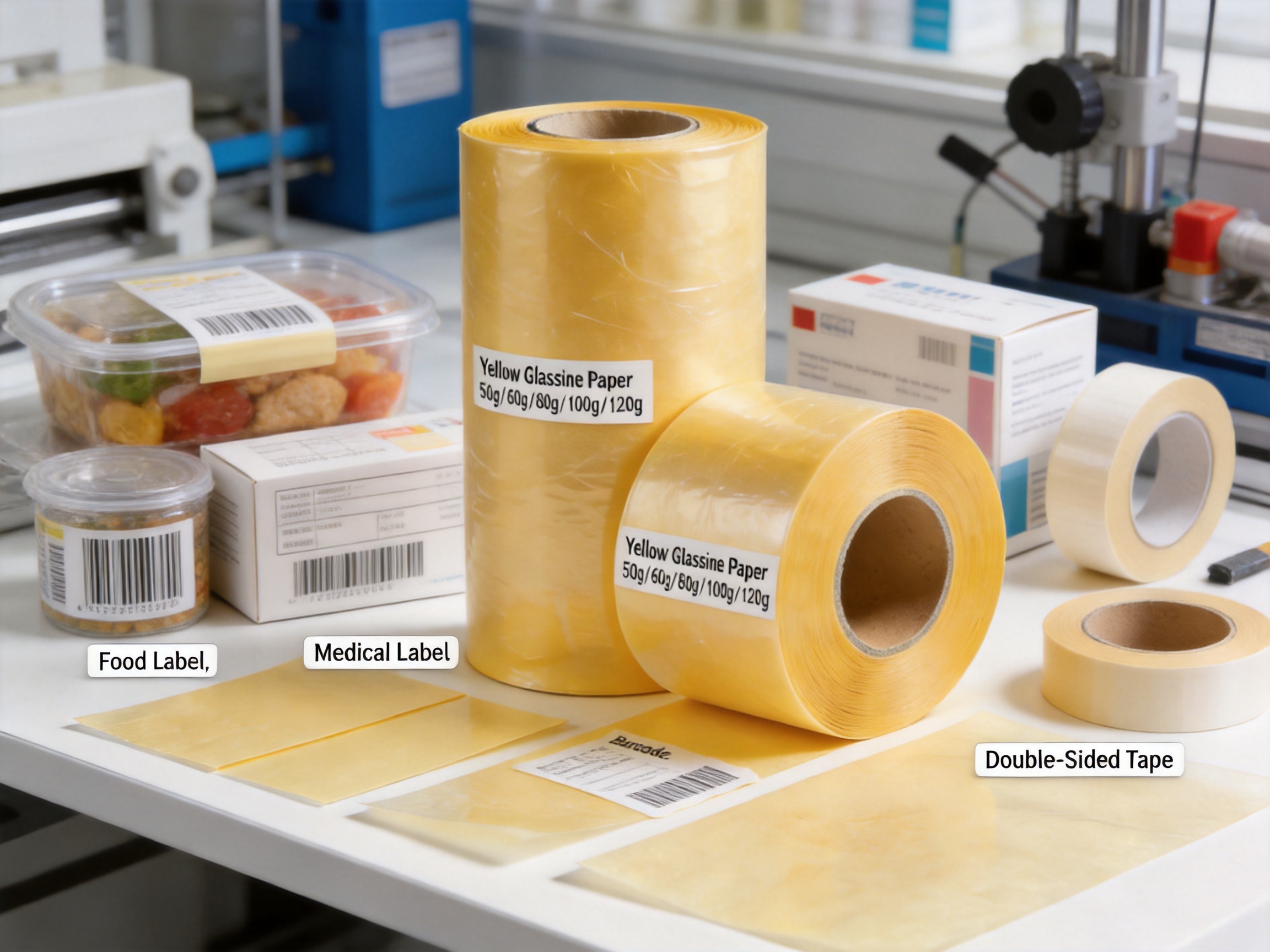
Yellow glassine paper is available in common basis weights such as 50 g, 60 g, 80 g, 100 g, and 120 g, giving customers flexibility according to their product design. Lighter weights may be used for cost-sensitive or flexible label constructions, while heavier weights can support improved rigidity, stability, and handling performance. Jumbo roll widths such as 1000 mm, 1020 mm, 1080 mm, and 1530 mm enable efficient slitting and converting. Sheet sizes such as A4, A3, 20 x 30, 21 x 30, 24 x 36, 50 cm x 70 cm, and 70 cm x 100 cm can also be supplied, with customization available for special requirements.
Core Product Specifications
Item |
Specification |
Practical Value |
Material |
Glassine paper |
Dense, smooth, and suitable for release liner and label applications |
Available Basis Weights |
50 g, 60 g, 80 g, 100 g, and 120 g |
Supports different converting, rigidity, and cost requirements |
Color |
Yellow, with white also available |
Improves identification, contrast, and product differentiation |
Jumbo Roll Width |
1000 mm, 1020 mm, 1080 mm, and 1530 mm |
Suitable for high-volume slitting, laminating, coating, and converting |
Sheet Sizes |
A4, A3, 20 x 30, 21 x 30, 24 x 36, 50 cm x 70 cm, 70 cm x 100 cm, customized sizes |
Meets printing, packaging, sample, and specialty processing needs |
Typical Applications |
Bar code labels, self-adhesive labels, tapes, double-sided tapes, industrial adhesive products |
Provides reliable release, clean die-cutting, and stable machine performance |
Packaging Options |
Roll or sheet packing, poly-wood pallet packing, carton packing, kraft paper wrapping, stretch film, fastening belt |
Protects product during storage, sea transport, and long-distance delivery |
Why Yellow Glassine Paper Matters in Self-Adhesive Systems
In a pressure-sensitive label or tape construction, the release liner is sometimes underestimated because it is removed before final use. However, the liner strongly affects converting speed, waste rate, adhesive protection, cutting accuracy, and dispensing performance. A weak or inconsistent liner can cause label lifting, poor die-cutting, matrix stripping failure, adhesive transfer, curl, or tearing during application.
Yellow glassine paper helps solve these problems by providing a uniform and dense base. Its smooth surface allows controlled silicone coating, which contributes to predictable release force. Its compact structure helps resist adhesive penetration. Its strength allows it to travel through converting machines at high speed while maintaining dimensional stability. These properties make it a dependable material for industrial label converters and tape manufacturers.
For bar code labels, a stable liner is vital. Bar code labels are often produced in large quantities and applied automatically to cartons, bottles, medical products, food packages, logistics labels, retail goods, and industrial components. If the liner tears or releases unevenly during dispensing, the labeling line may stop. Yellow glassine paper reduces this risk by supporting smooth peeling and consistent tension control.
For self-adhesive labels, the liner must protect the adhesive until the label is applied. If the paper is too porous or uneven, adhesive may migrate, leading to blocking or weak label performance. Glassine paper offers the density and smoothness required to preserve adhesive integrity. For special tapes and double-sided tapes, release performance is even more important because both adhesion and unwind behavior must be controlled. Yellow glassine paper can be engineered to meet these release needs.
Advantages Over Ordinary Release Papers
Yellow glassine paper has several advantages compared with ordinary kraft release papers, lower-density base papers, and inconsistent release liners. The first advantage is superior smoothness. Smoothness directly affects silicone coating uniformity and release consistency. A rough paper surface may require more coating material and can produce uneven release values. Glassine paper, because of its refined and calendered surface, supports a more consistent coating layer and cleaner release behavior.
The second advantage is excellent density. Dense paper reduces adhesive penetration and improves barrier properties. This is important for pressure-sensitive adhesive systems because adhesive migration can cause product defects. A dense glassine structure keeps the adhesive on the intended side of the laminate and helps maintain proper separation during application.
The third advantage is better die-cutting performance. In label production, die-cutting must cut through the face material and adhesive without cutting deeply into the liner. If the liner is inconsistent, dies may either fail to cut properly or cut too deeply, leading to liner breakage. Yellow glassine paper provides controlled thickness and strength, allowing converters to achieve cleaner cuts and more stable matrix removal.
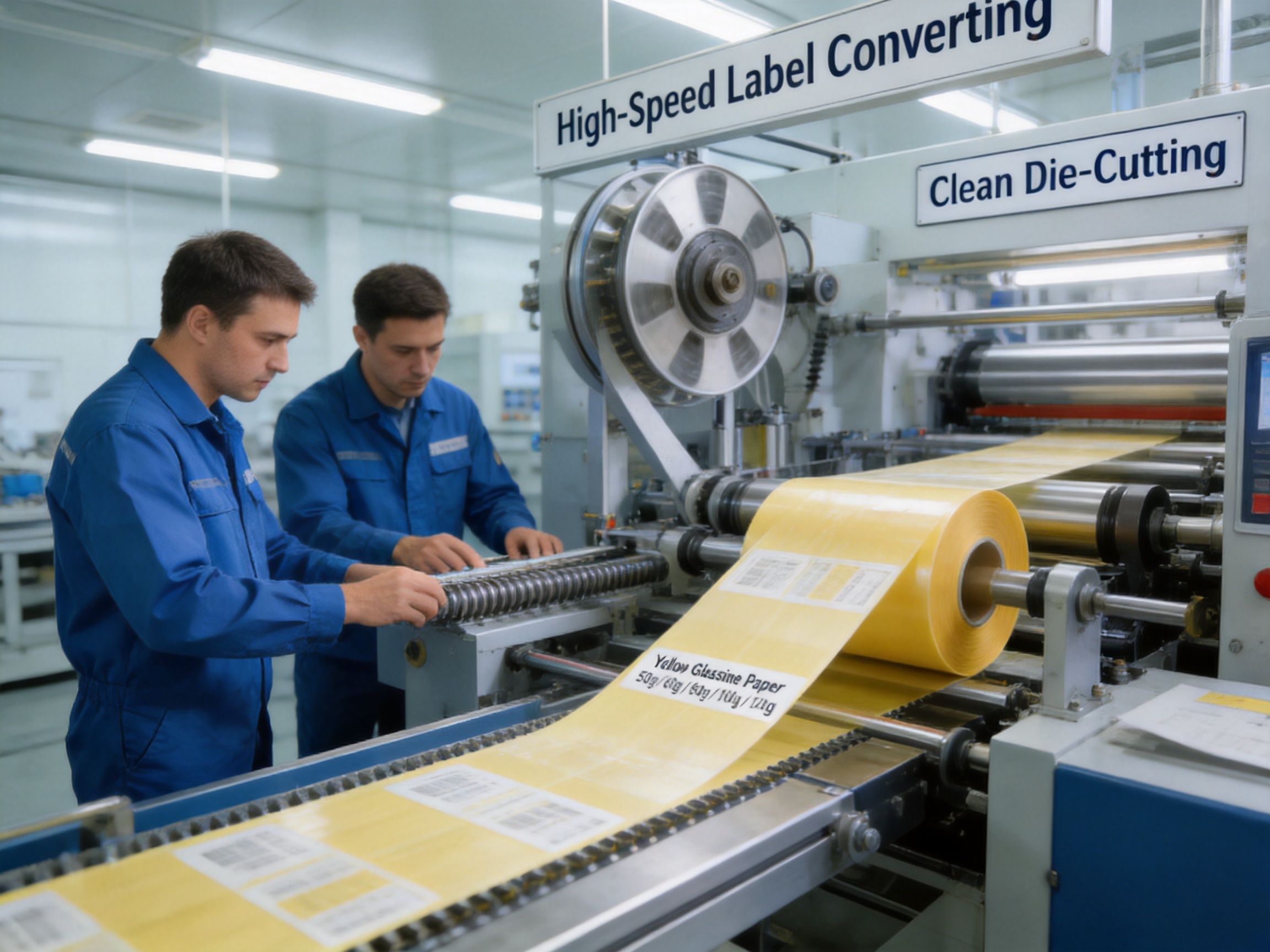
The fourth advantage is high-speed compatibility. Modern label and tape factories operate fast equipment to reduce unit cost. Materials that cannot tolerate high speed create downtime and waste. Yellow glassine paper is designed for rotary and flat-bed die-cutting, making it suitable for efficient converting lines. Its stable web behavior helps maintain productivity during continuous production.
The fifth advantage is improved visual identification. Yellow color is easy to distinguish from many white face stocks and other liners. This helps operators, warehouse staff, and quality inspectors quickly identify the material. In factories handling many similar rolls, color coding can reduce mix-ups and improve process control.
The sixth advantage is flexible availability. With multiple basis weights, roll widths, and sheet sizes, yellow glassine paper can be adapted to different markets. Whether a customer requires jumbo rolls for large-scale converting or sheets for special packaging and printing needs, the material can be supplied according to the application.
Applications in Food Packaging
Food packaging requires materials that support clean processing, reliable labeling, and efficient product identification. Yellow glassine paper is widely used in food-related label applications because it enables stable production of self-adhesive labels used on food containers, cartons, bottles, bags, and sealing components. The liner protects the adhesive before application and allows the label to separate cleanly during automatic labeling.
In food packaging factories, speed and hygiene are major priorities. Labeling machines often operate continuously, and interruptions can affect the entire packaging line. A release liner that tears, curls, or releases inconsistently can stop production. Yellow glassine paper supports smoother dispensing and reduces unexpected downtime. Its surface consistency also helps label manufacturers produce rolls with accurate release properties.
Labels used in food packaging may carry bar codes, batch numbers, expiration dates, branding, ingredient information, and safety marks. When the label construction is stable, printing and application quality improve. Although the liner is discarded after application, it plays a key role in protecting the adhesive and maintaining the label’s shape before use.
Yellow glassine paper can also support specialty adhesive constructions for cold-chain packaging, fresh food logistics, and retail labeling. These applications may require careful balance between adhesive tack, label stiffness, and release force. The uniform surface of glassine paper helps manufacturers maintain that balance during production.
Applications in Medicine and Healthcare Packaging
Medical and pharmaceutical packaging requires high reliability. Labels used in these industries may identify medicines, laboratory samples, diagnostic products, medical devices, and healthcare packages. Failure in labeling can create serious risks, including misidentification, tracking errors, or regulatory issues. For this reason, the release liner used in medical label production must be dependable and consistent.
Yellow glassine paper is suitable for medicine-related packaging labels because it supports clean die-cutting, stable printing processes, and precise automatic application. Bar code labels and information labels in pharmaceutical packaging are often applied at high speed. A consistent liner helps ensure that each label releases at the correct moment and adheres accurately to the package.
The material’s smoothness and density are also important for specialty medical adhesive systems. Some medical labels and tapes require controlled release to prevent damage during handling. Yellow glassine paper can serve as a practical base for silicone release coating, helping manufacturers create release liners that meet specific peel requirements.
In healthcare logistics, label clarity and accurate application are essential. By supporting reliable label production and dispensing, yellow glassine paper contributes indirectly to traceability, safety, and operational efficiency.
Applications in Industrial Adhesive Products
Industrial adhesive products often face more demanding mechanical requirements than ordinary consumer labels. They may be used in electronics, automotive components, building materials, appliances, logistics, protective films, and assembly tapes. Double-sided tapes, specialty tapes, foam tapes, transfer tapes, and protective adhesive materials all require liners that can protect adhesive layers and separate cleanly when needed.
Yellow glassine paper is well suited to these applications because of its strength, smooth surface, and stable release behavior. In double-sided tape production, release liners must sometimes withstand winding pressure, slitting, lamination, and long storage. A weak liner can wrinkle or tear, causing waste. A dense glassine liner can support tighter rolls and cleaner slitting.
For special tapes, release requirements may vary from easy release to medium or controlled release. Yellow glassine paper can be used as a base for release treatment designed according to the adhesive type and final application. Its uniformity helps achieve reproducible release values across the roll width and length.
Industrial manufacturers also value process efficiency. Materials that perform consistently reduce operator adjustments and machine stoppages. Yellow glassine paper therefore offers not only product quality but also production economy.
High-Speed Automatic Labeling Performance
One of the most important benefits of yellow glassine paper is its suitability for high-speed automatic labeling. In automatic labeling, labels are peeled from the liner as the web passes over a dispensing edge. The liner must bend sharply while the label separates and transfers to the product surface. If the liner lacks strength or has inconsistent release, labels may fail to dispense correctly.
Yellow glassine paper provides a combination of flexibility, tensile strength, and release stability. This makes it suitable for packaging lines where labels must be applied rapidly and accurately. It helps prevent missed labels, double feeds, edge lifting, and web breaks.
High-speed labeling also requires stable roll quality. The liner must wind evenly, maintain tension, and resist curling. Yellow glassine paper’s uniform structure contributes to smooth roll handling and predictable machine operation. For label converters, this means fewer customer complaints and stronger product reputation. For end users, it means fewer interruptions and more consistent packaging output.
Automatic labeling is common in food, medicine, cosmetics, logistics, retail, electronics, and general manufacturing. Across these industries, the release liner’s performance can determine whether a label construction works successfully on the customer’s equipment. Yellow glassine paper is designed to meet this practical demand.
Rotary and Flat-Bed Die-Cutting Suitability
Die-cutting is a critical process in label and adhesive product manufacturing. Rotary die-cutting is widely used for high-speed roll label production, while flat-bed die-cutting is often used for sheets, specialty shapes, or lower-volume precision work. Yellow glassine paper performs well in both processes because of its smoothness, strength, and thickness consistency.
During rotary die-cutting, the die must cut the face stock and adhesive but leave the liner intact. If the liner is too soft, uneven, or weak, the die may penetrate too deeply, causing liner cuts and web breaks. If the liner surface is inconsistent, die pressure may need frequent adjustment. Yellow glassine paper provides a stable base that supports accurate cutting depth and continuous production.
During flat-bed die-cutting, pressure is applied in cycles. The liner must withstand repeated cutting impact and maintain sheet stability. Yellow glassine paper helps reduce tearing and improves edge quality. It also supports cleaner stripping of waste matrix, which is important for label appearance and production efficiency.
For specialty label shapes, accurate die-cutting is essential. Poor liner quality can distort the label or cause adhesive stringing. A high-quality glassine liner supports clean edges and reliable separation, which improves both visual quality and application performance.
Manufacturing Strength Behind the Product
High-quality yellow glassine paper depends not only on raw material selection but also on advanced production management. The manufacturer behind this product specializes in high-grade self-adhesive labels and related composite materials, integrating research and development, production, sales, and after-sales service. This integrated structure allows the company to understand the complete value chain, from base paper and coating to laminating, slitting, packaging, and customer application.
The company operates a full range of production lines, including gluing, laminating, and cutting. Such vertical capability is important because release paper and self-adhesive materials require close control over multiple process stages. Coating uniformity, adhesive compatibility, web tension, drying, slitting accuracy, and packaging protection all influence final product quality. By managing these processes internally, the company can respond quickly to customer requirements and maintain stable quality.
With an annual production capacity exceeding 280 million square meters, the company has the scale required to support large orders and long-term supply agreements. Large production capacity also means better scheduling flexibility, stronger inventory support, and the ability to serve customers in different industries. For customers who require continuous supply, this production strength reduces procurement risk.
The company has more than 20 years of OEM manufacturing experience, giving it deep familiarity with customized specifications, customer drawings, special samples, and industry-specific performance requirements. This experience is especially important in release liner applications, where small changes in adhesive type, label construction, or machine speed can require adjustments to material properties.
Advanced Production Processes
The production of yellow glassine paper and related self-adhesive materials involves several controlled processes. Although exact process settings depend on customer requirements, the key manufacturing strengths include material selection, surface treatment, coating, laminating, cutting, inspection, and packaging.
Material selection begins with choosing an appropriate glassine base. The base paper must have proper basis weight, smoothness, density, tensile strength, and moisture profile. Inconsistent base paper can lead to coating defects or converting problems. By focusing on high-grade materials, the manufacturer improves the reliability of downstream applications.
Surface preparation and coating are essential for release performance. When used as a release liner, glassine paper may receive a silicone coating or related release treatment. Uniform coating is necessary to achieve predictable release force. Advanced coating control reduces streaks, pinholes, uneven silicone distribution, and release variation.
Laminating capability allows the company to combine face materials, adhesives, and liners into self-adhesive constructions. This is important because yellow glassine paper is often part of a larger label material system. Proper laminating requires controlled pressure, temperature, web alignment, and tension. A well-laminated material reduces curl, bubbles, wrinkles, and adhesive defects.
Cutting and slitting determine whether the material is easy for customers to use. Jumbo rolls must be slit accurately to customer widths. Sheets must be cut cleanly and stacked properly. Poor slitting can cause edge dust, telescoping, web breaks, and label defects. The company’s cutting capabilities help provide rolls and sheets that support efficient customer production.
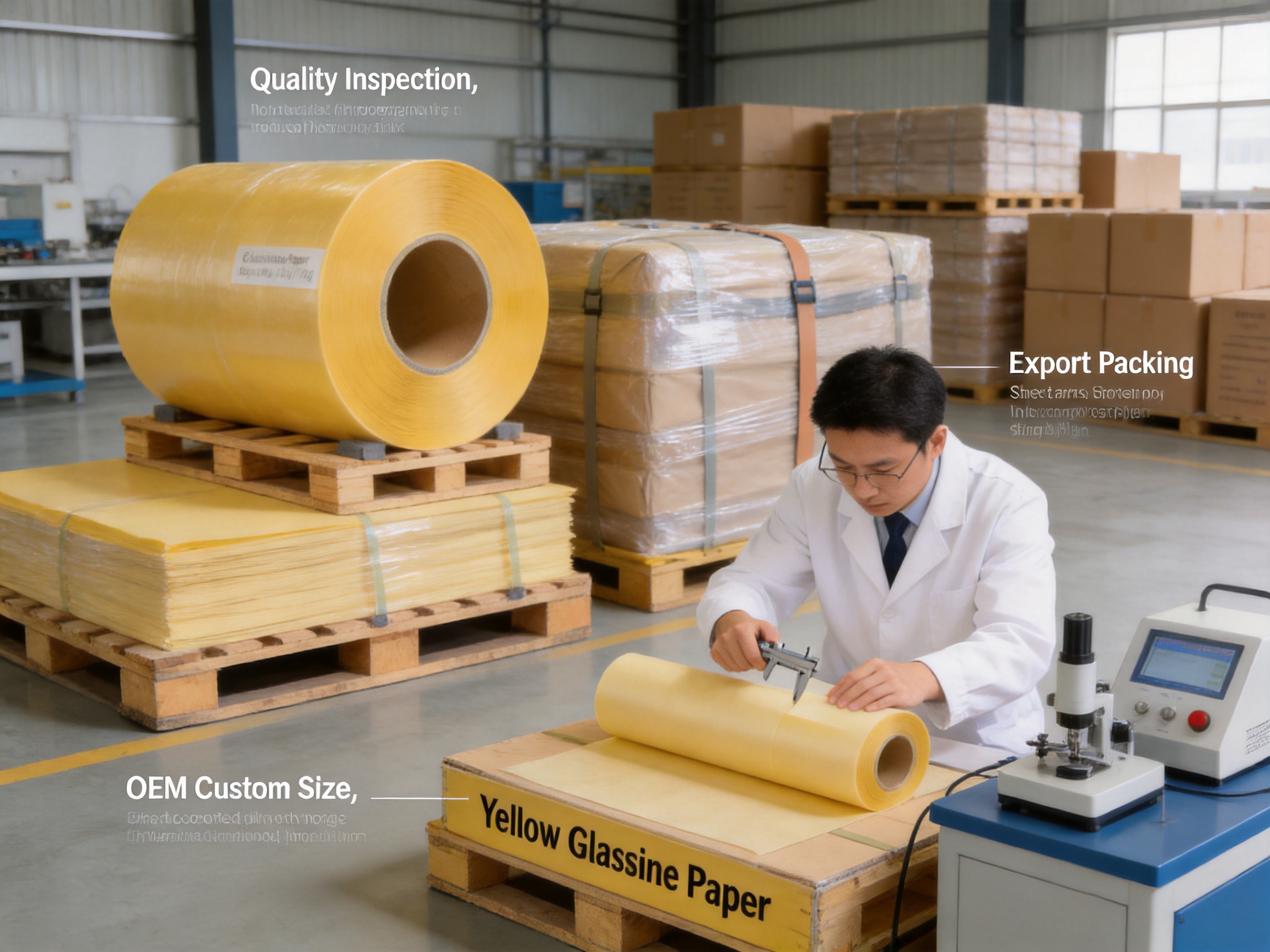
Inspection and testing ensure that each batch meets quality expectations. The company’s own testing laboratory and advanced inspection equipment support quality control. Testing may involve basis weight, thickness, release force, tensile strength, surface quality, coating uniformity, moisture content, and roll appearance. Strong inspection reduces the risk of hidden defects reaching customers.
Quality Control as a Competitive Advantage
In the self-adhesive material industry, quality is measured not only by laboratory data but also by machine performance. A material may look acceptable but still fail during high-speed converting or automatic labeling. Therefore, quality control must consider both physical properties and practical usability.
Yellow glassine paper benefits from a manufacturing system that emphasizes consistency. Consistent basis weight helps maintain die-cutting settings. Consistent thickness supports stable roll tension. Consistent surface smoothness improves coating uniformity. Consistent release behavior allows labels and tapes to separate cleanly. Consistent packaging protects the material until it reaches the customer.
The company’s testing laboratory allows problems to be detected before shipment. Advanced inspection equipment supports early identification of defects such as wrinkles, coating streaks, contamination, uneven edges, or roll deformation. This proactive approach is superior to relying only on customer feedback after problems occur.
Quality control also supports customization. When customers request OEM or ODM solutions, the manufacturer can test samples, compare performance, adjust specifications, and verify results. This technical capability allows customers to develop materials that match their own equipment and end-use conditions.
Compared with competitors that only trade materials or outsource key production steps, an integrated manufacturer with testing and production control can provide more dependable products. This is especially valuable for international customers who need stable quality across repeated shipments.
Customization and OEM/ODM Capability
Yellow glassine paper is not a one-size-fits-all product. Different customers may require different basis weights, roll widths, sheet sizes, colors, release forces, packaging styles, and performance properties. OEM and ODM capability allows the manufacturer to provide customized solutions based on customer drawings, samples, or application requirements.
For example, a label converter producing high-speed bar code labels may need a lighter liner with excellent die-cutting performance and easy release. A double-sided tape manufacturer may require a heavier liner with controlled release and strong dimensional stability. A pharmaceutical label customer may need strict batch consistency and clean packaging. A food packaging customer may need large-volume supply with reliable automatic labeling performance.
Customization can involve the selection of 50 g, 60 g, 80 g, 100 g, or 120 g glassine paper. It can also involve choosing jumbo roll widths such as 1000 mm, 1020 mm, 1080 mm, or 1530 mm to improve slitting efficiency. For sheet applications, custom sizes can reduce waste and improve workflow.
OEM experience also improves communication. Customers often describe problems in practical terms, such as label lifting, liner tearing, poor matrix stripping, excessive release force, or adhesive transfer. An experienced manufacturer can translate these problems into technical adjustments and recommend suitable material solutions.
ODM capability further supports innovation. With a professional research and development team and multiple patents, the company can develop new material structures, eco-friendly options, and improved release systems. This allows customers to respond to market trends rather than remain limited to standard materials.
Sustainable Development and Environmental Responsibility
Sustainability has become an important priority in label and packaging materials. Customers increasingly seek eco-friendly solutions that reduce waste, improve recyclability, and support responsible production. Yellow glassine paper can contribute to sustainability when produced and used within a responsible material system.
The company’s brand positioning emphasizes sustainable development and environmental protection. It develops eco-friendly solutions involving face materials, adhesives, and backing papers. This approach is important because sustainability in self-adhesive products cannot be solved by one layer alone. The face material, adhesive, and liner must be considered together.
Glassine paper is paper-based, which can be advantageous compared with some plastic release liners in applications where paper liners are preferred. Its high strength and stable performance may also reduce waste during converting. Fewer web breaks, fewer rejected rolls, and better die-cutting efficiency all contribute to lower material loss.
Environmental responsibility also involves manufacturing discipline. Efficient production, quality control, and proper packaging help avoid unnecessary waste. When materials arrive in good condition and perform correctly on customer machines, fewer resources are consumed in rework or replacement.
For customers with sustainability goals, the availability of customized eco-friendly solutions is a valuable advantage. The manufacturer’s R&D capability can help customers explore material choices that balance performance, cost, and environmental responsibility.
Packaging and Delivery Protection
Proper packaging is essential for glassine paper because release liner performance can be affected by moisture, deformation, edge damage, and contamination. Yellow glassine paper can be supplied in rolls or sheets, with sea-transit-worthy poly-wood pallet packing and carton packing available. This is important for customers who purchase internationally or store materials for extended periods.
For sheet products, packing may include 100 sheets per ream, with each ream packed using strong PE-coated kraft paper wrapping. This helps protect sheets from moisture and handling damage. Strong pallets wrapped with stretch film and fastened with plastic fastening belts help keep the goods secure during transport.
For roll products, pallet stability and edge protection are especially important. Rolls must remain round and undamaged. If roll edges are crushed, the material may create web breaks or slitting problems. Sea-transit-worthy packaging helps reduce transportation risk and supports long-distance delivery.
Reliable packaging is another competitive advantage because product quality must be preserved from factory to customer. A well-made product can still fail if packaging is inadequate. By offering strong packing options, the manufacturer protects customer investment and reduces logistics-related complaints.
International Supply Capability
The manufacturer has built a marketing network across many countries and regions, including markets in Asia, Europe, the Americas, Africa, the Middle East, and other regions. This international presence demonstrates the company’s ability to serve customers with different standards, applications, and procurement expectations.
For international buyers, supply stability is a major concern. They need reliable communication, consistent quality, export-ready packaging, and the ability to handle repeat orders. A manufacturer with large capacity, established production lines, and international experience can better meet these needs than smaller or less integrated suppliers.
The company’s domestic sales network also reflects strong market acceptance. Direct sales networks and franchise chains across many cities support customer service and market feedback. Such broad coverage helps the company understand changing requirements in label, packaging, and adhesive industries.
Long-term stable supplier relationships are built on quality, delivery, service, and technical support. Yellow glassine paper benefits from this broader supply platform because customers can source not only a single product but also related self-adhesive materials, films, special label materials, and silicone release papers.
How Yellow Glassine Paper Improves Converter Efficiency
Converters measure material value not only by purchase price but by total production cost. A lower-priced release paper may become expensive if it causes web breaks, die damage, matrix stripping failure, poor roll appearance, customer complaints, or high waste. Yellow glassine paper can improve converter efficiency by reducing these hidden costs.
First, stable thickness helps operators set die pressure more accurately. Once the correct die setting is found, consistent liner properties allow longer production runs without constant adjustment. This saves time and improves output.
Second, smooth release reduces matrix stripping problems. In label converting, the waste matrix must be removed cleanly after die-cutting. If release is too tight or inconsistent, the matrix may tear or lift labels. Yellow glassine paper supports cleaner matrix removal, especially when paired with appropriate silicone treatment.
Third, strong web performance reduces breaks during high-speed running. Each web break causes downtime, material waste, and operator intervention. A reliable liner helps maintain continuous operation.
Fourth, clean slitting and good roll formation improve customer satisfaction. End users expect label rolls to run smoothly on automatic equipment. A stable glassine liner contributes to neat rolls, predictable unwind, and accurate dispensing.
Fifth, color identification reduces handling errors. In busy converting plants, many materials may appear similar. Yellow liner color helps operators confirm that the correct material is being used, reducing production mistakes.
Comparison With Alternative Liner Materials
Different release liner materials have different strengths. Kraft paper liners may offer good stiffness and cost advantages, but they are often rougher and less dense than glassine. Film liners may provide excellent smoothness and moisture resistance, but they can be more expensive and may not be suitable for all paper-based label systems. Clay-coated liners may offer improved surface properties, but they may not match the density and calendered smoothness of glassine in certain release applications.
Yellow glassine paper offers a balanced solution. It combines paper-based structure with high smoothness and density. It is suitable for many label and tape applications and supports efficient coating and converting. For customers who need reliable performance without moving to higher-cost film liners, glassine paper can be an excellent choice.
In applications requiring high-speed labeling, clean die-cutting, and stable release, yellow glassine paper often provides stronger practical value than ordinary lower-grade paper liners. Its performance advantage becomes most visible during production, where fewer stoppages and cleaner converting results translate into measurable savings.
For customers comparing suppliers, it is important to evaluate not only the liner type but also the manufacturing quality. Glassine paper from an integrated manufacturer with testing, coating, laminating, and cutting capabilities can provide better consistency than materials from suppliers without process control.
Recommended Selection Considerations
When choosing yellow glassine paper, customers should consider the final application, adhesive type, face material, converting method, labeling speed, storage conditions, and packaging requirements. Basis weight is one of the first decisions. A 50 g or 60 g option may suit flexible labels and cost-sensitive applications. An 80 g option may provide a balanced choice for many label constructions. A 100 g or 120 g option may be suitable where additional strength, stiffness, or handling performance is needed.
Roll width should match converting equipment and slitting plans. Jumbo roll widths such as 1000 mm, 1020 mm, 1080 mm, and 1530 mm help optimize production efficiency. Custom widths can reduce waste if the converter has specific finished roll dimensions.
Release requirements should be discussed clearly. Easy release, medium release, and controlled release may be needed depending on the adhesive and application. For double-sided tapes, release balance can be especially important. Customers should provide samples or technical details when possible.
Packaging should be selected according to transport distance and storage environment. For export shipments, strong pallet packing and moisture-resistant wrapping are recommended. For sheet products, ream packing with protective wrappers helps preserve flatness and cleanliness.
Customers should also consider supplier capability. A strong supplier should be able to provide stable quality, technical communication, customization, inspection support, and after-sales service. The manufacturer described in this article offers these strengths through production scale, R&D capability, testing resources, and OEM/ODM experience.
Q&A Section
What is yellow glassine paper mainly used for?
Yellow glassine paper is mainly used as a release liner or release-base material for bar code labels, self-adhesive labels, tapes, double-sided tapes, sticky industrial products, and special release applications. It is also widely used in food, medicine, and packaging industries where reliable labeling and adhesive protection are required.
Why is glassine paper preferred for release liner applications?
Glassine paper is preferred because it has a dense structure, smooth surface, good strength, and stable thickness. These properties support uniform silicone coating, clean die-cutting, reliable release, and high-speed converting performance.
What makes the yellow color useful?
The yellow color improves identification, contrast, and process control. It helps operators distinguish the liner from face materials and other liners, reducing material mix-ups and improving inspection efficiency.
Is yellow glassine paper suitable for high-speed automatic labeling?
Yes. Yellow glassine paper is suitable for high-speed automatic labeling because it supports smooth peeling, stable web tension, and consistent release. These features help reduce labeling interruptions, missed labels, and web breaks.
Can the product be used for rotary and flat-bed die-cutting?
Yes. The material is especially suitable for rotary and flat-bed die-cutting. Its thickness consistency, strength, and smoothness help achieve clean cuts and stable matrix stripping.
What basis weights are available?
Common available basis weights include 50 g, 60 g, 80 g, 100 g, and 120 g. The best choice depends on the application, required stiffness, converting speed, and cost target.
Can sizes be customized?
Yes. Jumbo roll widths such as 1000 mm, 1020 mm, 1080 mm, and 1530 mm are available, and sheet sizes such as A4, A3, 20 x 30, 21 x 30, 24 x 36, 50 cm x 70 cm, and 70 cm x 100 cm can be supplied. Custom sizes can also be produced according to customer requirements.
How does this material compare with ordinary release paper?
Compared with ordinary release paper, yellow glassine paper generally offers better smoothness, higher density, more consistent release behavior, cleaner die-cutting, and stronger suitability for high-speed converting. These advantages can reduce waste and improve production efficiency.
What manufacturing strengths support product quality?
The product is supported by integrated production capabilities including gluing, laminating, cutting, inspection, and customized development. The manufacturer also has large annual capacity, more than 20 years of OEM experience, a professional R&D team, testing laboratory resources, and advanced inspection equipment.
Is the product suitable for international shipment?
Yes. Sea-transit-worthy poly-wood pallet packing and carton packing are available for rolls and sheets. Sheet products can be packed in reams with strong PE-coated kraft paper wrappers, while pallets can be wrapped with stretch film and secured with fastening belts.
Conclusion
Yellow glassine paper is a high-performance material for release, labeling, tape, and packaging applications. Its smooth surface, dense structure, stable thickness, and reliable release behavior make it especially valuable for bar code labels, self-adhesive labels, high-speed automatic labeling, rotary die-cutting, flat-bed die-cutting, special tapes, and double-sided tapes.
Compared with ordinary release papers, yellow glassine paper offers stronger process stability, better die-cutting performance, more consistent adhesive protection, and improved visual identification. These advantages help converters reduce downtime, improve product quality, and satisfy demanding end users in food, medicine, packaging, logistics, and industrial markets.
The product’s value is further strengthened by advanced manufacturing capability. Full production lines for gluing, laminating, and cutting, combined with large annual capacity, testing laboratory support, advanced inspection equipment, OEM/ODM experience, and professional R&D resources, create a dependable supply foundation. Customers can obtain not only standard yellow glassine paper but also customized solutions based on specific applications.
For manufacturers seeking a reliable release liner or glassine paper solution, yellow glassine paper provides a balanced combination of quality, efficiency, adaptability, and long-term supply confidence. It is more than a backing material; it is a critical performance layer that supports the success of modern self-adhesive products.
References
1. Pressure Sensitive Tape Council. Technical Guide to Pressure Sensitive Adhesives and Tape Constructions.
2. FINAT. Label Materials and Release Liner Technical Handbook.
3. TAPPI Press. Paper and Paperboard Manufacturing and Converting Fundamentals.
4. Handbook of Pressure-Sensitive Adhesive Technology, edited by Donatas Satas.
5. ASTM International. Standard Test Methods for Paper, Paperboard, and Release Materials.