
 English
 Español
 русский
 Français
 عربى
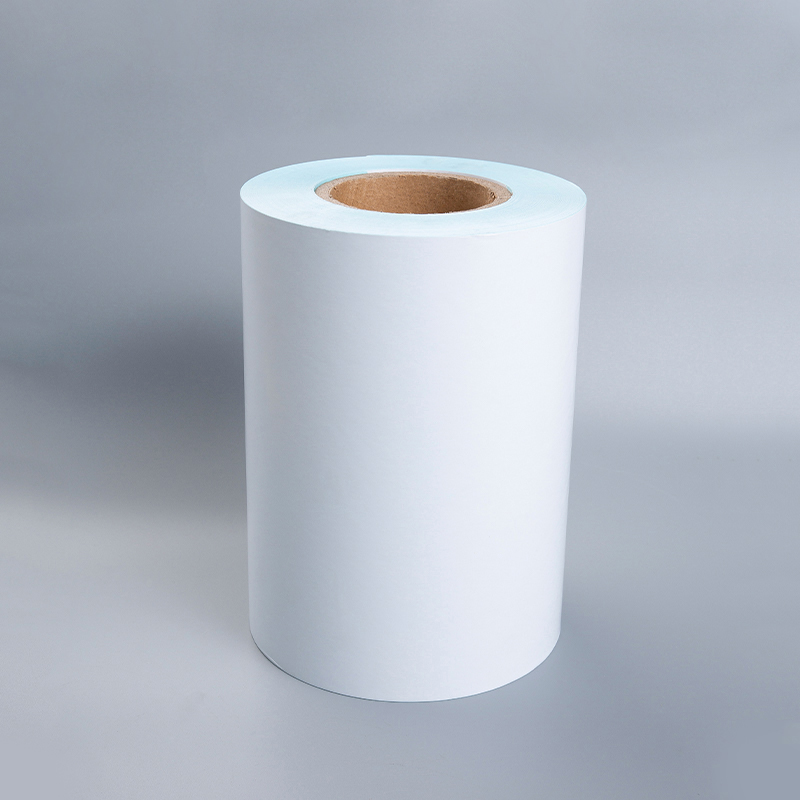
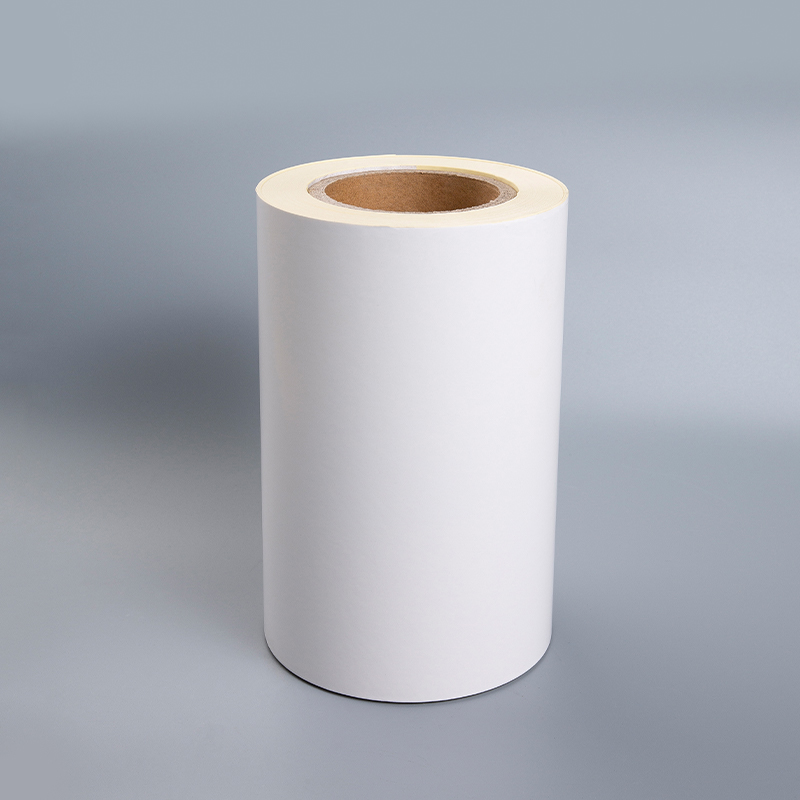
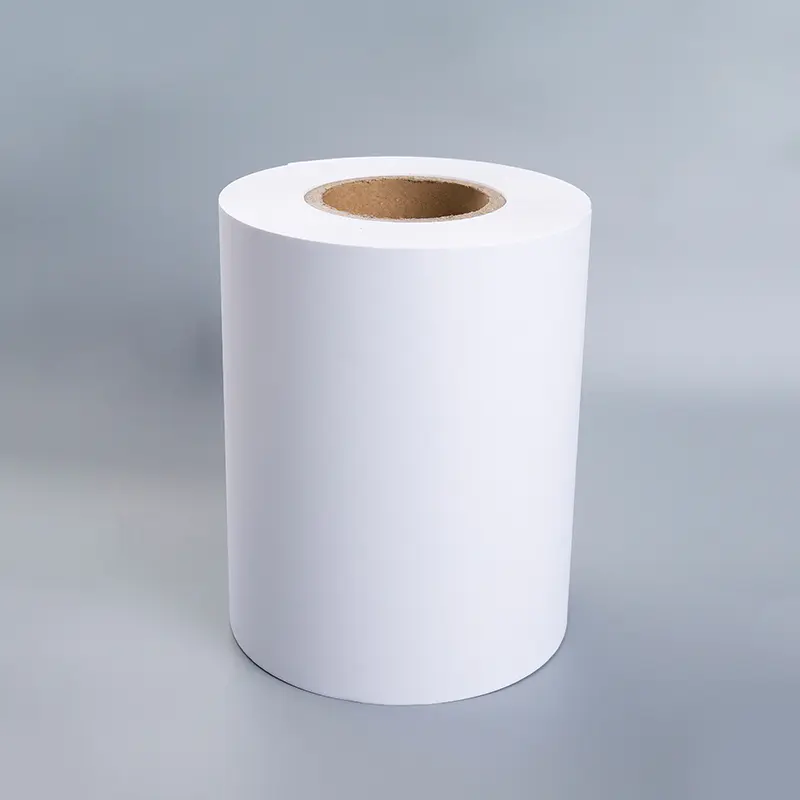
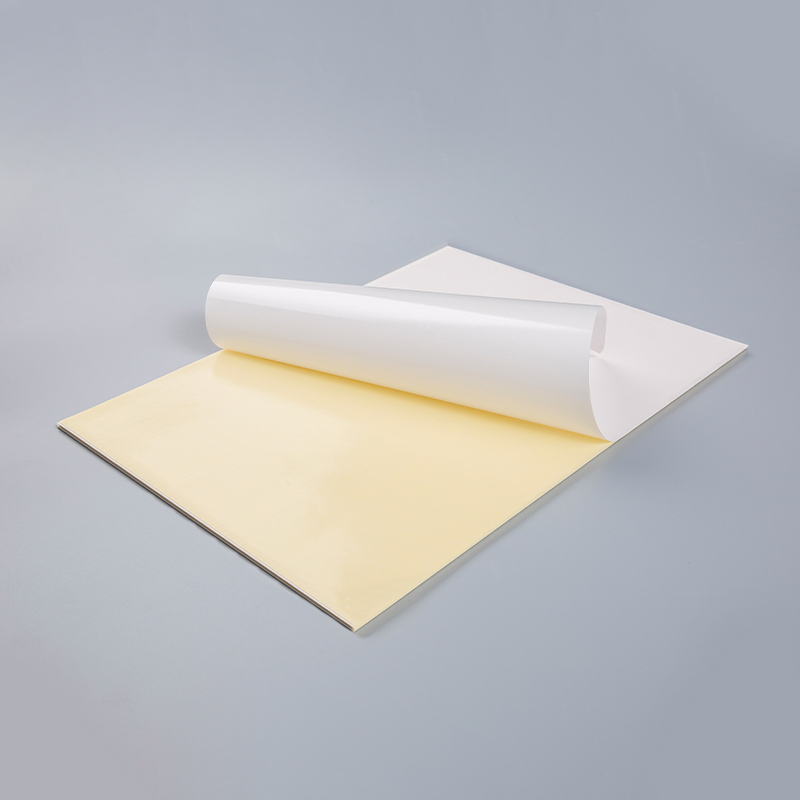
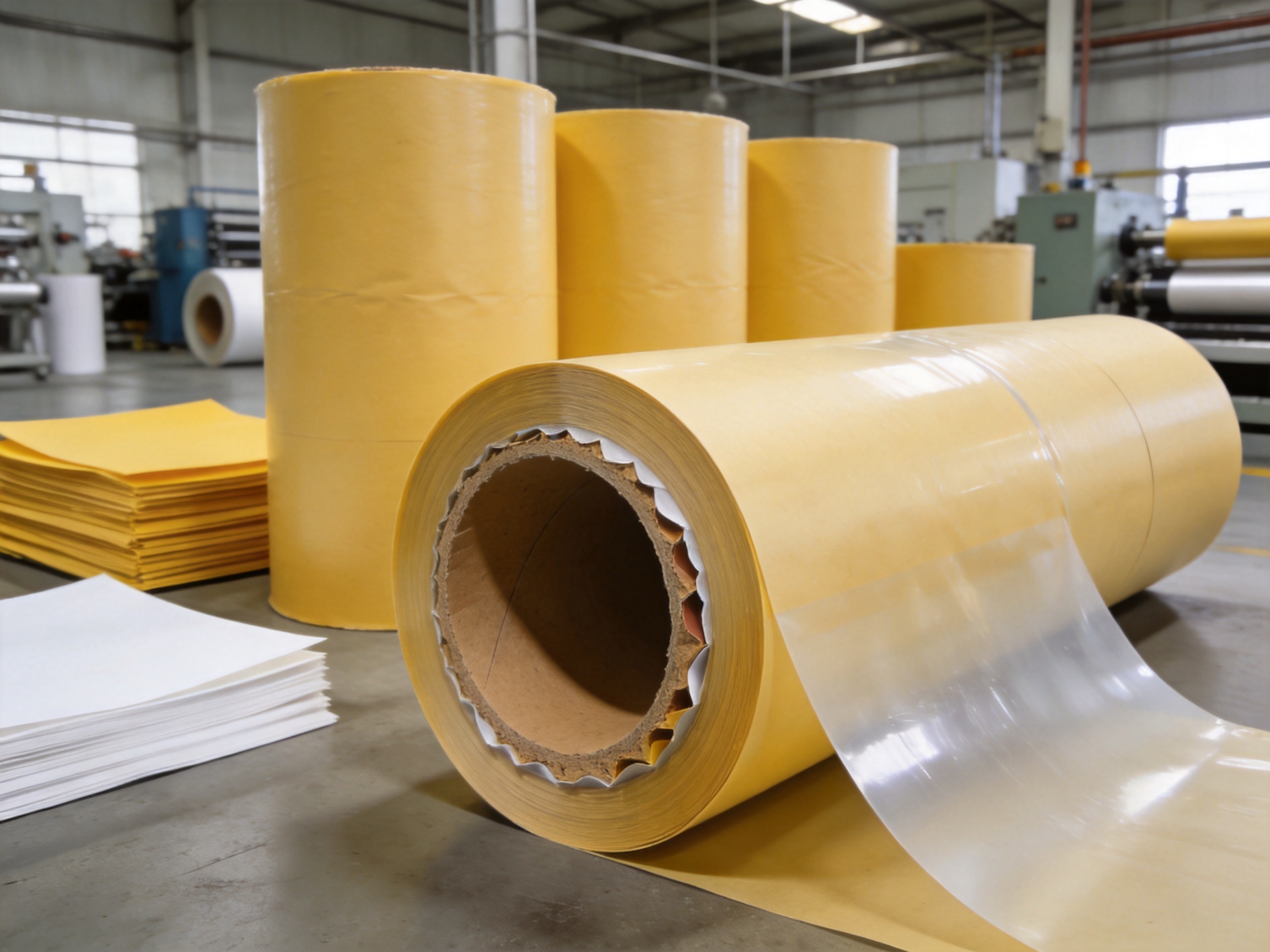
عربىYellow release paper is a specialized PE coated kraft paper engineered to provide stable support, controlled release performance, and reliable processability for adhesive labels, hot stamping foils, pressure-sensitive adhesive printing, and other converting applications. In modern label and packaging production, the backing material is not simply a disposable carrier. It directly affects printing accuracy, die-cutting quality, adhesive protection, storage stability, production speed, and final application efficiency. A well-made yellow release paper helps manufacturers reduce defects, maintain clean production lines, protect adhesive layers, and achieve consistent peeling behavior during automated and manual application.
This article focuses on the advantages, technical structure, manufacturing process, application value, and supply strengths of yellow release paper made from PE coated kraft paper. It also explains why a stable release base is essential for self-adhesive labels, special label materials, self-adhesive films, and silicone release paper systems. By combining kraft paper strength, polyethylene coating protection, and precision silicone release treatment, yellow release paper offers a balanced solution for converters that require dimensional stability, moisture resistance, smoothness, puncture resistance, clean processing, and compatibility with high-speed production equipment.
Content
- 1 Understanding Yellow Release Paper
- 2 Core Product Specifications
- 3 Why Release Paper Quality Matters
- 4 Advantages Over Ordinary Release Paper
- 5 Advanced Manufacturing Process
- 6 Material Structure and Performance Balance
- 7 Application in Label Backing
- 8 Application in Hot Stamping
- 9 Application in Pressure-Sensitive Adhesive Printing
- 10 Suitability for Medical-Grade and High-Precision Products
- 11 Packaging and International Transportation Protection
- 12 Quality Control and Consistency
- 13 Customization and OEM or ODM Capability
- 14 Manufacturing Strength and Supply Capacity
- 15 Sustainability and Safety Considerations
- 16 How Yellow Release Paper Improves Production Efficiency
- 17 Selecting the Right Grade
- 18 Competitive Value for Global Buyers
- 19 Q&A Section
- 19.1 What is yellow release paper used for?
- 19.2 Why is PE coated kraft paper suitable for release paper?
- 19.3 What advantages does yellow release paper offer over ordinary liners?
- 19.4 Can the product be supplied in customized sizes?
- 19.5 What basis weights are available?
- 19.6 Why is low paper dust important?
- 19.7 How does the silicone layer affect performance?
- 19.8 Is yellow release paper suitable for hot stamping?
- 19.9 What packaging is used for international shipment?
- 19.10 What makes the manufacturer reliable for global buyers?
- 20 Conclusion
- 21 References
Understanding Yellow Release Paper
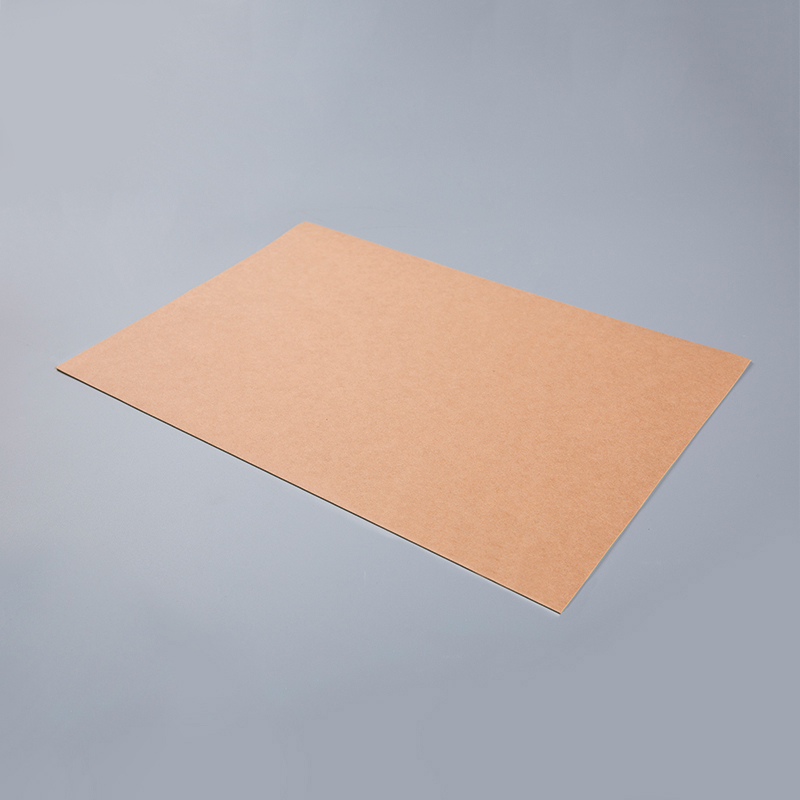
Yellow release paper is typically produced by coating kraft paper with polyethylene and then applying a controlled silicone release layer. The kraft paper provides the mechanical body and tensile strength. The PE coating improves moisture resistance, surface sealing, and barrier performance. The silicone layer creates the release function, allowing adhesives, labels, or transfer materials to separate cleanly when required. The yellow color helps with visual identification, process control, and differentiation from white release liners in production environments.
The product discussed here belongs to the PE coated kraft paper category and is available in multiple basis weights, including 50 g, 60 g, 65 g, 70 g, 80 g, 85 g, 90 g, 100 g, 120 g, 135 g, 155 g, and 240 g. This wide gram-weight range allows manufacturers to select the right stiffness, thickness, and strength according to specific converting requirements. Lightweight grades are suitable for flexible applications and cost-sensitive label production, while heavier grades are preferred where stronger support, better flatness, or improved resistance to deformation is required.
Yellow and white colors are available, but yellow release paper has particular practical benefits in factories. It can be easier to recognize during roll handling, line inspection, sample comparison, and quality control. In high-volume label production where several liners and facestocks may be processed at the same time, color differentiation reduces confusion and supports more efficient workflow management. For customers who need a custom look, process identification, or specific label backing appearance, color availability is also useful.
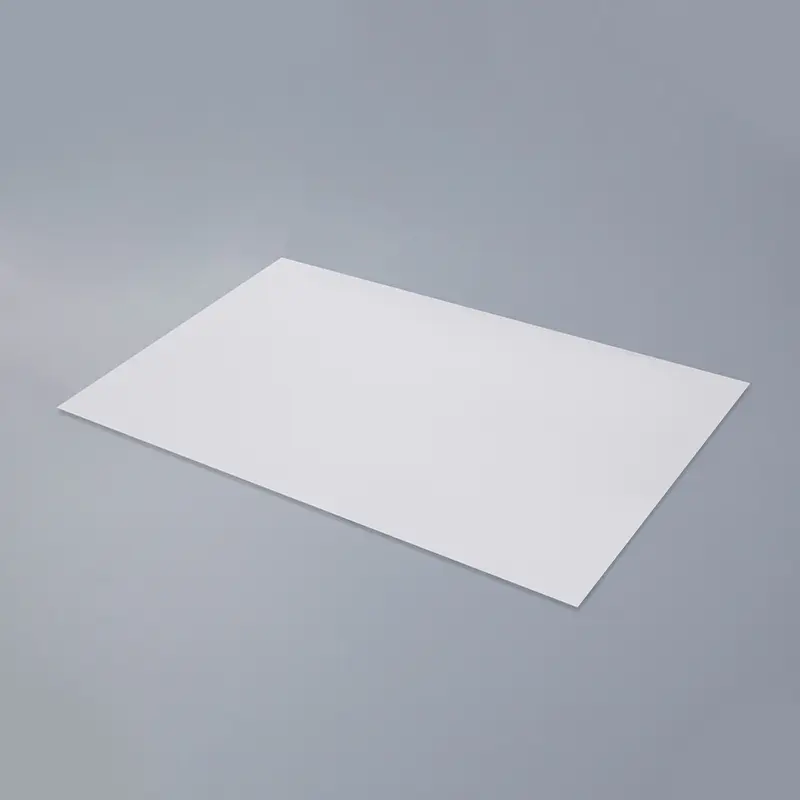
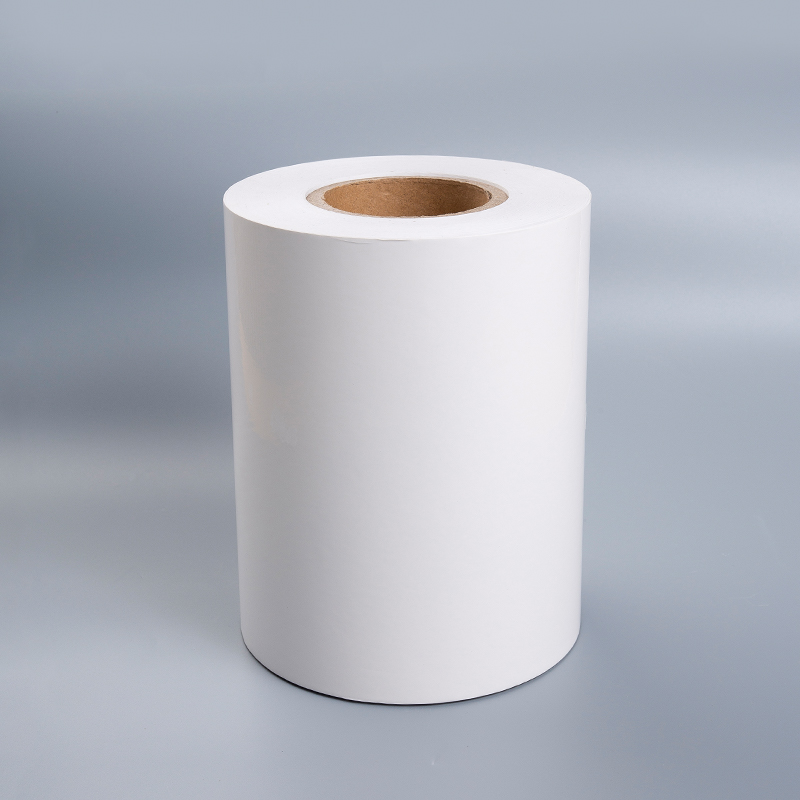
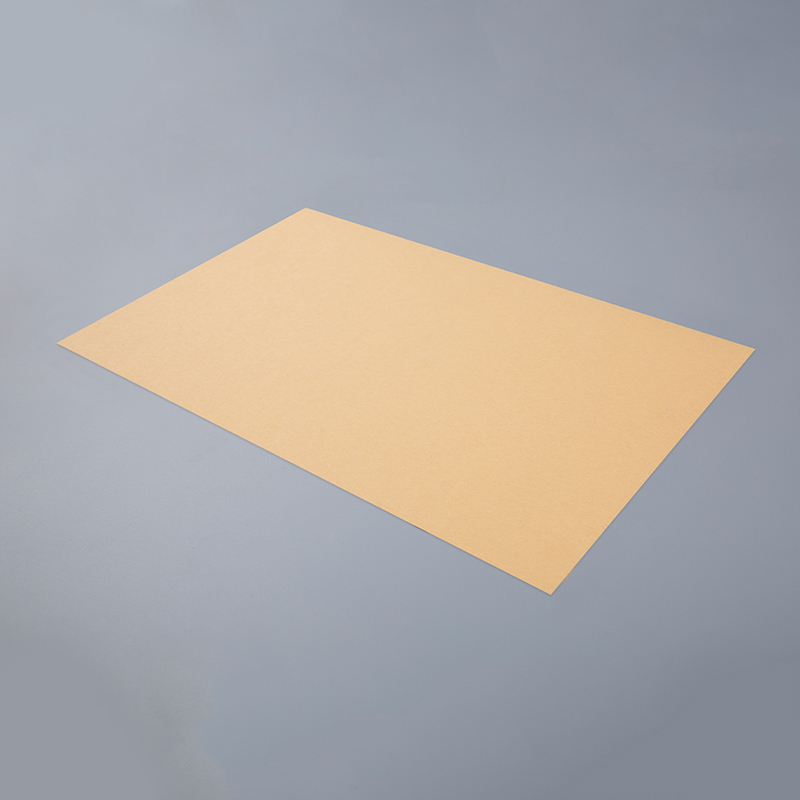
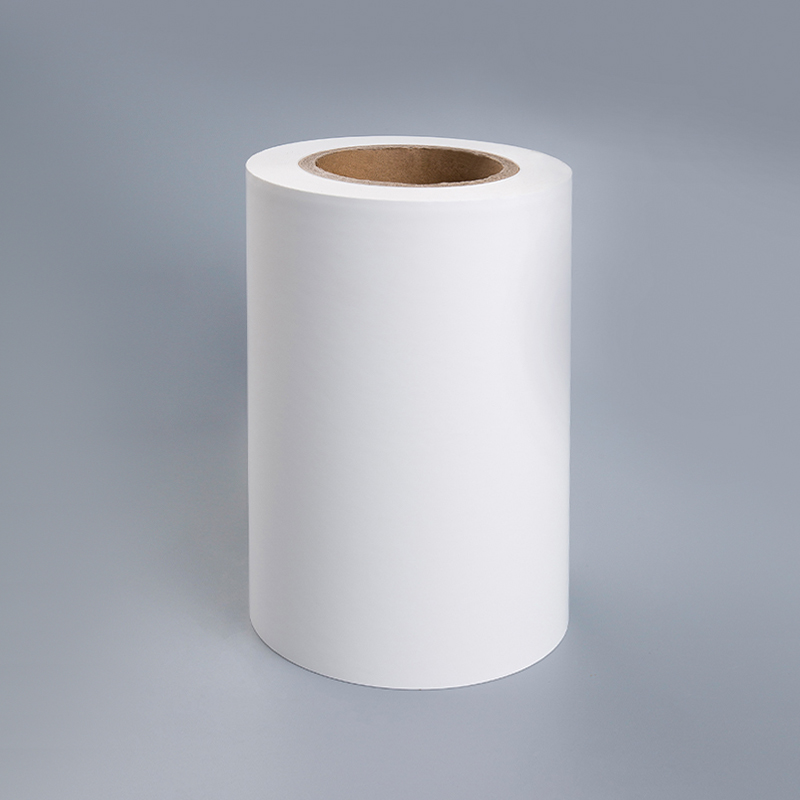
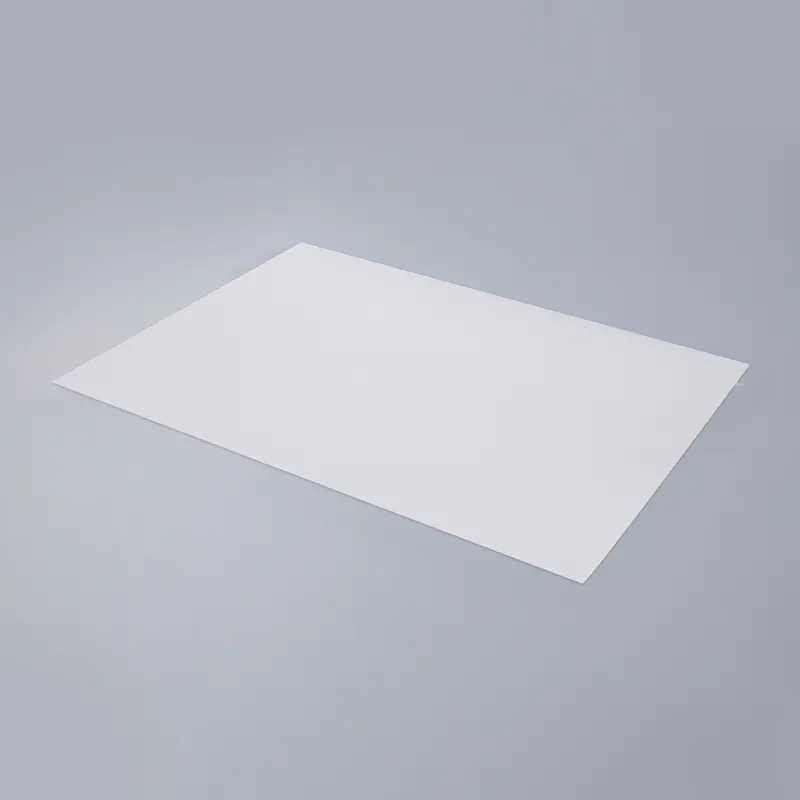
Size flexibility is another important feature. Jumbo roll widths such as 1000 mm, 1020 mm, 1080 mm, and 1530 mm can support slitting, laminating, adhesive coating, and large-scale converting. Sheet sizes such as A4, A3, 20 x 30, 21 x 30, 24 x 36, 50 cm x 70 cm, and 70 cm x 100 cm are suitable for sheet-fed printing, small batch processing, sample preparation, and specialized manufacturing. Customized sizes can also be provided to match the requirements of different production lines and end-use industries.
Core Product Specifications
Item |
Specification |
Practical Value |
Base Material |
PE coated kraft paper |
Combines kraft strength with moisture-resistant polyethylene protection |
Available Basis Weights |
50 g, 60 g, 65 g, 70 g, 80 g, 85 g, 90 g, 100 g, 120 g, 135 g, 155 g, and 240 g |
Supports different stiffness, strength, and converting requirements |
Color Options |
Yellow and white |
Allows visual process identification and product differentiation |
Jumbo Roll Widths |
1000 mm, 1020 mm, 1080 mm, and 1530 mm |
Suitable for large-scale coating, laminating, slitting, and converting |
Sheet Sizes |
A4, A3, 20 x 30, 21 x 30, 24 x 36, 50 cm x 70 cm, 70 cm x 100 cm, and customized formats |
Supports sheet-fed printing, sample making, packaging, and specialized applications |
Release Function |
Stable silicone release surface |
Enables clean peeling and reliable adhesive protection |
Typical Applications |
Label backing, hot stamping, pressure-sensitive adhesive printing, die-cutting, and medical-grade product manufacturing |
Provides stable support across demanding converting processes |
Why Release Paper Quality Matters
In adhesive material production, the release paper serves as a temporary but essential foundation. It protects the adhesive, maintains product shape, supports printing and die-cutting, and allows the finished label or adhesive part to be removed at the correct moment. If the release liner is unstable, dusty, warped, uneven, or inconsistent in release force, the entire production sequence may suffer. Problems can appear as adhesive contamination, inaccurate die-cutting, roll telescoping, label lifting, poor printing registration, liner tearing, or difficult peeling during application.
For electronic labels, warning labels, product identification labels, logistics labels, and industrial adhesive components, the backing paper must remain stable under handling, printing, storage, and transportation. Dimensional changes caused by humidity or temperature may affect registration and lead to waste. A liner that absorbs moisture excessively may curl, warp, or become difficult to feed through machines. A surface that is not smooth may cause printing defects, adhesive voids, or uneven transfer. Yellow release paper designed with PE coating and controlled silicone application helps minimize these risks.
The value of a high-quality release liner is often measured by what it prevents. It prevents unnecessary downtime caused by web breaks. It prevents adhesive bleeding and contamination. It prevents unpredictable peeling. It prevents roll deformation during sea transport. It prevents damage during storage in humid environments. It also supports better final product appearance, especially in applications such as hot stamping, where clean separation and accurate metallic transfer are necessary for sharpness and gloss.
Advantages Over Ordinary Release Paper
Compared with ordinary backing materials, yellow release paper made with PE coated kraft paper provides improved stability, durability, and protective performance. Many low-grade release liners may be acceptable for simple manual applications, but they often fail under demanding industrial conditions. High-speed automated production requires the material to feed smoothly, maintain tension, resist deformation, and release consistently. The stronger and more uniform the liner, the more stable the converting process becomes.
One major advantage is excellent dimensional stability after coating. The paper resists deformation under changing temperature and humidity conditions, which helps maintain processing precision. This is especially valuable for die-cutting and printing. When the liner expands or contracts unevenly, the cutting line may shift, printed graphics may misalign, and labels may lose consistency. Stable yellow release paper helps converters achieve higher yield and better repeatability.
Another important advantage is uniform density. A dense and well-formed paper base supports smooth coating and reduces weak points. Superior puncture resistance allows the liner to withstand pressure from cutting tools, rollers, rewinding systems, and handling equipment. During die-cutting, a liner with poor puncture resistance may be damaged too deeply, leading to tearing during stripping or application. A stronger liner provides a safer processing window and reduces the risk of production interruption.
Low paper dust is also a significant competitive advantage. Paper dust can contaminate adhesive layers, block machine components, affect printing quality, and shorten equipment service life. In adhesive label production, even small particles may create visible defects or reduce bonding performance. Yellow release paper with controlled surface quality and cleaner production characteristics helps maintain a cleaner converting environment, reduces maintenance frequency, and supports higher product quality.
The PE coating creates outstanding moisture resistance. Moisture is one of the most common causes of liner instability, curling, and adhesive performance problems. A PE coated structure helps block moisture and provides resistance against certain chemical influences. For long-term storage, export shipment, or use in humid climates, this barrier performance becomes highly valuable. It helps prevent warping, supports roll flatness, and protects the adhesive construction before final use.
Smoothness and flatness are also central to performance. A smooth and flat surface supports uniform adhesive coating, precise laminating, stable printing, and clean die-cutting. When the surface is uneven, adhesive thickness may vary, and the product may show wrinkles, bubbles, or release defects. Yellow release paper manufactured with precision coating control provides a more reliable platform for high-quality adhesive materials.
Advanced Manufacturing Process
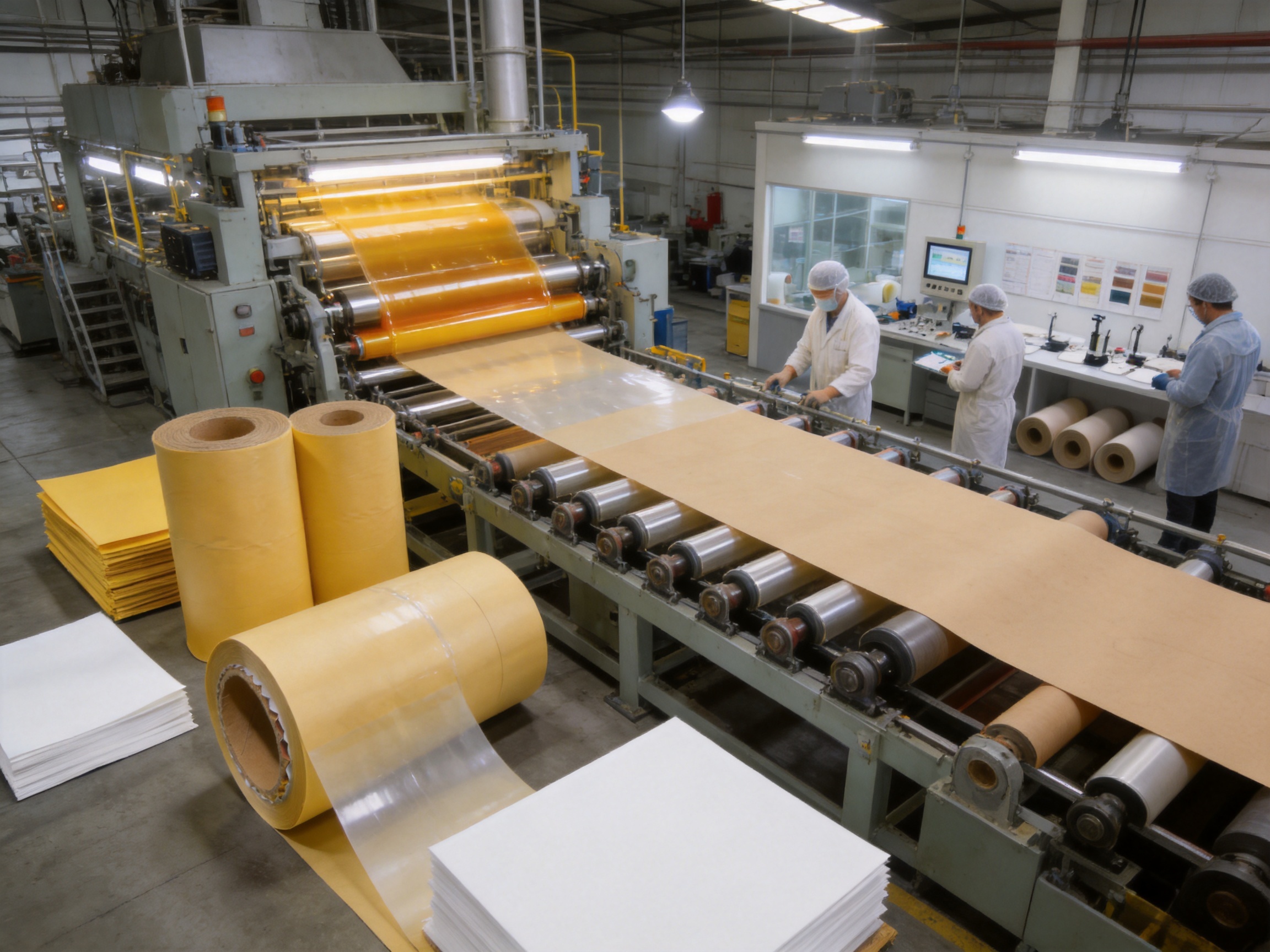
The performance of yellow release paper depends not only on the raw materials but also on the manufacturing process. Advanced production requires careful control of paper selection, PE coating, silicone coating, drying, curing, tension, winding, inspection, slitting, and packaging. Each stage influences final release behavior, surface quality, dimensional stability, and roll appearance.
One of the key manufacturing technologies is cast extrusion coating. In this process, molten polyethylene is extruded onto the kraft paper surface to form a continuous, uniform coating layer. Depending on the application, single-sided or double-sided PE coating can be selected. Single-sided coating may be suitable where one protected surface is sufficient, while double-sided coating can improve moisture protection and dimensional balance. Cast extrusion coating helps create a dense barrier, improves surface sealing, and prepares the paper for silicone treatment.
A multi-roller precision coating system is used to control the silicone layer. The silicone release layer must be uniform, stable, and properly cured. If the coating is too light, the adhesive may bond too strongly to the liner. If it is too heavy or uneven, the release force may become inconsistent, causing problems during printing, die-cutting, stripping, or application. Precision coating equipment helps distribute the silicone layer evenly and supports controlled breathability, which is important for certain adhesive constructions and specialty applications.
Process stability is especially important for high-speed automated production. The web must pass through equipment without wrinkles, breaks, excessive curl, or coating defects. Tension control must be accurate to prevent stretching or deformation. Drying and curing conditions must be optimized to ensure that the coating performs correctly without damaging the base paper. Roll winding must be controlled to avoid telescoping, hard edges, soft rolls, or deformation during transportation.
Suzhou Piaozhihua Composite Material Technology Co., Ltd. has developed production capabilities that integrate gluing, laminating, coating, cutting, and related converting operations. With a full range of production lines and large annual capacity, the company can support both standard supply and customized requirements. This integrated manufacturing system is important for customers who need stable quality, reliable lead times, and flexible product development support.
The company also emphasizes testing and inspection. A dedicated testing laboratory and advanced inspection equipment help verify product quality before shipment. Quality inspection may include appearance checks, coating uniformity evaluation, release performance testing, thickness and basis weight confirmation, moisture-related stability assessment, and roll or sheet packaging inspection. Strong inspection capability helps reduce customer risk and supports long-term cooperation.
Material Structure and Performance Balance
The success of yellow release paper comes from the balance of three primary layers: kraft paper, PE coating, and silicone release coating. Each layer has a distinct role, and the interaction between them determines final performance. Kraft paper contributes strength, body, and stiffness. PE coating provides surface sealing and barrier properties. Silicone coating delivers controlled release.
Kraft paper is widely used in industrial applications because it has strong fiber structure and good mechanical properties. For release paper, kraft quality affects tensile strength, tear resistance, density, smoothness, and stability. A well-selected kraft base reduces the likelihood of web breaks and supports consistent coating. It also helps maintain shape during converting, storage, and transportation.
The PE layer improves resistance to moisture and contamination. Paper alone can absorb water vapor from the environment, resulting in expansion, curling, or loss of flatness. PE coating reduces moisture absorption and helps preserve dimensional stability. It also creates a smoother, more sealed surface for silicone coating. This improves release consistency and reduces the influence of paper porosity on adhesive interaction.
The silicone layer is the functional release surface. In pressure-sensitive adhesive systems, the adhesive must remain protected until use but must also release cleanly when required. Silicone chemistry, coating weight, curing conditions, and surface uniformity all influence release force. Stable silicone release performance allows labels to be peeled smoothly without adhesive transfer, liner tearing, or unpredictable resistance.
A high-quality yellow release paper must therefore be engineered as a system, not as separate layers. If the kraft base is weak, the PE coating cannot fully compensate for poor mechanical strength. If the PE coating is uneven, silicone coating may not perform consistently. If silicone curing is incomplete, release behavior may change over time. Advanced production control helps ensure that all layers work together reliably.
Application in Label Backing
One of the most important uses of yellow release paper is as a label backing. In this role, it supports electronic device labels, product identification labels, warning labels, logistics labels, industrial labels, and other pressure-sensitive label constructions. The backing allows the adhesive-coated label material to be printed, die-cut, stored, transported, and finally applied to a surface.
For electronic device labels, accuracy and cleanliness are essential. Labels may contain barcodes, serial numbers, regulatory marks, safety warnings, or product identification data. The backing paper must provide stable support during printing and die-cutting so that label dimensions remain consistent. Yellow release paper with dimensional stability and low dust generation is particularly suitable for these applications because it reduces contamination risk and helps preserve printing clarity.
During die-cutting, the release liner must be strong enough to withstand pressure from cutting tools while allowing the label face material to be cut cleanly. If the die cuts too deeply into a weak liner, the liner may tear. If the liner surface is too unstable, stripping waste matrix becomes difficult. A strong PE coated kraft release paper offers better puncture resistance and supports smoother die-cutting operations.
In label application, clean peeling is essential. The end user expects the label to separate from the liner without curling, tearing, adhesive transfer, or excessive force. Stable silicone release helps the label peel away smoothly while preserving adhesive performance. This is especially important in automated labeling systems, where inconsistent release can cause misfeeds, label jams, or missed applications.
Application in Hot Stamping
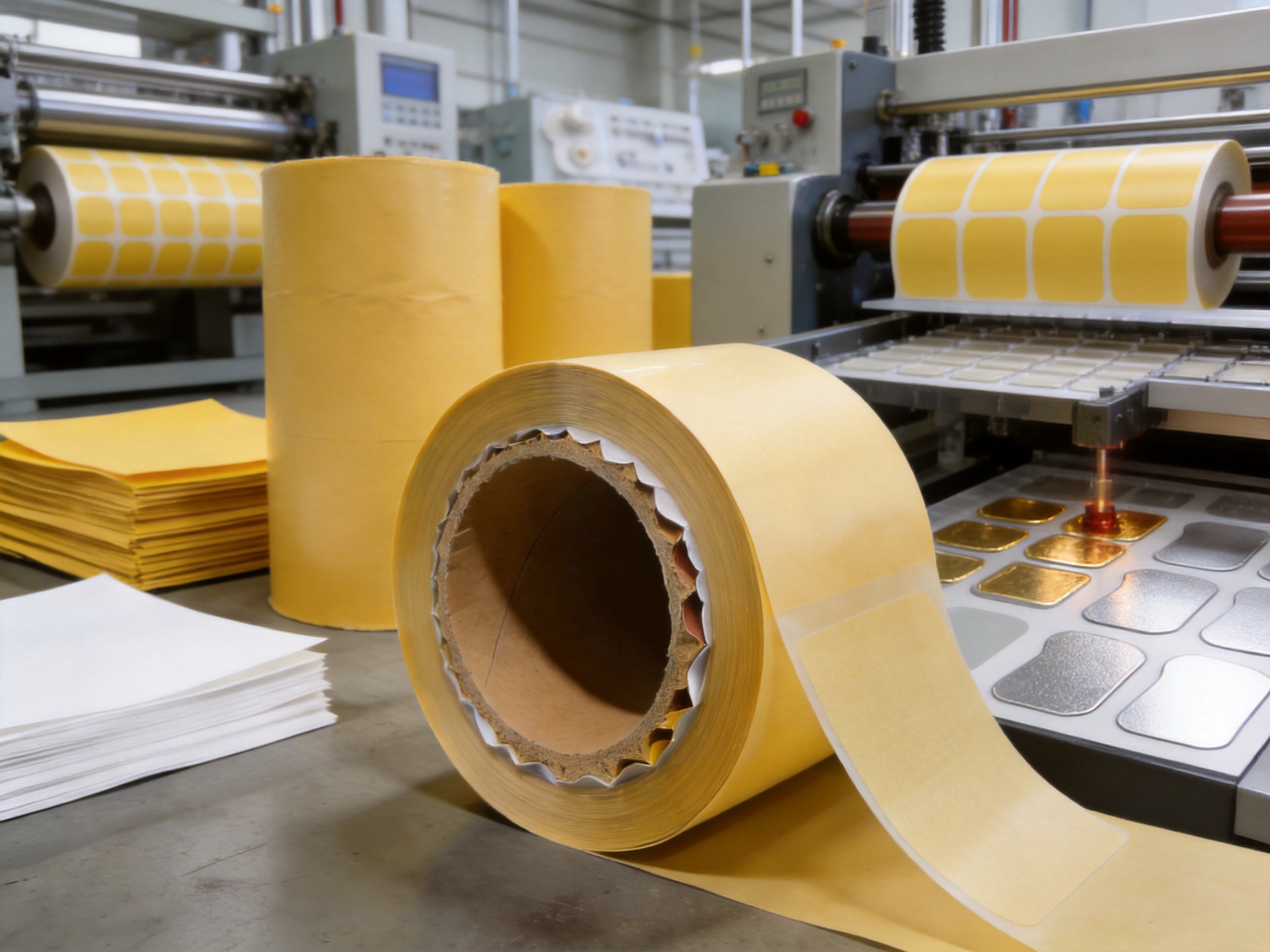
Yellow release paper can also serve as a carrier in hot stamping processes, including gold and silver stamping. Hot stamping uses heat, pressure, and a transfer foil to apply metallic or decorative finishes onto printed materials, labels, packaging, or other surfaces. The carrier material must allow accurate transfer and clean separation after stamping.
In hot stamping, surface stability and release behavior are extremely important. The foil or decorative layer must detach at the intended point while retaining sharp edges and strong gloss. If the carrier releases unevenly, the stamped image may show incomplete transfer, blurred details, or surface defects. Yellow release paper with a smooth surface and controlled release properties helps achieve precise metallic transfer and clean separation.
Durability under heat and pressure is also important. The liner must resist distortion during the stamping process. Dimensional stability helps ensure that repeated patterns, logos, text, or decorative lines remain accurately positioned. For premium packaging and high-quality printed materials, these details directly affect product appearance and customer perception.
Application in Pressure-Sensitive Adhesive Printing
Pressure-sensitive adhesive printing relies on a stable multi-layer structure. The face material, adhesive, and release liner must work together throughout printing, die-cutting, rewinding, storage, and application. Yellow release paper plays a critical role by providing a flat and dependable backing surface.
In printing, surface flatness affects feed stability and registration. A warped or curled liner can cause print misalignment, uneven ink transfer, or machine stoppage. A smooth release paper supports consistent contact with rollers and printing plates. In high-speed production, this stability becomes even more important because small defects can quickly generate large amounts of waste.
For adhesive label manufacturing, the liner also protects the adhesive from contamination and premature contact. The PE coated and silicone-treated surface helps keep the adhesive layer in good condition until application. When the label is removed, the adhesive should remain on the label and not transfer to the liner. Consistent release performance supports this requirement.
Yellow release paper is also useful in production environments where operators need to identify materials quickly. The yellow backing can distinguish certain adhesive constructions, customer orders, product grades, or processing stages. This visual advantage can reduce handling errors and improve production efficiency.
Suitability for Medical-Grade and High-Precision Products
The material can also support high-precision adhesive bonding, die-cutting, and medical-grade product manufacturing. Medical and healthcare-related adhesive products often require clean handling, stable release, and consistent performance. While final suitability always depends on the specific customer standard and regulatory requirement, a clean production process and controlled coating technology provide an important foundation for demanding applications.
In medical-grade adhesive components, liners may be used for protective films, wound care materials, diagnostic components, or other adhesive assemblies. The liner must protect the adhesive and release smoothly without leaving contamination. Low dust, smooth surface quality, and stable release force are valuable characteristics in these applications.
High-precision die-cutting also benefits from release paper stability. Many specialty adhesive parts are cut into complex shapes with tight tolerances. If the backing material stretches, shrinks, or deforms, dimensional accuracy may be compromised. Strong and stable yellow release paper supports more consistent cutting results, helping converters reduce scrap and improve production reliability.
Packaging and International Transportation Protection
Packaging is not an afterthought for release paper. Even a well-manufactured roll or sheet product can be damaged if packaging is weak or unsuitable for international transport. Yellow release paper is often shipped by sea, exposed to long transportation cycles, humidity changes, vibration, stacking pressure, and handling by forklifts. Proper packaging protects product quality from the factory to the customer’s warehouse.
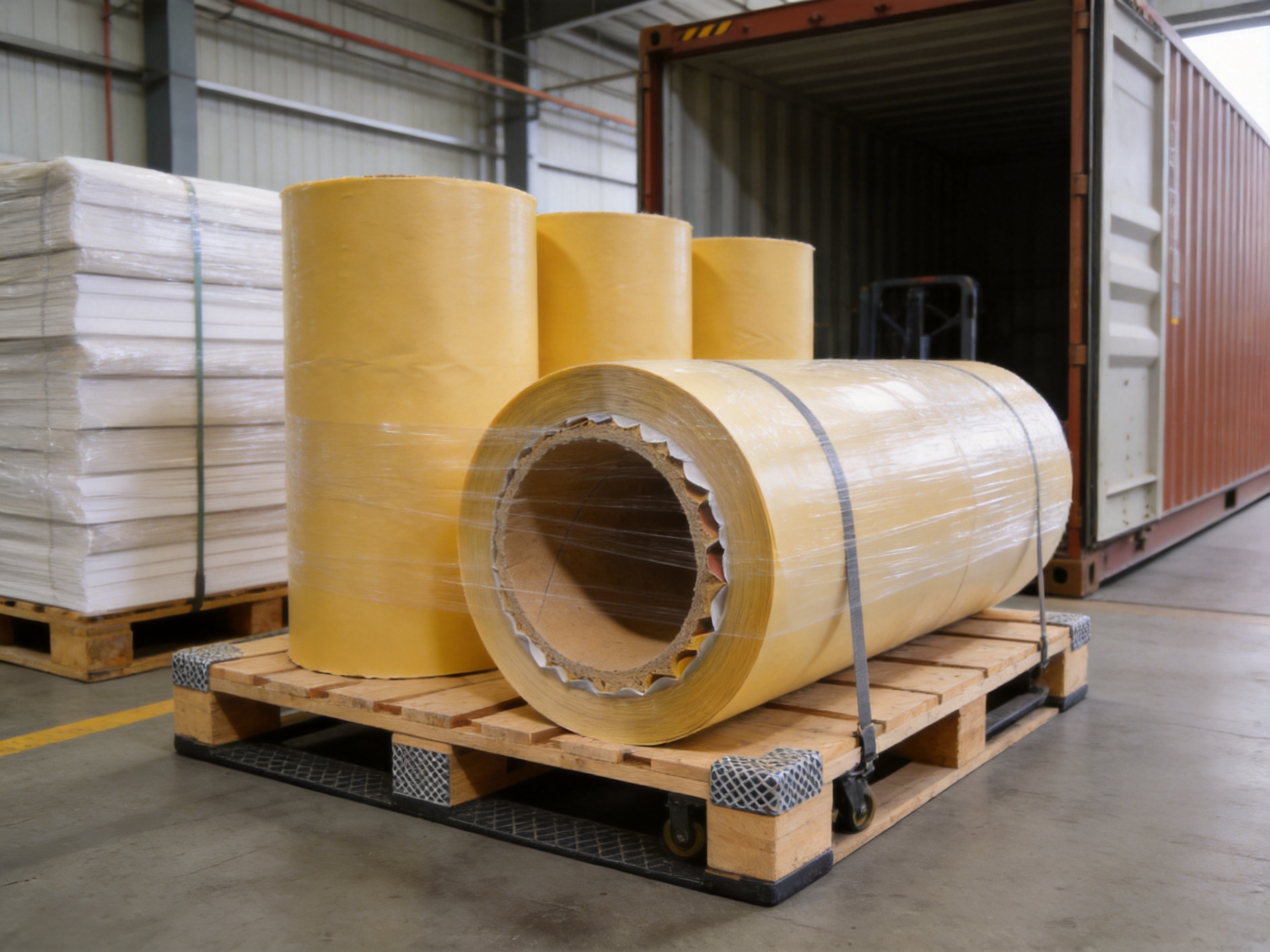
For roll products, fumigation-treated recycled wooden pallets are used to meet international sea transportation requirements. These pallets are designed for insect and mold resistance and comply with global shipping expectations. Stable pallet design helps optimize stacking and distribute weight evenly, reducing the risk of roll deformation. Protective corner guards are embedded, and pallets are tightly wrapped with stretch film to secure the load.
Standardized forklift slots improve logistics efficiency and reduce the possibility of damage during loading and unloading. When rolls are moved repeatedly through warehouses, ports, containers, and customer facilities, pallet strength and handling design matter. Good packaging reduces claims, protects roll geometry, and helps customers place the material directly into production with minimal preparation.
For ream packaging, such as 100 sheets per ream, each ream is fully sealed with PE-coated kraft paper for moisture and dust protection. Reinforced edges help reduce damage during handling. Multiple reams are stacked on pallets, secured with high-strength stretch film and anti-slip plastic straps to prevent shifting during transit. This packaging method is especially valuable for sheet products that must remain flat, clean, and undamaged.
Quality Control and Consistency
Consistency is one of the strongest indicators of a reliable release paper supplier. Customers do not only need one good batch; they need stable performance across repeated orders, different production dates, and changing environmental conditions. Yellow release paper must provide repeatable basis weight, coating uniformity, release force, roll quality, flatness, color appearance, and packaging reliability.
Quality control begins with raw material selection. Kraft paper must meet specifications for strength, density, moisture, and surface characteristics. PE resin and silicone materials must be selected according to application requirements. During production, process parameters such as extrusion temperature, coating weight, line speed, curing condition, and winding tension must be monitored carefully.
Inspection after production helps identify defects before shipment. Common concerns include coating streaks, pinholes, wrinkles, uneven release, contamination, edge damage, roll looseness, or sheet deformation. Advanced inspection equipment and trained quality teams help ensure that customers receive products that can run smoothly on their equipment.
Suzhou Piaozhihua Composite Material Technology Co., Ltd. has more than twenty years of manufacturing experience in self-adhesive label materials and related products. This long-term experience allows the company to understand customer pain points across industries, including label conversion, digital printing, pressure-sensitive adhesive production, specialty materials, packaging, and export supply. Experience matters because release paper performance is highly practical; it must succeed in real production lines, not only in theoretical specifications.
Customization and OEM or ODM Capability
Different customers often require different release paper solutions. Some need special widths for existing coating lines. Some need specific basis weights to balance cost and stiffness. Some need sheet sizes for printing or packaging. Others need controlled release force, color preference, roll diameter requirements, core specifications, or packaging standards. Strong customization capability is therefore a major supplier advantage.
The company accepts OEM and ODM services, producing products based on customer drawings, samples, or functional requirements. This is important for customers developing new label materials, special adhesive products, or customized backing systems. A professional research and development team can help evaluate material structure, production feasibility, coating options, and performance requirements.
ODM capability is especially useful when customers know the final application but need support selecting the right material. For example, a converter may need a liner for high-speed label application in humid environments. Another customer may need a heavier sheet for hot stamping support. A manufacturer with coating, laminating, gluing, cutting, testing, and R&D capability can recommend more suitable options and help shorten the development cycle.
OEM manufacturing experience also supports brand owners, distributors, and industrial customers who need stable private-label supply. The ability to produce according to customer samples and drawings helps ensure continuity when replacing an existing material or improving a current product. Full after-sales service further supports troubleshooting and long-term cooperation.
Manufacturing Strength and Supply Capacity
A release paper supplier must combine technical performance with dependable supply. In large-scale label and adhesive production, material interruption can stop production lines and cause delivery delays. Therefore, production capacity, equipment completeness, and supply chain management are as important as laboratory performance.
Suzhou Piaozhihua Composite Material Technology Co., Ltd. is a private company specializing in high-grade self-adhesive labels and related composite materials. The company integrates research and development, production, sales, and after-sales service. Its production system includes gluing, laminating, cutting, and related lines, with an annual production capacity of more than 280 million square meters. This scale allows the company to support large customers, recurring orders, and expanding international demand.
The company has built domestic sales networks in many major Chinese cities and has developed marketing coverage in countries and regions such as the United States, Germany, Japan, South Korea, Brazil, Mexico, Russia, and the Middle East. This international market experience is useful for customers who require export documentation, sea transportation packaging, consistent specifications, and communication across different application standards.
Large capacity alone is not enough; it must be paired with quality awareness. The company’s quality manufacturing concept has been developed over more than twenty years. Its testing laboratory, advanced inspection equipment, R&D team, and patented capabilities support continuous improvement. These strengths help the company compete not merely on price but on performance, consistency, customization, and service.
Sustainability and Safety Considerations
Sustainability is increasingly important in label, packaging, and adhesive material industries. Customers are looking for materials that reduce environmental burden while maintaining performance. Yellow release paper uses paper as a primary base, and the paper component can be recyclable and biodegradable under suitable systems and conditions. Compared with some fully synthetic carrier structures, paper-based liners may support more sustainable product strategies when properly designed and managed.
The production process is designed to be clean and compliant with safety expectations in food and medical-related industries. For applications close to food, healthcare, or consumer goods, customers often need confidence that manufacturing practices are controlled and that materials are produced with attention to cleanliness and safety. While specific certifications and compliance documents should be confirmed for each order, clean production capability provides a valuable foundation.
The company’s broader brand positioning focuses on sustainable development and environmental protection. It develops eco-friendly solutions involving face materials, adhesives, and backing papers to meet customers’ sustainable product needs. This approach is consistent with market trends toward responsible sourcing, cleaner production, waste reduction, and long-term environmental responsibility.
In practical terms, sustainability also includes reducing waste during customer production. A stable release paper reduces defective labels, machine stops, roll waste, and rejected shipments. Therefore, higher material consistency can contribute to environmental goals by improving manufacturing efficiency. A product that runs smoothly and reduces scrap may have a lower overall impact than a cheaper material that causes frequent losses.
How Yellow Release Paper Improves Production Efficiency
Production efficiency depends on speed, stability, and predictability. Yellow release paper improves efficiency by providing a stable web, smooth surface, consistent release, and strong mechanical properties. In high-speed automated production, even small irregularities can become serious. A liner that tears or curls may require operators to stop the machine, remove jammed material, reset tension, clean adhesive contamination, and discard defective output.
Stable release behavior helps reduce stoppages during matrix stripping and label dispensing. When labels release too easily, they may lift prematurely. When they release too tightly, they may fail to dispense or may distort during peeling. Controlled silicone release helps keep the process within a reliable operating range. This is especially important in automated label application, where equipment depends on predictable separation between label and liner.
Moisture resistance supports warehouse and transportation stability. Materials may sit in storage before processing, and environmental conditions can vary widely. PE coated kraft paper helps reduce moisture-related deformation, allowing rolls and sheets to remain more usable after storage. Customers benefit from less preconditioning, fewer complaints, and more predictable production planning.
Low dust generation improves machine cleanliness. Dust accumulation can affect sensors, rollers, printing units, and adhesive surfaces. Cleaner material supports longer operating intervals between maintenance events. It also reduces the risk of visible defects on printed labels or adhesive parts. For customers producing high-value labels or technical adhesive components, this cleanliness can be a decisive advantage.
Selecting the Right Grade
Choosing the right yellow release paper grade depends on the application, process equipment, adhesive type, face material, storage condition, and final use. Lightweight grades may be suitable for standard label backing where flexibility and cost efficiency are important. Medium-weight grades often provide a balanced combination of strength, processability, and flatness. Heavy grades are useful where strong support, stiffness, or higher puncture resistance is required.
Jumbo roll width should match the customer’s coating, laminating, or slitting equipment. Wider rolls such as 1530 mm may improve productivity for large converting operations, while narrower widths may reduce trimming waste for specific production lines. Sheet sizes should be selected based on printing equipment, packaging requirements, and final part dimensions. Customized formats can reduce waste and improve workflow.
Color choice should also be considered. Yellow is useful for visual identification and may help distinguish the liner from white facestocks or other backing materials. White may be preferred for certain appearance requirements. Both options can be selected according to customer needs.
Release force should be matched to adhesive strength and application process. Aggressive adhesives may require a carefully controlled release surface to prevent difficult peeling. Delicate labels may need smooth release to avoid distortion. High-speed dispensing may require tight release tolerance. Consultation with the manufacturer can help determine the best structure and specification.
Competitive Value for Global Buyers
Global buyers of label materials and release liners often evaluate suppliers based on quality, price, capacity, customization, communication, export packaging, and technical support. Yellow release paper produced by an experienced composite material manufacturer offers a strong balance of these factors. The product provides functional advantages such as stability, moisture resistance, smoothness, puncture resistance, low dust, and controlled release. The company provides manufacturing advantages such as integrated production lines, large capacity, testing capability, R&D support, OEM and ODM service, and export experience.
Compared with suppliers that only offer standard commodity liners, an integrated manufacturer can respond more effectively to special requests. If a customer needs a different basis weight, roll width, sheet size, release property, or packaging method, production and technical teams can work together to develop a solution. This flexibility reduces the buyer’s need to coordinate multiple suppliers and helps ensure consistent quality.
For distributors and converters, stable supply is also a competitive advantage. When release paper performs consistently, customers can build confidence in their own finished products. They can reduce incoming inspection pressure, improve production planning, and strengthen their reputation with downstream buyers. A reliable liner supplier becomes part of the customer’s quality system.
Q&A Section
What is yellow release paper used for?
Yellow release paper is used as a backing or carrier material for adhesive labels, pressure-sensitive adhesive products, hot stamping foils, die-cut adhesive parts, electronic labels, warning labels, and specialty label materials. It protects the adhesive layer and allows clean peeling during application.
Why is PE coated kraft paper suitable for release paper?
PE coated kraft paper combines the mechanical strength of kraft paper with the moisture resistance and surface sealing of polyethylene. This structure improves dimensional stability, reduces moisture-related curling, and creates a better surface for silicone release coating.
What advantages does yellow release paper offer over ordinary liners?
It offers better dimensional stability, stronger puncture resistance, lower paper dust, improved moisture protection, smoother surface quality, and more consistent release performance. These advantages support high-speed automated production and reduce defects during printing, die-cutting, and label application.
Can the product be supplied in customized sizes?
Yes. Jumbo roll widths such as 1000 mm, 1020 mm, 1080 mm, and 1530 mm are available, and sheet sizes such as A4, A3, 20 x 30, 21 x 30, 24 x 36, 50 cm x 70 cm, and 70 cm x 100 cm can be supplied. Customized sizes can also be produced according to customer requirements.
What basis weights are available?
Available basis weights include 50 g, 60 g, 65 g, 70 g, 80 g, 85 g, 90 g, 100 g, 120 g, 135 g, 155 g, and 240 g. The appropriate grade depends on the required stiffness, strength, processing method, and end-use application.
Why is low paper dust important?
Low paper dust helps keep adhesive surfaces clean, reduces printing defects, protects machine components, and extends equipment service life. It is especially important for high-quality label production, electronic labels, and precision adhesive components.
How does the silicone layer affect performance?
The silicone layer determines the release behavior between the adhesive and liner. A uniform and properly cured silicone coating allows labels or adhesive parts to peel cleanly without adhesive transfer, liner tearing, or inconsistent resistance.
Is yellow release paper suitable for hot stamping?
Yes. It can act as a carrier for hot stamping foils and supports precise transfer of metallic finishes. Its smooth surface and stable release properties help maintain sharpness, gloss, and clean separation after stamping.
What packaging is used for international shipment?
Rolls are shipped on fumigation-treated recycled wooden pallets with stretch film wrapping, protective corner guards, and forklift slots. Sheet reams are sealed with PE-coated kraft paper, reinforced at the edges, stacked on pallets, and secured with stretch film and anti-slip plastic straps.
What makes the manufacturer reliable for global buyers?
The manufacturer offers more than twenty years of OEM experience, integrated production lines, large annual capacity, an in-house testing laboratory, advanced inspection equipment, R&D capability, OEM and ODM services, customized production, and established domestic and international market experience.
Conclusion
Yellow release paper is a critical material for modern adhesive label and specialty converting industries. By combining kraft paper strength, PE coating protection, and precision silicone release performance, it provides a stable, clean, and reliable backing for label production, hot stamping, pressure-sensitive adhesive printing, die-cutting, and high-precision adhesive applications. Its advantages include dimensional stability, moisture resistance, puncture resistance, low dust, smooth surface quality, and compatibility with automated production.
For manufacturers and converters, choosing a high-quality release paper is not only a material decision but also a production efficiency decision. A better liner reduces waste, improves machine performance, protects adhesive quality, and supports consistent final products. With advanced cast extrusion coating, multi-roller precision silicone coating, integrated manufacturing lines, testing capability, customization service, and strong export packaging, yellow release paper from an experienced supplier offers clear value for both domestic and global markets.
As label materials continue to evolve toward higher precision, cleaner processing, better sustainability, and greater customization, the demand for dependable release liners will remain strong. Yellow release paper provides a practical and technically balanced solution for customers who need stable performance, flexible specifications, and professional manufacturing support.
References
1. Pressure-Sensitive Tape Council. Pressure-Sensitive Adhesive Products: Technical Guide and Industry Practices.
2. FINAT. Technical Handbook for Self-Adhesive Label Materials and Converting.
3. ASTM International. Standard Test Methods for Paper, Paperboard, and Pressure-Sensitive Adhesive Materials.
4. TAPPI Press. Paper and Paperboard Manufacturing, Coating, and Converting Technology.
5. Handbook of Pressure-Sensitive Adhesive Technology. Technical literature on adhesive performance, release liners, and silicone release systems.
6. Industry references on extrusion coating, silicone release coating, label backing materials, and high-speed converting process control.