
 English
 Español
 русский
 Français
 عربى
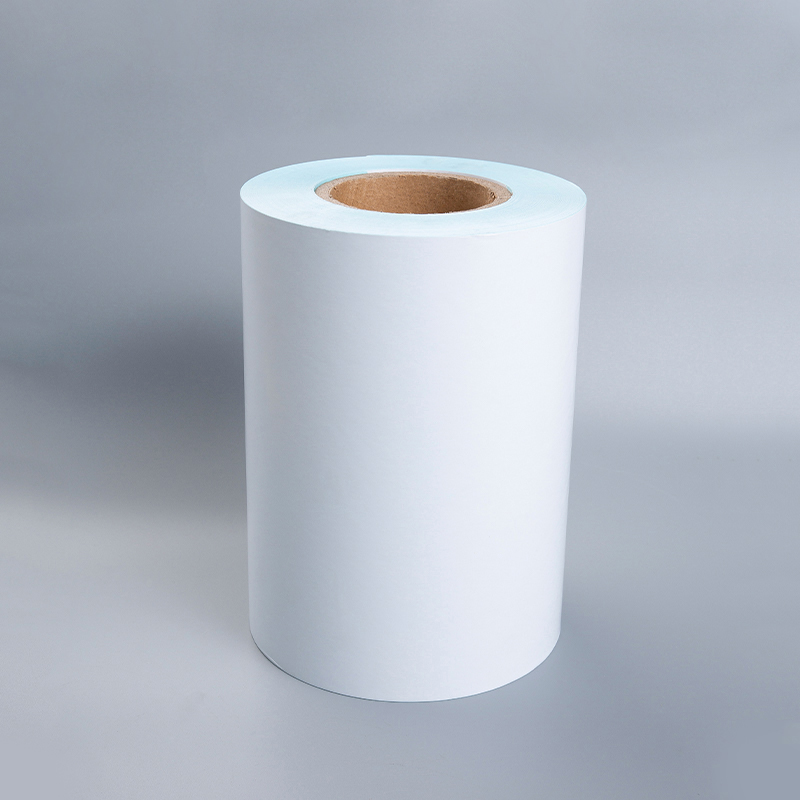
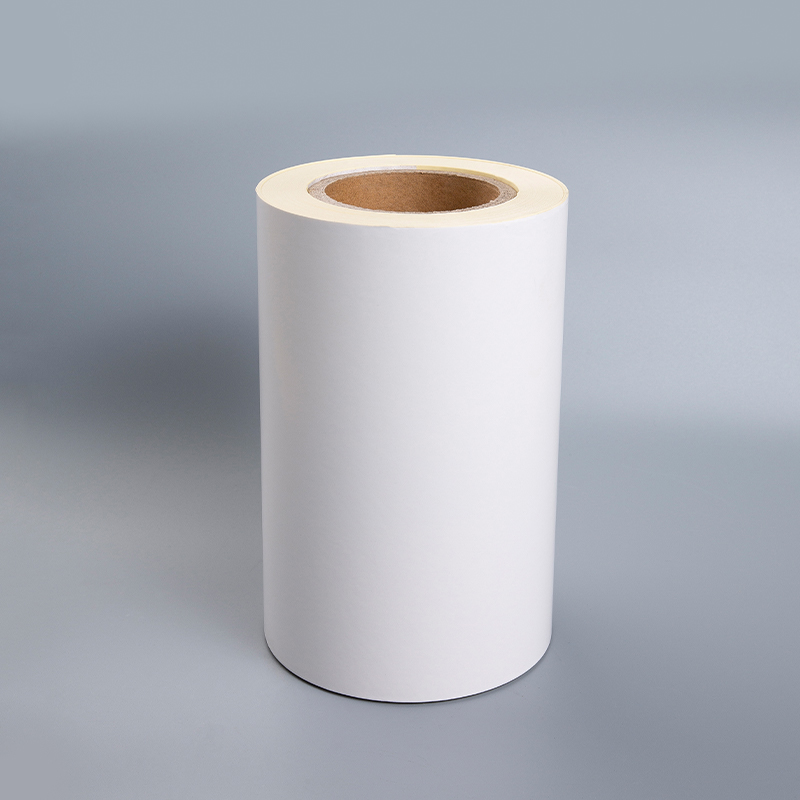
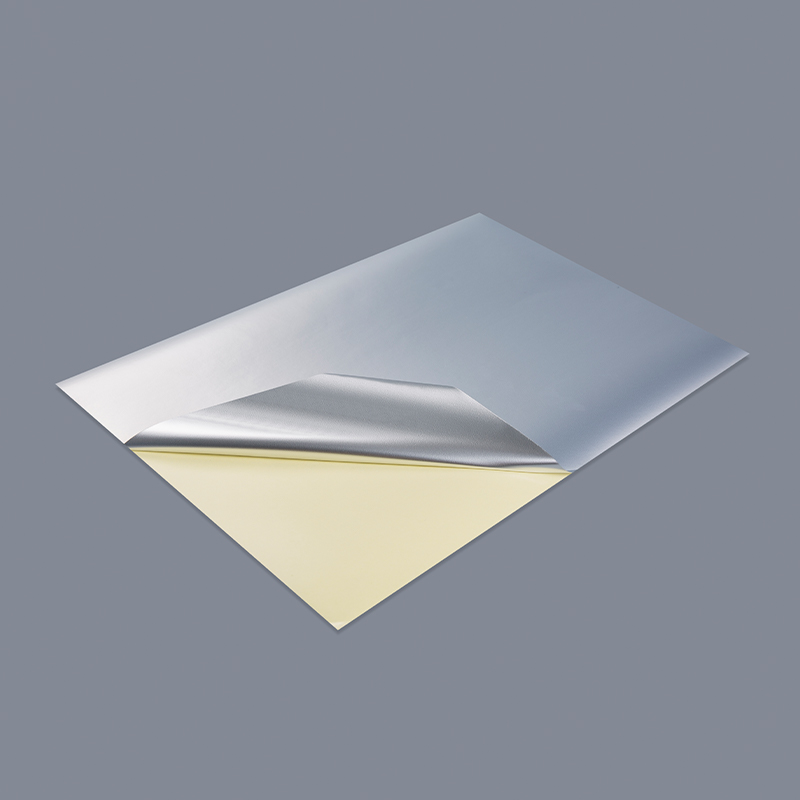
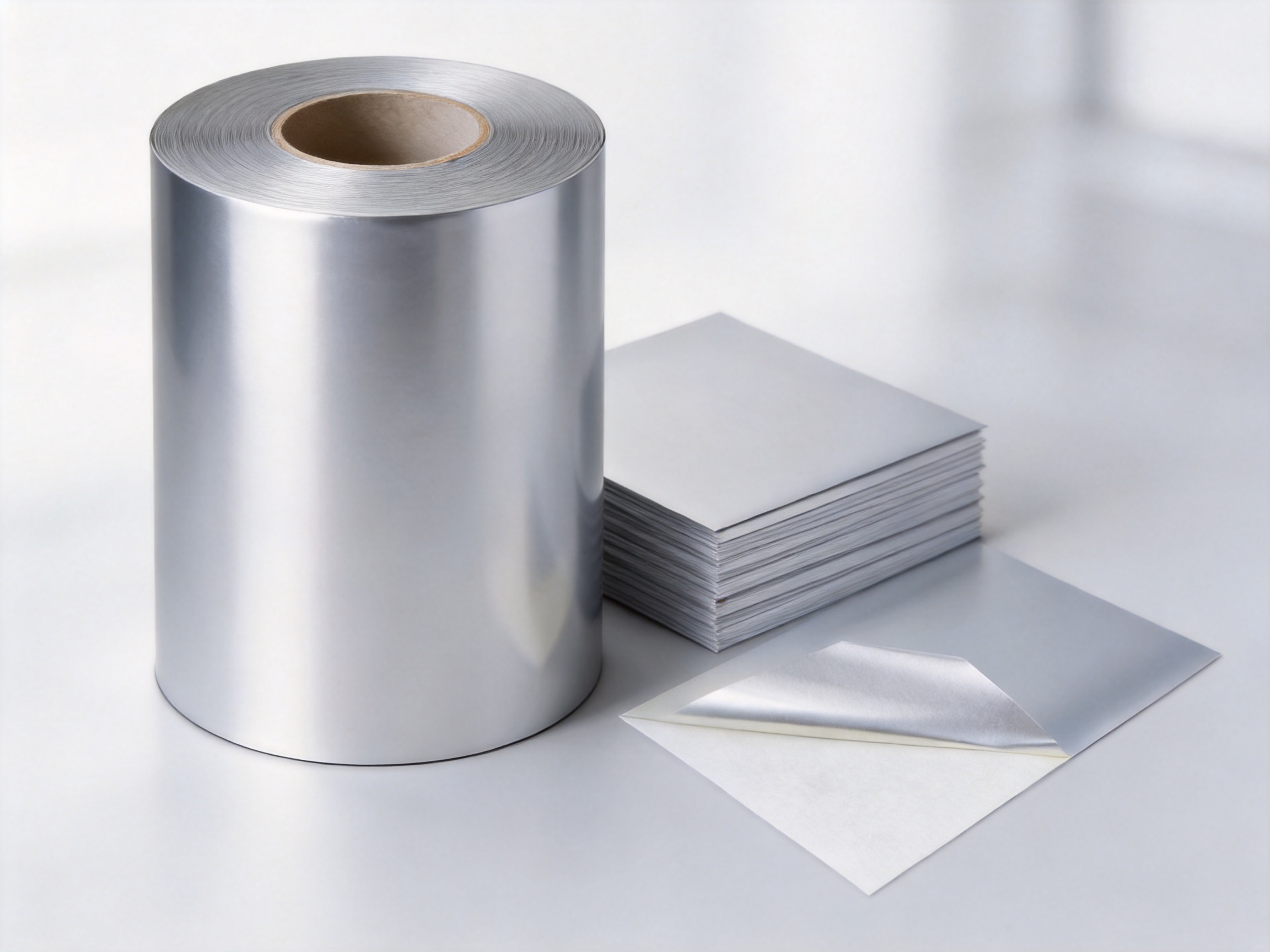
عربىSilver aluminum foil paper is a specialized self-adhesive label material designed for applications that require a refined metallic appearance, dimensional stability, reliable bonding, and long-term label performance. It combines the decorative value of a matt silver aluminum foil surface with the practical advantages of pressure-sensitive adhesive technology, making it suitable for medicine, food, cultural goods, consumer products, information labels, promotional labeling, and premium packaging identification.
In the self-adhesive label industry, many materials can provide basic printing and bonding functions, but only a carefully engineered metallic label material can deliver visual impact, environmental resistance, and consistent converting behavior at the same time. Silver aluminum foil paper is developed for users who need more than a standard paper label. It supports a high-grade appearance, resists warping and deformation after application, and maintains a stable label profile even when temperature and humidity conditions fluctuate.
The product is particularly valuable in markets where label appearance directly influences product perception. A silver metallic label can communicate quality, precision, cleanliness, technology, and premium value. Compared with conventional coated paper, ordinary self-adhesive paper, or simple synthetic film labels, silver aluminum foil paper offers a more distinctive surface effect and improved visual differentiation on shelves, cartons, bottles, boxes, cosmetic containers, pharmaceutical packages, food packaging, stationery, and cultural product packaging.
Silver Aluminum Foil Paper
Content
- 1 Product Overview
- 2 Key Technical Specification Table
- 3 Why Silver Aluminum Foil Paper Stands Out
- 4 Premium Matt Silver Appearance
- 5 Dimensional Stability After Application
- 6 Adhesive Options for Different Applications
- 7 Liner Choices and Converting Performance
- 8 Roll and Sheet Flexibility
- 9 Applications in Medicine and Healthcare
- 10 Applications in Food Packaging
- 11 Applications in Cultural Goods and Premium Stationery
- 12 Printing and Finishing Considerations
- 13 Packaging and Delivery Advantages
- 14 Manufacturing Strength Behind the Material
- 15 Advanced Gluing Process
- 16 Precision Laminating
- 17 Accurate Cutting and Slitting
- 18 Quality Inspection and Laboratory Support
- 19 OEM and ODM Customization Capability
- 20 Sustainability and Responsible Material Development
- 21 Advantages Over Competitors
- 22 Storage and Handling Recommendations
- 23 How to Select the Right Construction
- 24 Q&A Section
- 24.1 Q1: What is silver aluminum foil paper used for?
- 24.2 Q2: What makes this material different from ordinary self-adhesive paper?
- 24.3 Q3: Can the adhesive be customized?
- 24.4 Q4: What liner options are available?
- 24.5 Q5: Is the product available in rolls and sheets?
- 24.6 Q6: Why is matt silver useful for premium labels?
- 24.7 Q7: How does the product perform in changing temperature and humidity?
- 24.8 Q8: What manufacturing strengths support product quality?
- 24.9 Q9: What packing methods are available?
- 24.10 Q10: How should customers choose the correct specification?
- 25 Conclusion
- 26 References
- 27 Product: Silver Aluminum Foil Paper
Product Overview
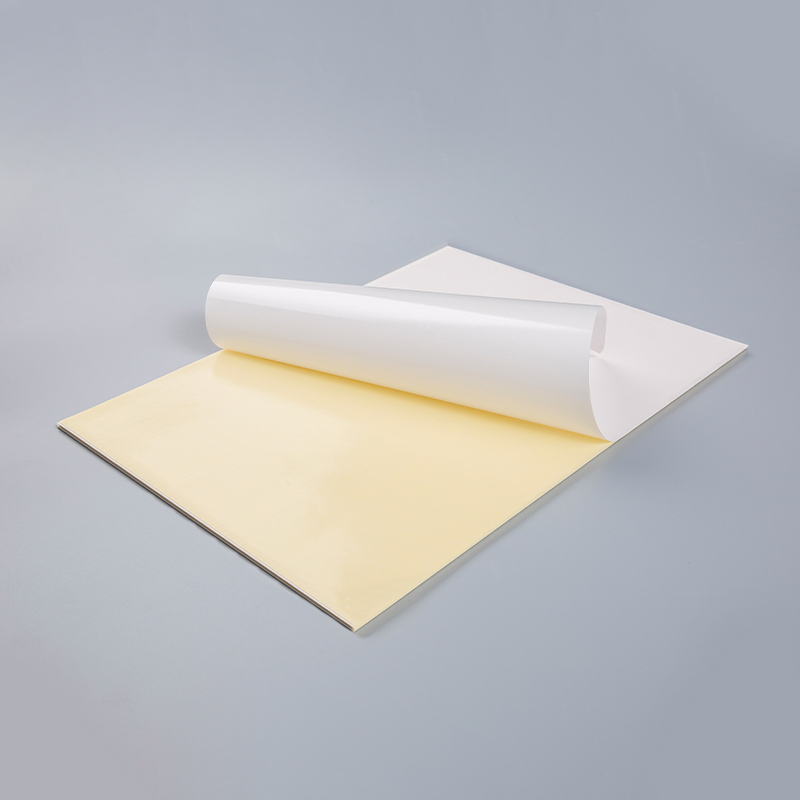
Silver aluminum foil paper is a self-adhesive material built with an aluminum foil face layer, adhesive layer, and release liner. The typical construction includes 80gsm matt silver aluminum foil paper as the face material, water-based adhesive as the standard adhesive option, and 60g white glassine paper as the standard liner. Depending on application needs, the structure can be customized with different adhesive systems, release liner weights, and roll or sheet formats.
The face material provides the signature matt silver metallic appearance. This surface is designed to look elegant without being overly reflective, allowing the label to deliver a premium visual impression while remaining suitable for information printing. The material can be used for labels that require text, barcodes, logos, batch numbers, product names, safety information, instructions, or decorative graphics.
One of the major characteristics of this product is that after pasting, the label is not easily affected by ambient temperature and humidity. This helps prevent long-term warping, curling, lifting, and deformation. For labels used on products that may be stored, transported, displayed, or handled in different environments, this dimensional stability becomes a practical advantage.
Silver aluminum foil self-adhesive materials are commonly used for high-grade information labels. Medicine, food, cultural goods, gift packaging, electronics, cosmetics, and specialty retail products can all benefit from the combination of an attractive silver surface and dependable adhesive performance. While many aluminum foil self-adhesive materials are available in gold and silver, matt silver is especially versatile because it matches both modern minimalist packaging and classic premium branding styles.
Key Technical Specification Table
| Item | Standard Option | Available Customization |
|---|---|---|
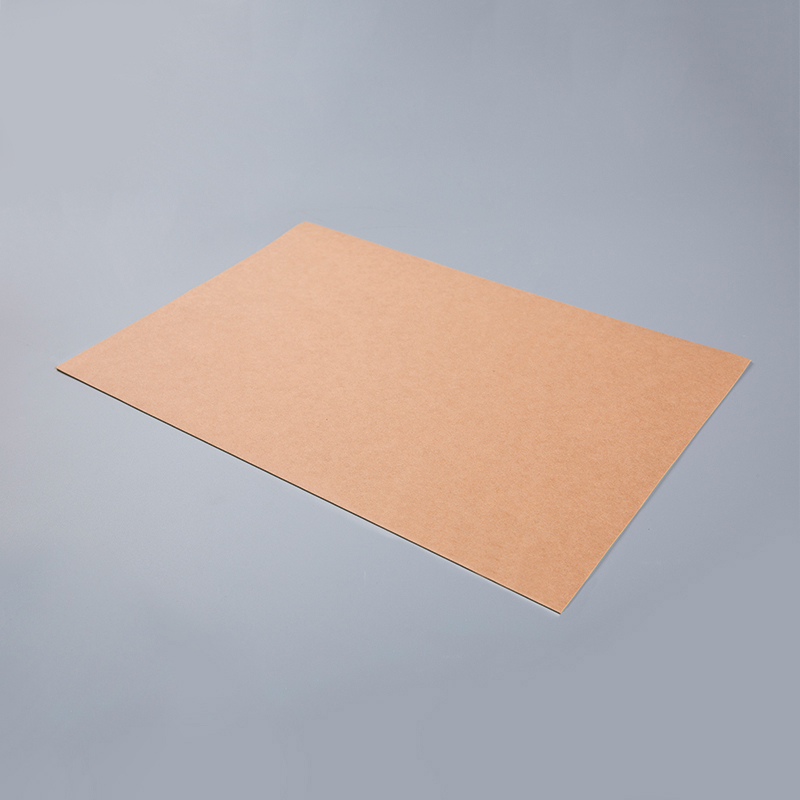
| Face Material | 80gsm matt silver aluminum foil paper | 90 mic and 100 mic options available |
| Adhesive | Water-based adhesive | Hotmelt adhesive, solvent adhesive, anti-freeze adhesive, removable adhesive, cryogenic adhesive, tyre-grade rubber adhesive |
| Liner | 60g white glassine paper | 50g, 80g, 100g, 120g glassine paper; 60g, 85g, 120g, 140g release paper; 140g, 165g art paper; 50g, 80g, 90g, 120g CCK liner; 25 mic, 36 mic, 50 mic, 100 mic transparent PET liner |
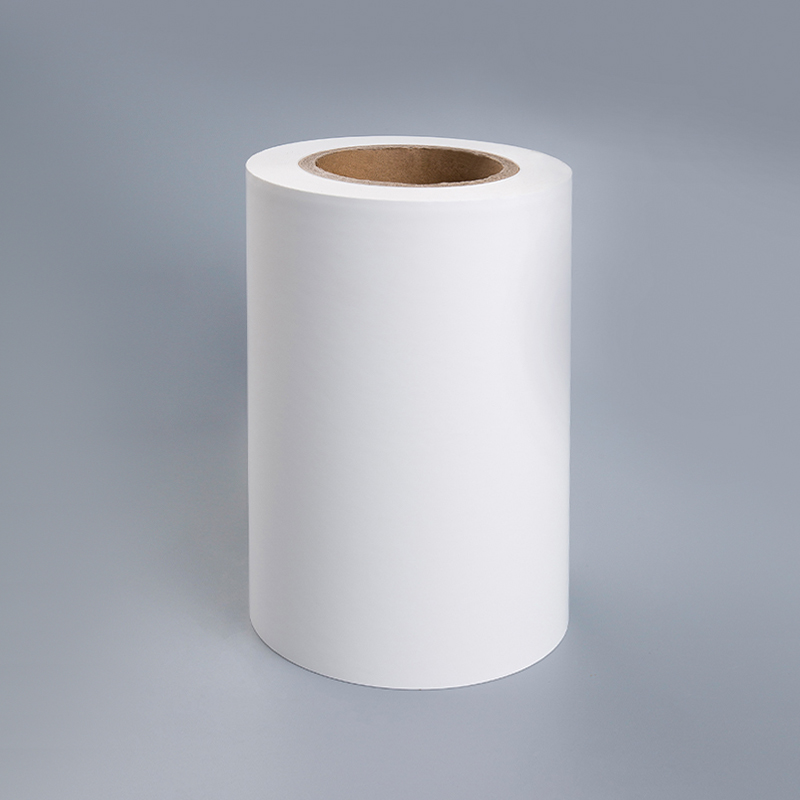
| Jumbo Roll Width | 1000mm, 1020mm, 1080mm, 1530mm | Width can be selected according to converting and labeling requirements |
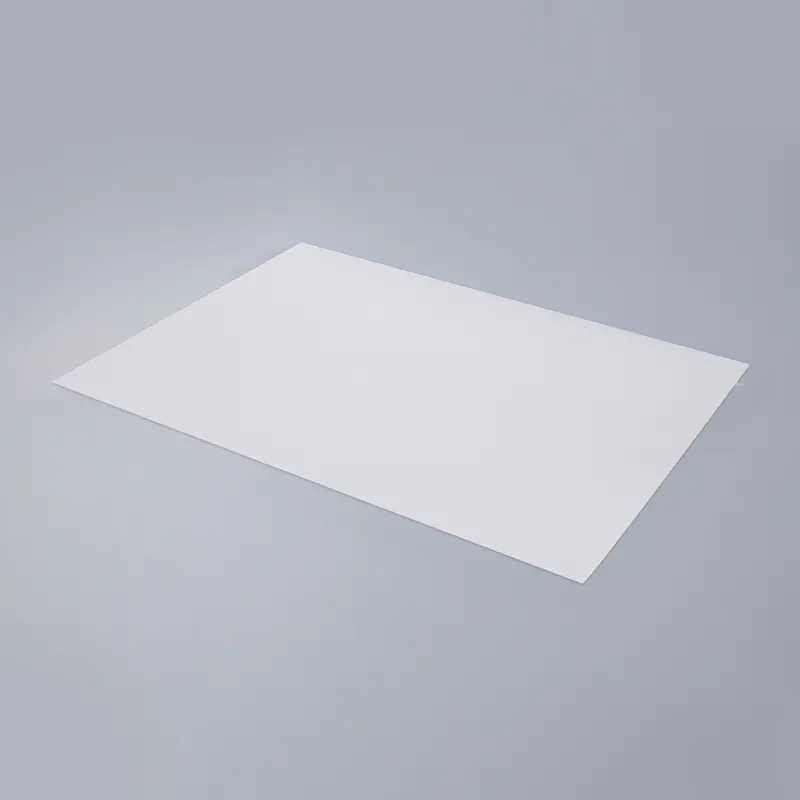
| Sheet Size | A4, A3, 20 x 30, 21 x 30, 24 x 36, 50cm x 70cm, 70cm x 100cm | Customized sheet sizes available |
| Packing | Roll or sheet packing | Sea-transit-worthy poly-wood pallet packing and carton packing available |
Why Silver Aluminum Foil Paper Stands Out
In competitive label material selection, users often compare aluminum foil paper with coated paper, mirror paper, synthetic film, metallized film, and ordinary paper-based self-adhesive materials. Each material has its own advantages, but silver aluminum foil paper occupies a distinct position because it offers a balance of premium appearance, environmental stability, adhesive versatility, and converting flexibility.
Compared with ordinary coated paper, silver aluminum foil paper provides a more luxurious surface. Coated paper labels are economical and widely used, but they often lack the visual impact required for premium products. A matt silver aluminum surface immediately raises the perceived value of the product package. This advantage is especially important for pharmaceutical, nutraceutical, specialty food, gift, wine, cosmetic, stationery, and cultural goods markets, where packaging communicates quality before the consumer reads the product description.
Compared with standard film labels, silver aluminum foil paper offers a different tactile and visual identity. Film labels can be transparent, white, or colored, and they are often chosen for moisture resistance or flexibility. However, they may not deliver the metallic paper-like quality desired by brands seeking a refined silver finish. Silver aluminum foil paper provides a stable and elegant surface that bridges the gap between decorative foil and functional self-adhesive labeling.
Compared with low-cost metallic labels, a well-manufactured silver aluminum foil paper offers better consistency in surface appearance, adhesive coating, liner release, and sheet or roll converting. Inferior metallic label materials may show uneven brightness, poor coating uniformity, adhesive overflow, liner release instability, or edge curling. These problems can lead to printing waste, die-cutting problems, labeling failures, and customer complaints. A professionally manufactured material reduces those risks by controlling every stage of production.
Another competitive advantage is the availability of multiple adhesive choices. Many standard products are limited to one adhesive system, which may not suit all substrates or environments. This product can be supplied with water-based adhesive, hotmelt adhesive, solvent adhesive, anti-freeze adhesive, removable adhesive, cryogenic adhesive, and tyre-grade rubber adhesive. This flexibility allows the material to be matched to actual application conditions rather than forcing the customer to adapt to a single adhesive behavior.
Premium Matt Silver Appearance
The matt silver surface is one of the most important features of this material. It offers a metallic look without excessive glare, making it suitable for both decorative and information-based labels. A highly reflective surface may create reading difficulties under strong light, while a matt metallic surface can preserve elegance and readability. This is why matt silver labels are often chosen for high-grade information labels, product identification labels, brand labels, and packaging seals.
In retail packaging, appearance affects consumer confidence. When a product carries a metallic silver label, it can create associations with precision, hygiene, durability, modernity, and premium quality. These associations are especially useful for medicine, health products, electronics, food packaging, specialty gifts, and cultural products. Even when the package structure is simple, a silver aluminum foil label can add a strong decorative highlight.
The silver surface can also support contrast with printed graphics. Black, blue, red, white, and deep color inks can appear sharp against the matt metallic background when printing conditions are properly controlled. This makes the material useful for labels that require both decorative impact and clear information presentation. For brands that want a premium look without losing practical readability, matt silver aluminum foil paper is an effective choice.
Dimensional Stability After Application
One of the product’s notable performance advantages is that after pasting, the label is not significantly affected by ambient temperature and humidity. This helps maintain label flatness over time. Many paper labels absorb or release moisture from the environment, which can cause curling, edge lifting, wrinkling, or distortion. Such deformation not only affects appearance but can also interfere with barcode scanning, product identification, and regulatory information display.
Silver aluminum foil paper improves stability by using a metallic face layer that is less sensitive to moisture than ordinary paper materials. When combined with a suitable adhesive and liner construction, the finished label can remain more stable during storage and use. This is important for applications where products pass through multiple climates during distribution, including factory warehousing, sea transport, inland trucking, retail storage, and consumer use.
In pharmaceutical labeling, dimensional stability is closely related to safety and compliance. Labels must remain attached and readable during the product’s shelf life. In food packaging, labels may face refrigeration, humidity, handling, and display lighting. In cultural goods and premium stationery, label appearance must remain neat because the label often contributes directly to product aesthetics. For all these conditions, resistance to warping and deformation helps protect the user’s brand image.
Adhesive Options for Different Applications
The adhesive system determines how a label bonds to a surface, how it performs under temperature changes, and whether it can be removed or repositioned. Silver aluminum foil paper can be configured with several adhesive types, giving customers the ability to select a structure that fits their end-use requirements.
Water-based adhesive is the standard option and is suitable for many general labeling applications. It is widely used because of its balanced performance, clean processing characteristics, and suitability for paper-based label materials. For general packaging, product information labels, and many indoor applications, water-based adhesive can provide dependable bonding.
Hotmelt adhesive is useful when strong initial tack is required. It can bond quickly to many surfaces and is often selected for applications that require fast labeling or stronger grip on difficult substrates. Hotmelt adhesive can be advantageous in packaging lines where labels must adhere immediately after application.
Solvent adhesive can provide strong resistance and stable bonding in demanding conditions. It may be selected for applications that require higher durability, better resistance to certain environmental influences, or stronger performance on specific surfaces. For products exposed to complex storage or transportation conditions, solvent adhesive may be a suitable option.
Anti-freeze adhesive is designed for labels used in low-temperature environments. Food packaging, cold-chain products, refrigerated goods, and frozen logistics can require labels that remain attached when ordinary adhesive becomes less effective. Anti-freeze adhesive helps improve label reliability in these conditions.
Removable adhesive is used when the label needs to be removed without leaving excessive residue or damaging the substrate. This is valuable for promotional labels, temporary information labels, reusable containers, retail displays, or products where the label must be cleanly removed by the user.
Cryogenic adhesive is suitable for extremely low-temperature conditions. It is often relevant in specialized fields where products are stored in very cold environments. While not every user needs this level of performance, its availability demonstrates the product’s broad customization potential.
Tyre-grade rubber adhesive is formulated for difficult bonding applications such as rough, curved, or low-energy surfaces. Rubber-based adhesive can provide high tack and aggressive adhesion where ordinary adhesive may fail. Although tyre-grade adhesive may not be necessary for standard packaging, it expands the application range of the aluminum foil paper into more demanding sectors.
Liner Choices and Converting Performance
The release liner is often overlooked, but it plays a critical role in the performance of self-adhesive materials. A good liner protects the adhesive, supports die-cutting, enables smooth matrix stripping, and ensures consistent label dispensing during automatic application. Silver aluminum foil paper can be paired with various liner options to match printing, die-cutting, sheet cutting, and automatic labeling needs.
The standard liner is 60g white glassine paper, which is suitable for many self-adhesive label applications. Glassine liners are known for smoothness, density, and consistent release performance. They support efficient die-cutting and are commonly used in label stock because they run well on converting equipment.
Additional glassine liner weights include 50g, 80g, 100g, and 120g. Lighter liners may be selected when material economy or specific roll diameter requirements are important, while heavier liners can provide improved strength and handling. Different liner weights allow converters to balance cost, rigidity, and machine performance.
Release paper options include 60g, 85g, 120g, and 140g. These may be selected for particular sheet formats, manual labeling uses, or production preferences. Art paper liners in 140g and 165g are also available when thicker backing is required, especially for sheets or applications where handling stiffness matters.
CCK liner options include 50g, 80g, 90g, and 120g. CCK liners can offer excellent lay-flat properties and dimensional stability, making them useful for certain sheeted or precision converting applications. Transparent PET liner options are available in 25 mic, 36 mic, 50 mic, and 100 mic thicknesses. PET liners offer high strength, transparency, and stable release characteristics, and they may be selected for high-speed automatic labeling or specialized visual registration needs.
Roll and Sheet Flexibility
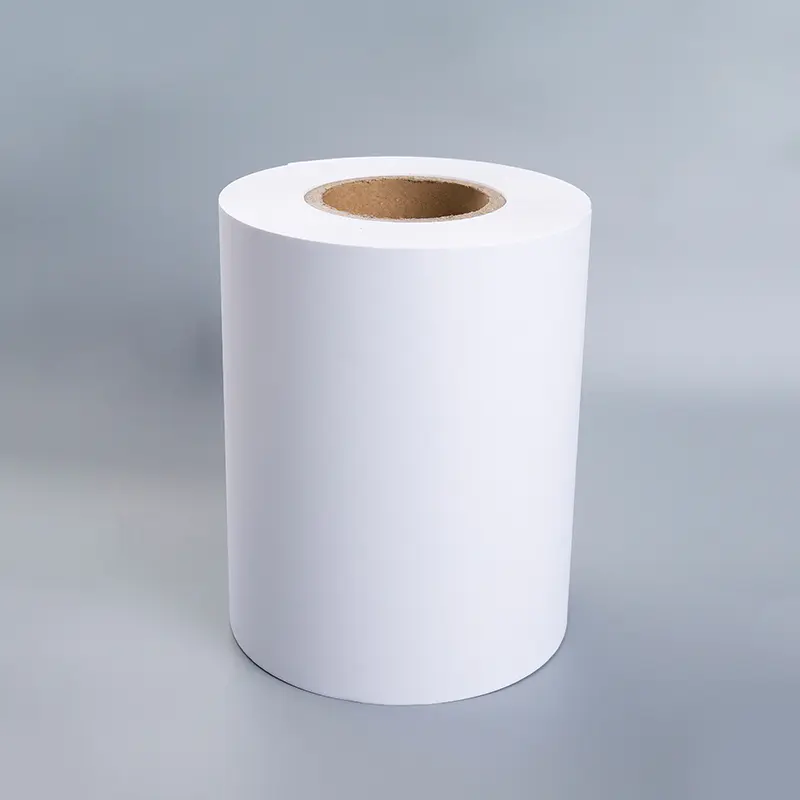
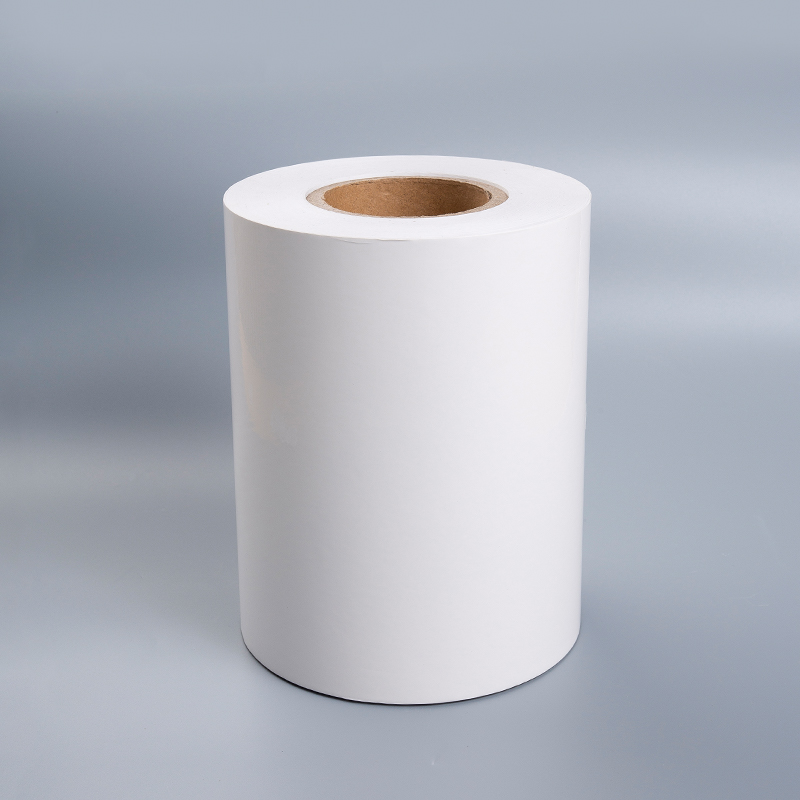
Silver aluminum foil paper can be supplied in jumbo roll widths of 1000mm, 1020mm, 1080mm, and 1530mm. These widths are practical for converters who need to slit rolls into smaller label stock sizes or integrate the material into high-volume production. Jumbo roll supply allows efficient inventory management and supports large-scale label manufacturing.
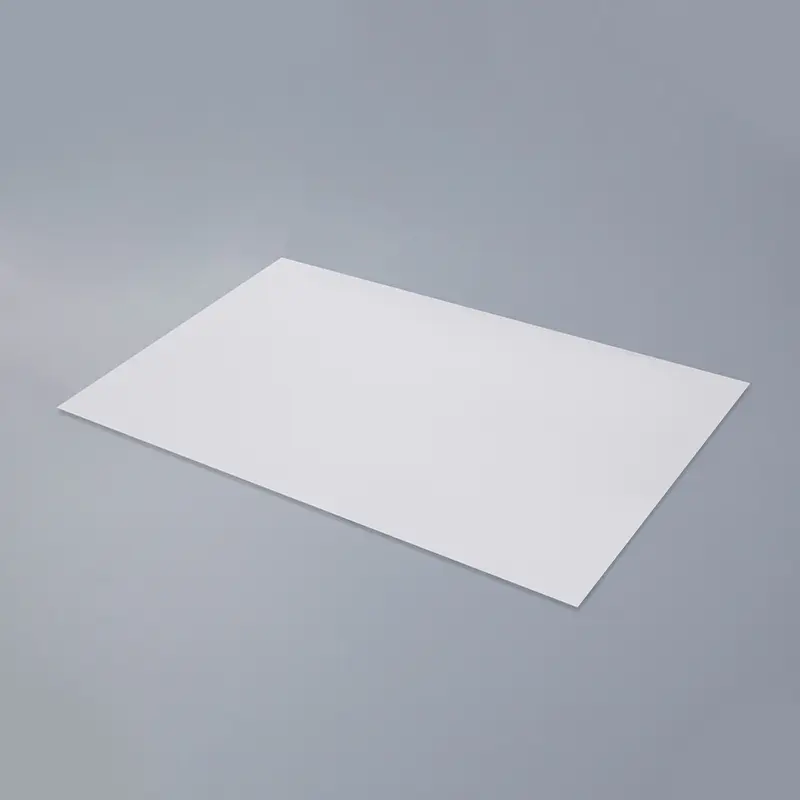
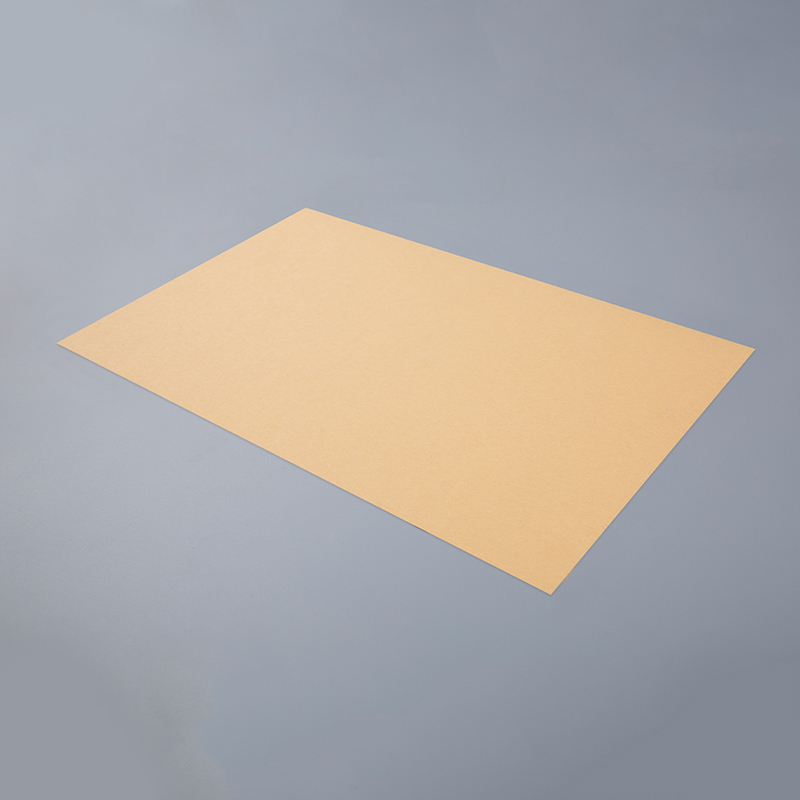
Sheet sizes include A4, A3, 20 x 30, 21 x 30, 24 x 36, 50cm x 70cm, and 70cm x 100cm, with customized sheet sizes available. Sheet format is useful for printing shops, digital printing operations, sampling, short-run label production, craft packaging, and specialty applications. The ability to provide both roll and sheet formats gives customers more freedom to match the material with their equipment and order volume.
For customers using automatic label converting systems, roll supply is often the preferred option. For customers using flatbed printing, screen printing, digital printing, offset printing, or manual cutting, sheet supply may be more convenient. This flexibility reduces purchasing limitations and helps customers optimize workflow.
Applications in Medicine and Healthcare
Medicine and healthcare labels require clarity, durability, and trustworthy appearance. Labels may carry product names, dosage information, batch numbers, expiration dates, regulatory symbols, anti-counterfeiting features, storage instructions, and safety warnings. A label that curls, fades, lifts, or becomes unreadable can create operational and safety risks.
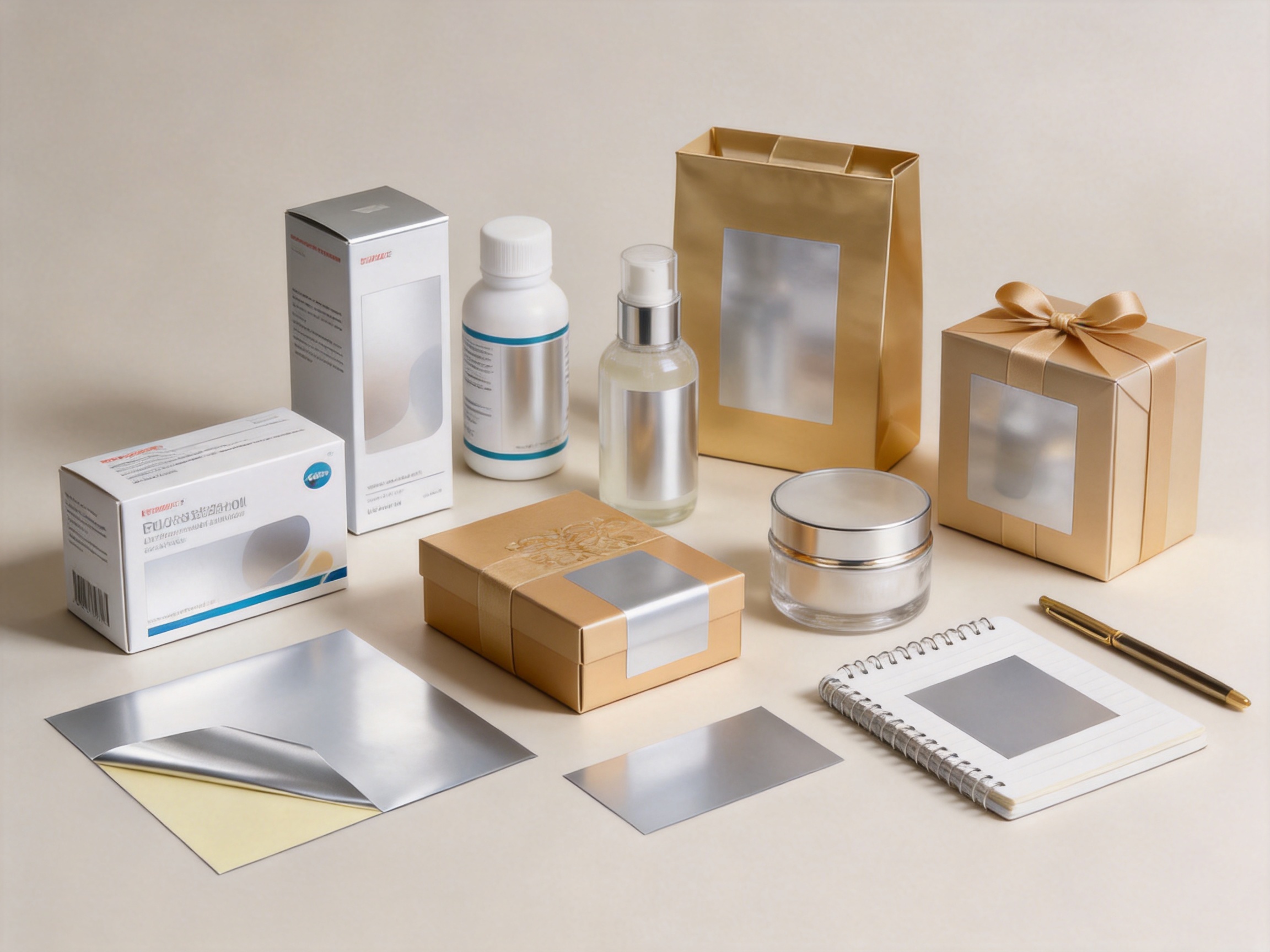
Silver aluminum foil paper is suitable for high-grade pharmaceutical information labels because it combines a clean metallic appearance with stable performance. The matt silver surface conveys hygiene and precision, which aligns well with medical and healthcare product expectations. It can be used on cartons, boxes, bottles, containers, sample kits, medical accessories, and premium healthcare packaging.
In addition, the option of different adhesives allows the label material to be adapted to specific medical packaging substrates. For example, removable adhesive may be used for temporary identification, while stronger adhesive may be used for permanent package labeling. If products are stored in colder environments, anti-freeze or cryogenic adhesive options can be considered.
Applications in Food Packaging
Food packaging labels need to remain attractive and readable through filling, packing, warehousing, transportation, and retail display. Many food products are exposed to temperature changes, moisture, refrigeration, or handling. Ordinary labels may curl or wrinkle when exposed to humidity, which can reduce shelf appeal and cause scanning issues.
Silver aluminum foil paper offers an upscale look for specialty foods, gifts, sauces, teas, confectionery, bakery packaging, nutrition products, and premium retail food items. The metallic silver face can highlight brand identity and create a more refined shelf presence. For products positioned as high-quality or gift-worthy, the label can help communicate premium value immediately.
The availability of anti-freeze adhesive is especially valuable for refrigerated and cold-chain food products. Labels that lose adhesion in cold conditions can become a serious problem in distribution. By selecting the appropriate adhesive, food packaging companies can improve label reliability while maintaining visual quality.
Applications in Cultural Goods and Premium Stationery
Cultural goods, stationery, gift boxes, art supplies, commemorative products, and educational products often rely on packaging details to communicate creativity and quality. A silver aluminum foil label can serve as a brand seal, certificate label, product identification label, limited-edition label, or decorative highlight.
For cultural and stationery products, label flatness and surface quality are important because customers often inspect the product closely. Wrinkles, lifted edges, uneven metallic appearance, or poor die-cutting can reduce perceived value. A stable self-adhesive aluminum foil paper helps maintain a refined presentation from production through retail display.
Because the material can be supplied in sheets, it is also useful for specialty printers and creative packaging producers who handle short runs or customized designs. Customized sheet sizes can support unique project requirements, while roll formats remain suitable for larger production volumes.
Printing and Finishing Considerations
Silver aluminum foil paper can be used for a variety of label printing and finishing processes, depending on surface treatment, ink system, equipment, and customer requirements. Before mass production, printers should test ink adhesion, drying behavior, color density, barcode readability, and finishing compatibility. Metallic surfaces can behave differently from ordinary paper, so process optimization is important.
Common printing possibilities may include letterpress printing, flexographic printing, offset printing, screen printing, thermal transfer printing, and digital printing, depending on the exact material construction and surface requirements. For premium labels, additional finishing effects such as embossing, debossing, varnishing, spot coating, hot stamping, or die-cutting may be considered. These processes can further enhance the metallic label’s visual impact.
Because the face material has a matt silver appearance, designers should consider how ink colors interact with the metallic background. Dark colors often provide strong contrast, while transparent or light inks may produce special metallic effects. White ink or opaque underlayers may be used when accurate color reproduction is required. For barcode labels, contrast testing is especially important to ensure reliable scanning.
Die-cutting should be controlled to avoid cutting through the liner or causing rough edges. The quality of adhesive coating and liner release helps support smooth matrix removal. A consistent release liner can reduce web breaks and improve converting efficiency. This is one reason why liner selection is part of the overall product design rather than a minor accessory.
Packaging and Delivery Advantages
Proper packaging is essential for protecting self-adhesive materials during transportation and storage. Silver aluminum foil paper can be packed in sea-transit-worthy poly-wood pallet packing and carton packing, with options suitable for rolls or sheets from stock. This helps protect the material during export shipping and long-distance logistics.
For sheet supply, 100 sheets per ream can be packed with strong PE coated kraft paper wrapper. Strong pallets can be wrapped with stretch film and fastened with plastic fastening belts. This packaging method helps protect the sheets from moisture, dust, handling damage, and movement during transport. For international customers, stable export packing reduces the risk of receiving damaged or deformed materials.
Roll materials require careful protection against edge damage, compression, contamination, and moisture exposure. Palletized packing supports safer loading, unloading, warehousing, and container shipping. By offering both roll and sheet packing solutions, the manufacturer supports different customer operating models, from large label converters to smaller printing and packaging businesses.
Manufacturing Strength Behind the Material
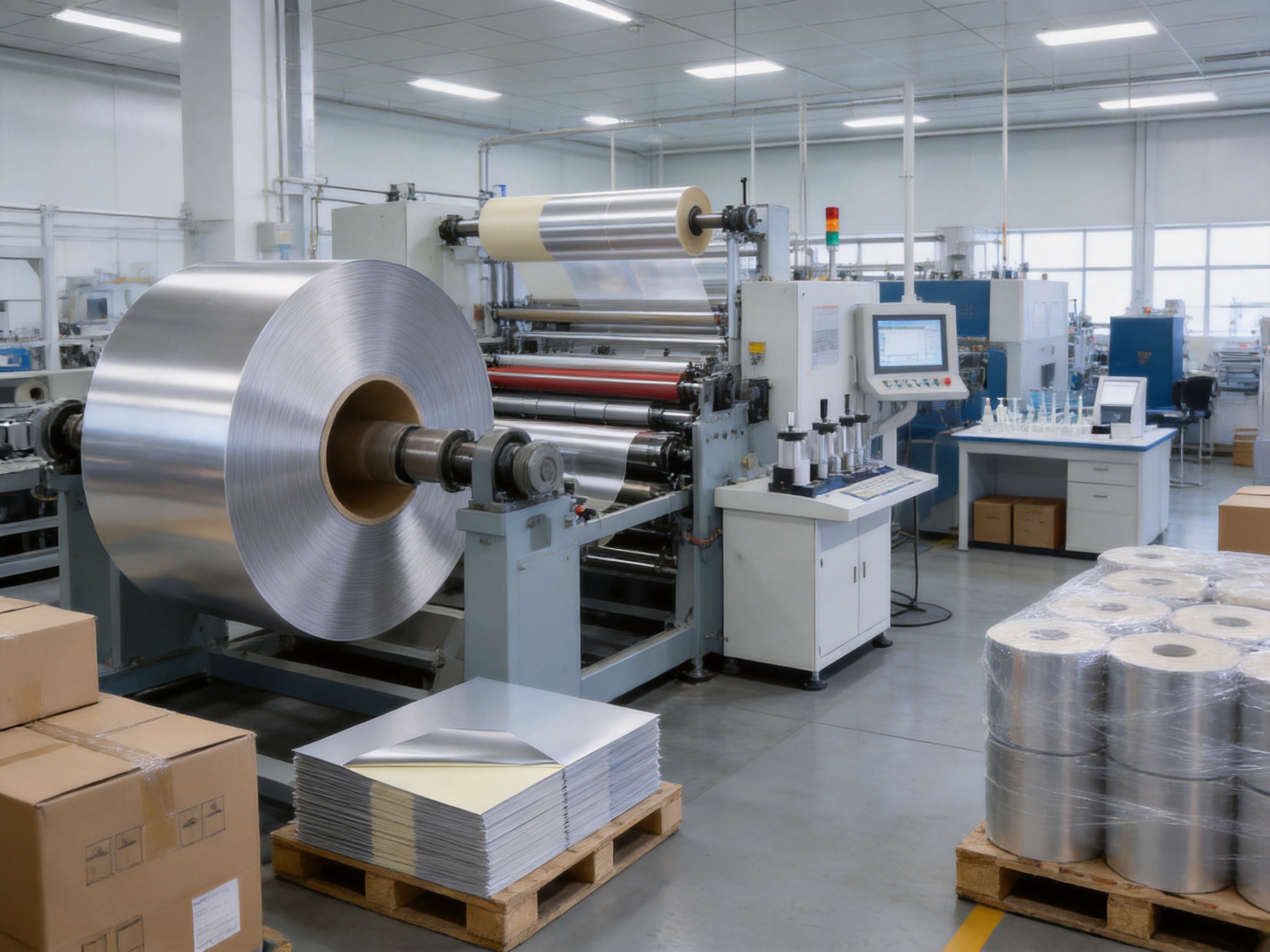
The performance of silver aluminum foil paper depends not only on raw materials but also on manufacturing control. Suzhou Piaozhihua Composite Material Technology Co., Ltd. specializes in high-grade self-adhesive labels and integrates research and development, production, sales, and after-sales service. The company’s manufacturing foundation includes gluing, laminating, and cutting production lines, enabling it to control key processes internally.
Internal production capabilities are important because self-adhesive materials require precise coordination among face material, adhesive, liner, coating weight, drying conditions, lamination tension, and cutting accuracy. If any stage is poorly controlled, the final label material may suffer from curling, uneven adhesion, unstable release, edge defects, or printing problems. A full-process production system makes it easier to maintain consistency and respond to customer requirements.
The company has an annual production capacity of more than 280 million square meters, placing it among leading self-adhesive product manufacturers in China. Large production capacity gives customers confidence in supply continuity, especially for long-term projects, export orders, repeated label programs, and seasonal packaging demand. It also supports stable cost control and efficient production scheduling.
With more than 20 years of OEM manufacturing experience, the company understands that different customers require different material combinations. Some customers need stronger adhesive, some need removable labels, some need sheet materials for digital printing, and some need roll materials for high-speed converting. Experience across many applications allows the manufacturer to recommend suitable structures instead of offering only a standard product.
Advanced Gluing Process
The gluing process is one of the most important steps in producing self-adhesive aluminum foil paper. Adhesive coating must be uniform across the full web width, and coating weight must be controlled to meet bonding requirements without causing adhesive overflow, uneven tack, or poor converting behavior. A controlled gluing line helps ensure that the adhesive layer performs consistently from one roll or sheet to another.
Water-based, hotmelt, solvent, anti-freeze, removable, cryogenic, and rubber adhesive systems each have different processing requirements. Temperature, viscosity, coating method, drying or curing conditions, line speed, and surface compatibility must be managed carefully. The ability to process multiple adhesive types demonstrates technical flexibility and supports a wider range of customer applications.
For aluminum foil face materials, adhesive compatibility is especially important. The adhesive must bond well to the face material while also achieving the desired adhesion to the final application surface. Poorly matched adhesives can result in delamination, edge lifting, or weak bonding. A manufacturer with experience in composite materials can optimize adhesive selection and lamination conditions for reliable final performance.
Precision Laminating
Laminating combines the face material, adhesive, and liner into a stable self-adhesive construction. During lamination, tension control is critical. If tension is uneven, the material may curl, wrinkle, or develop internal stress. Such defects may not always appear immediately but can cause problems after printing, cutting, or label application.
Precision laminating helps create a flat and stable material structure. This contributes directly to the product’s ability to resist warping and deformation after pasting. Good lamination also supports smoother printing and converting because the material remains consistent during machine processing.
For metallic face materials, surface protection is also important. The matt silver aluminum surface must remain clean, uniform, and free from scratches or contamination. Controlled production environments, careful web handling, and quality inspection help preserve the premium appearance that customers expect from aluminum foil label stock.
Accurate Cutting and Slitting
Cutting and slitting determine whether the material can be delivered in the correct roll widths, sheet sizes, and edge quality. Poor slitting can create rough edges, dust, telescoping rolls, or uneven roll tension. Poor sheet cutting can lead to inconsistent dimensions, skewed sheets, and printing registration problems. For label converters and printers, accurate size control is essential.
The company’s cutting capabilities support jumbo rolls, slit rolls, and sheet formats. Standard jumbo roll widths include 1000mm, 1020mm, 1080mm, and 1530mm, while sheet sizes include A4, A3, and multiple larger sheet dimensions. Custom sizes can be produced to match customer equipment and project needs.
Accurate cutting also reduces waste at the customer’s facility. When materials arrive with consistent dimensions and clean edges, printers and converters can run production more efficiently. This advantage may not be obvious from a simple product description, but it can significantly affect total production cost.
Quality Inspection and Laboratory Support
A strong self-adhesive label material program requires testing. The company has its own testing laboratory and advanced inspection equipment to support product quality. Testing may include adhesive performance, release force, thickness, coating uniformity, dimensional stability, surface appearance, and converting behavior. These checks help ensure that customers receive materials that meet practical performance expectations.
For silver aluminum foil paper, inspection is particularly important because both appearance and function matter. A label material may have strong adhesive but poor surface uniformity, or it may look attractive but fail during die-cutting or application. Comprehensive quality control helps balance all performance factors.
Quality inspection also supports OEM and ODM projects. When customers provide drawings, samples, or special requirements, laboratory evaluation can help develop the correct construction. This is valuable for customers who need labels for unusual substrates, difficult environments, special printing systems, or specific packaging designs.
OEM and ODM Customization Capability
Customization is one of the major strengths behind this product. The company accepts OEM and ODM services and can produce products based on customer drawings or samples. This is important because the self-adhesive label market is highly diverse. A pharmaceutical customer may need a stable information label, while a food customer may need low-temperature adhesion, and a cultural goods customer may need a decorative sheet material for short-run printing.
Customization can involve face material thickness, adhesive type, liner type, roll width, sheet size, packing method, and performance requirements. Rather than forcing all customers into one specification, the manufacturer can adapt the product structure. This flexibility helps customers improve their own label performance and differentiate their packaging in the market.
OEM experience also supports brand owners and converters who want a stable supply partner. When a label material becomes part of a product’s packaging system, consistency is critical. Customers need repeat orders to match previous batches in appearance, adhesion, and converting behavior. Experienced manufacturing and quality control help maintain this repeatability.
Sustainability and Responsible Material Development
The company’s brand positioning includes sustainable development and environmental protection, with efforts to develop eco-friendly solutions involving face materials, adhesives, and backing papers. In the label industry, sustainability is becoming increasingly important as brands seek to reduce waste, improve recyclability, and select responsible packaging components.
Silver aluminum foil paper is a premium material, and responsible development means matching the material to applications where its functional and decorative advantages justify its use. Appropriate adhesive selection, efficient converting, stable quality, and reduced production waste all contribute to more responsible material usage. When labels run smoothly through printing and application, fewer defective products are produced, which also supports waste reduction.
Water-based adhesive options may be preferred by customers seeking cleaner processing characteristics, while liner selection can be optimized according to converting and handling needs. As sustainability expectations continue to evolve, the ability to develop customized solutions becomes increasingly valuable.
Advantages Over Competitors
Silver aluminum foil paper offers several advantages compared with many competing label materials and suppliers. The first advantage is the combination of premium appearance and practical stability. Some metallic labels look attractive but curl or lift after application. Some stable labels perform well but lack visual appeal. This product is designed to deliver both.
The second advantage is adhesive versatility. Many competitors provide only standard permanent adhesive. This may be acceptable for basic packaging, but it limits performance in cold, removable, high-tack, or difficult-surface applications. With multiple adhesive options available, the material can be engineered for the actual use environment.
The third advantage is liner flexibility. A high-quality liner supports smooth converting, accurate die-cutting, and reliable dispensing. By offering glassine, release paper, art paper, CCK, and transparent PET liners in multiple weights or thicknesses, the product can serve both common and specialized production needs.
The fourth advantage is manufacturing scale. With annual production capacity exceeding 280 million square meters, the manufacturer can support large orders, stable supply programs, and export demand. Smaller suppliers may struggle with consistency or delivery time when orders increase. Large-scale production capacity helps reduce that risk.
The fifth advantage is integrated manufacturing. Gluing, laminating, and cutting capabilities allow better process control. Instead of relying heavily on external processing at every stage, the company can manage key production steps and quality inspection internally. This can improve consistency, speed up customization, and support technical problem-solving.
The sixth advantage is practical export packing. Sea-transit-worthy poly-wood pallet packing, carton packing, PE coated kraft paper wrapping, stretch film, and plastic fastening belts help protect the product during international transportation. Good packing reduces damage, moisture exposure, and handling risk.
The seventh advantage is long-term industry experience. More than 20 years of OEM manufacturing experience gives the manufacturer a practical understanding of customer needs, material behavior, and problem prevention. In self-adhesive materials, experience is important because many performance issues only appear during real printing, converting, shipping, or application.
Storage and Handling Recommendations
To achieve the best performance, silver aluminum foil paper should be stored and handled properly. Even high-quality self-adhesive materials can be affected by poor storage conditions. Materials should generally be stored in a clean, dry, and temperature-controlled environment. Extreme humidity, direct sunlight, high heat, and heavy compression should be avoided.
Rolls should be stored upright or according to recommended warehouse procedures to prevent deformation. Sheets should remain in protective wrapping until use to reduce moisture influence and surface contamination. Before printing or converting, materials should be acclimated to the production environment when there is a significant temperature difference between storage and workshop conditions.
Operators should avoid touching the aluminum surface with dirty or oily hands, as surface contamination may affect printing results. During printing, ink compatibility and drying should be confirmed. During application, the substrate surface should be clean, dry, and free from dust, oil, and condensation. Correct surface preparation helps the adhesive reach its intended bonding performance.
How to Select the Right Construction
Choosing the right silver aluminum foil paper construction begins with understanding the end-use application. The first question is the substrate. A label applied to paperboard may require different adhesive performance than a label applied to plastic, glass, metal, rubber, or textured packaging. Surface energy, roughness, curvature, and cleanliness all affect adhesion.
The second question is the use environment. If the product will be stored at room temperature, standard water-based adhesive may be suitable. If it will face refrigeration or freezing, anti-freeze adhesive may be a better choice. If it will be exposed to demanding conditions, solvent adhesive or another specialized adhesive may be considered.
The third question is whether the label must be permanent or removable. Permanent labels are designed to stay attached, while removable labels should be cleanly removed under intended conditions. Choosing the wrong adhesive can create either poor bonding or difficult removal, so this decision should be made early.
The fourth question is the printing and converting process. Roll-fed flexographic printing, sheet-fed offset printing, digital printing, screen printing, and thermal transfer printing may each have different material requirements. Liner selection, sheet size, roll width, and surface compatibility should be matched to the equipment.
The fifth question is the required appearance. If the label must present a premium metallic look with clear information printing, matt silver aluminum foil paper is an excellent candidate. Design testing should confirm ink color, contrast, barcode readability, and finishing results.
Q&A Section
Q1: What is silver aluminum foil paper used for?
Silver aluminum foil paper is used for premium self-adhesive labels, high-grade information labels, medicine labels, food packaging labels, cultural goods labels, gift packaging labels, decorative labels, and product identification labels. It is chosen when a label must provide both a refined metallic appearance and reliable application performance.
Q2: What makes this material different from ordinary self-adhesive paper?
Ordinary self-adhesive paper usually has a white or coated paper face and may be more sensitive to humidity. Silver aluminum foil paper has a matt metallic face that improves visual value and helps reduce long-term warping or deformation after application. It is better suited for premium packaging and demanding appearance requirements.
Q3: Can the adhesive be customized?
Yes. The standard adhesive is water-based adhesive, but hotmelt adhesive, solvent adhesive, anti-freeze adhesive, removable adhesive, cryogenic adhesive, and tyre-grade rubber adhesive are also available. This allows the label material to be matched to different substrates, temperatures, and application conditions.
Q4: What liner options are available?
The standard liner is 60g white glassine paper. Other options include multiple weights of glassine paper, release paper, art paper, CCK liner, and transparent PET liner in several thicknesses. The liner can be selected according to printing, die-cutting, dispensing, sheet handling, and automatic labeling requirements.
Q5: Is the product available in rolls and sheets?
Yes. Jumbo roll widths include 1000mm, 1020mm, 1080mm, and 1530mm. Sheet sizes include A4, A3, 20 x 30, 21 x 30, 24 x 36, 50cm x 70cm, and 70cm x 100cm. Customized sheet sizes can also be produced.
Matt silver provides a metallic appearance without excessive glare. It looks refined and modern while preserving readability for printed text, logos, and product information. This makes it suitable for medicine, food, cultural goods, cosmetics, electronics, and gift packaging.
Q7: How does the product perform in changing temperature and humidity?
After pasting, the label is designed to resist the influence of ambient temperature and humidity, helping prevent warping and deformation over time. For special low-temperature applications, anti-freeze or cryogenic adhesive options can be selected.
Q8: What manufacturing strengths support product quality?
The manufacturer has integrated gluing, laminating, and cutting production lines, an annual production capacity of more than 280 million square meters, more than 20 years of OEM manufacturing experience, a testing laboratory, advanced inspection equipment, and OEM and ODM customization capabilities.
Q9: What packing methods are available?
Roll and sheet packing are available. Sea-transit-worthy poly-wood pallet packing and carton packing can be used. Sheet materials can be packed as 100 sheets per ream with strong PE coated kraft paper wrapper, and pallets can be wrapped with stretch film and fastened with plastic fastening belts.
Q10: How should customers choose the correct specification?
Customers should consider the application surface, temperature conditions, required permanence or removability, printing method, converting process, roll or sheet format, and final appearance. For demanding projects, sample testing is recommended before mass production.
Conclusion
Silver aluminum foil paper is a high-value self-adhesive label material for customers who require premium appearance, stable performance, flexible adhesive options, and dependable converting behavior. Its matt silver surface enhances product presentation, while its resistance to warping and deformation helps maintain a neat label appearance after application. With applications in medicine, food, cultural goods, premium packaging, and product identification, it meets the needs of industries where both function and brand image matter.
The product’s advantages come not only from its material structure but also from the manufacturing strength behind it. Integrated gluing, laminating, and cutting processes, broad adhesive and liner customization, strong production capacity, laboratory testing, advanced inspection equipment, and long-term OEM and ODM experience all contribute to consistent quality. For customers comparing label materials and suppliers, silver aluminum foil paper offers a strong combination of visual differentiation, technical adaptability, and reliable supply capability.
Whether used in roll form for large-scale label conversion or sheet form for specialized printing projects, silver aluminum foil paper provides a versatile solution for premium self-adhesive labeling. Its ability to combine decorative metallic appeal with practical label stability makes it a competitive choice for brands, converters, printers, and packaging companies seeking better performance and stronger market presentation.
References
1. Pressure Sensitive Tape Council. Pressure Sensitive Adhesive Technology: Technical Guide for Label and Tape Applications.
2. FINAT. Technical Handbook for Self-Adhesive Label Materials and Converting.
3. ASTM International. Standard Test Methods for Pressure-Sensitive Adhesive-Coated Tapes and Label Materials.
4. Handbook of Pressure Sensitive Adhesive Technology, edited by Donatas Satas.
5. Packaging Materials and Converting Technology, industry reference materials on paper, film, foil, adhesives, and release liners.