
 English
 Español
 русский
 Français
 عربى
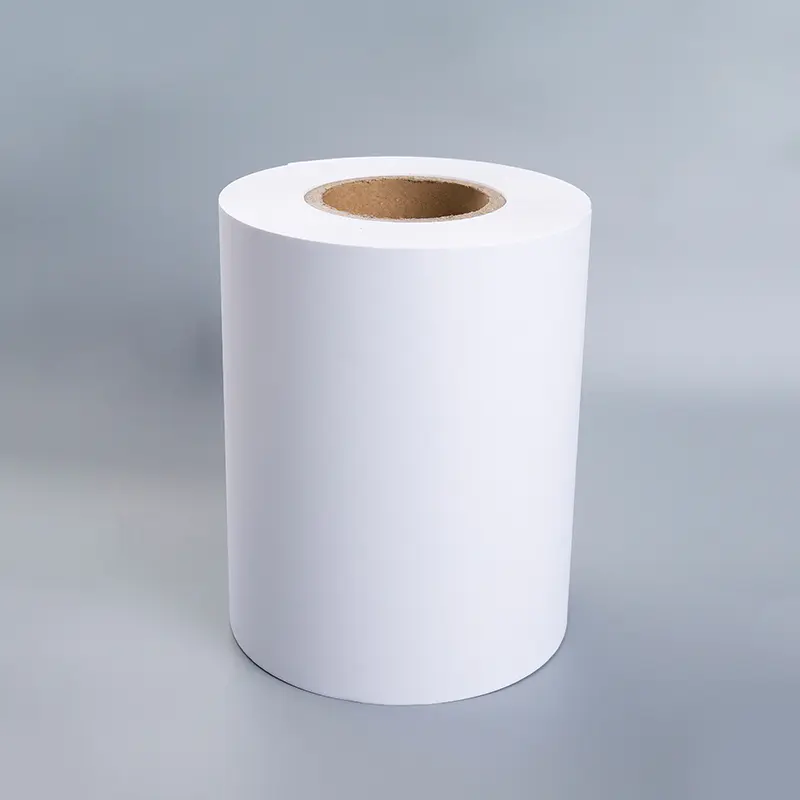
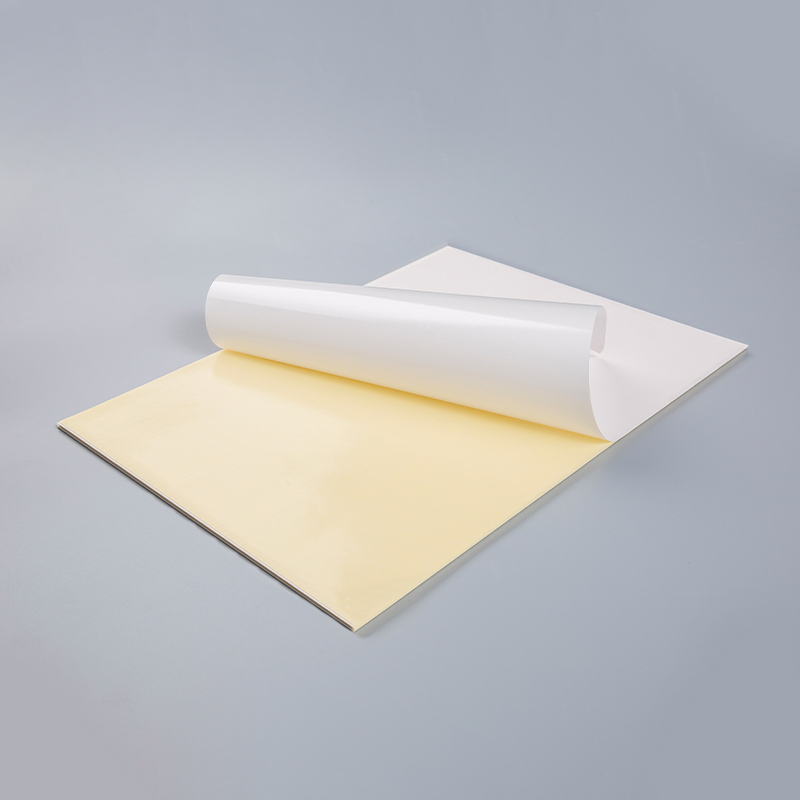
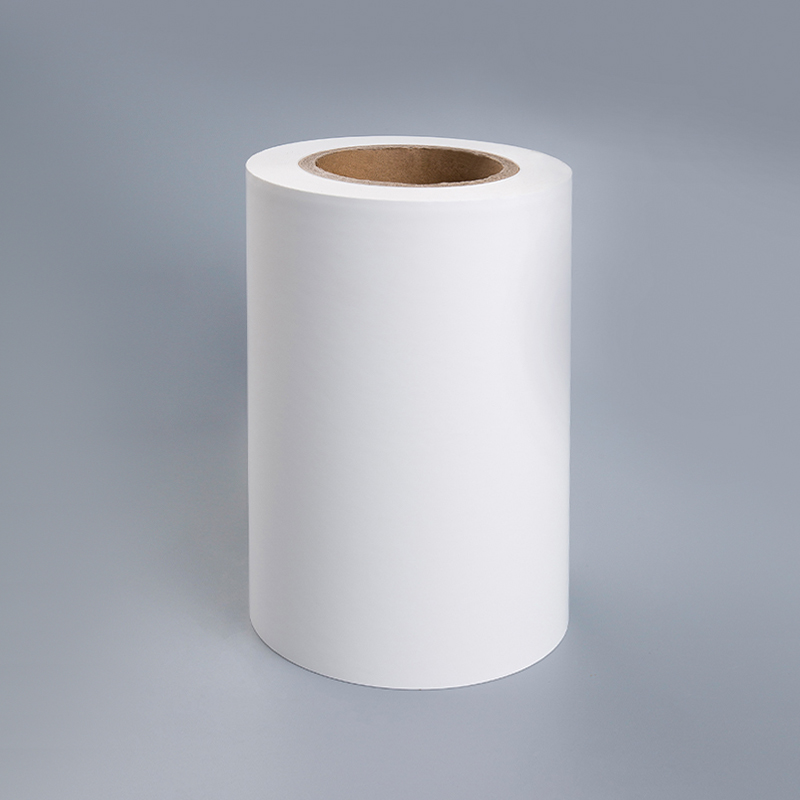
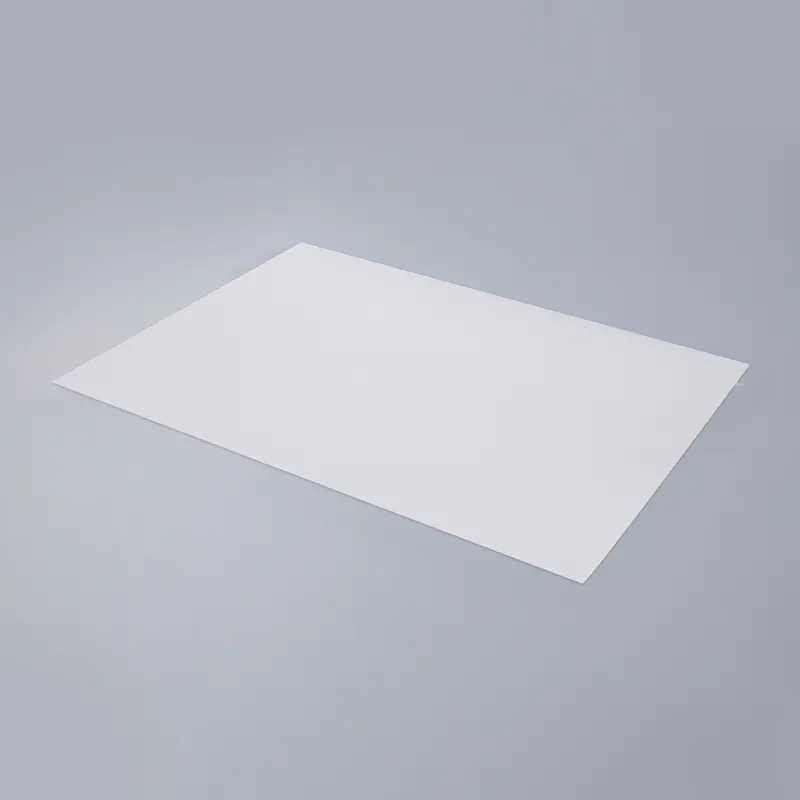
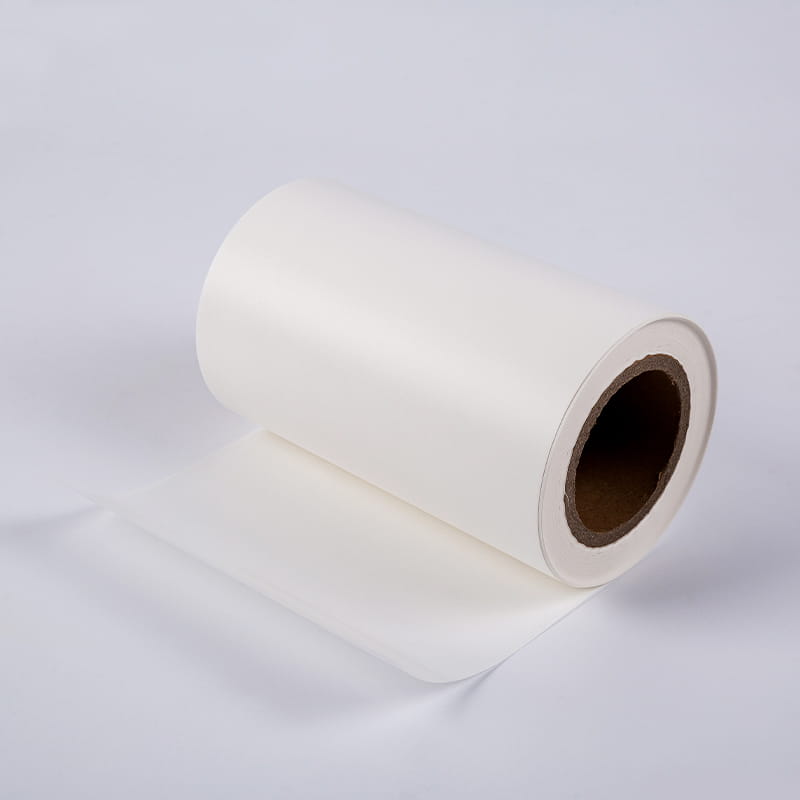
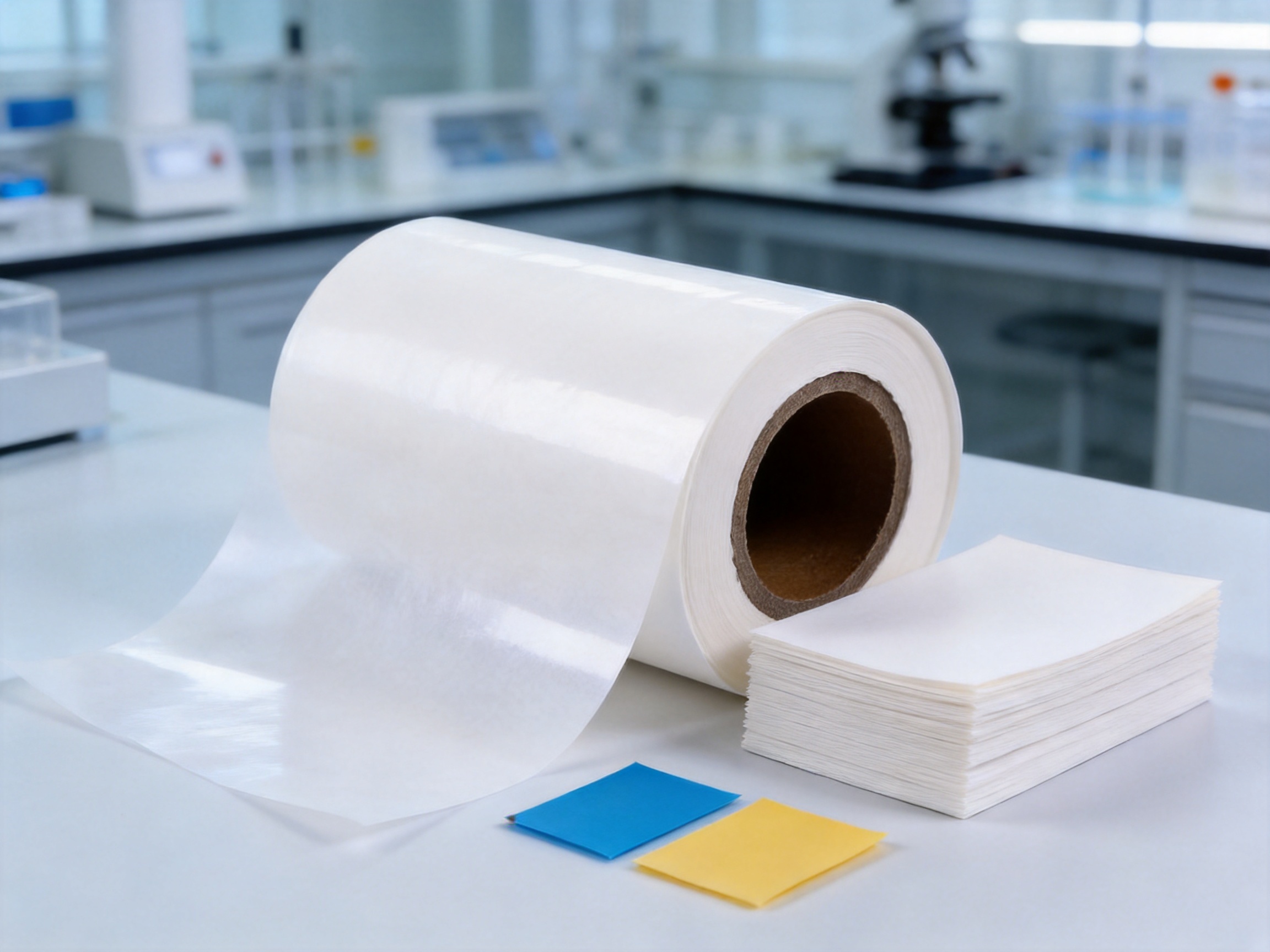
عربىWhite glassine paper is a specialized, dense, smooth, and highly uniform base material designed for release liners, self-adhesive label constructions, bar code labels, tapes, sticky industrial products, and precision converting applications. In modern label manufacturing, the liner is more than a disposable carrier. It controls release stability, supports die-cutting accuracy, protects adhesive performance, enables automatic labeling speed, and helps converters maintain consistent productivity from roll to roll and sheet to sheet.
For buyers in the self-adhesive label, special label material, tape, packaging, and industrial converting sectors, white glassine paper offers a strong balance of strength, transparency, smoothness, heat resistance, moisture resistance, and oil resistance. It is especially suitable for plate crosscutting, rotary processing, high-speed automatic labeling, special tapes, double-sided tape substrates, trademarks, laser anti-counterfeiting labels, and other release applications where precision and stability are essential.
Suzhou Piaozhihua Composite Material Technology Co., Ltd. manufactures and supplies glassine paper and related self-adhesive materials with a production system built around gluing, laminating, cutting, inspection, customization, and after-sales support. With more than 20 years of OEM manufacturing experience, an annual production capacity exceeding 280 million square meters, advanced inspection equipment, a dedicated testing lab, and strong ODM and OEM capabilities, the company is positioned to support customers requiring reliable, scalable, and customized label material solutions.
Content
- 1 Understanding White Glassine Paper
- 2 Core Product Specifications
- 3 Why Glassine Paper Matters in Self-Adhesive Material Construction
- 4 Key Performance Advantages
- 5 Applications Across Label and Adhesive Industries
- 6 Advantages Over Common Competing Materials
- 7 Manufacturing Strength Behind the Product
- 8 Quality Control from Raw Material to Delivery
- 9 How White Glassine Paper Improves Converting Efficiency
- 10 Sustainability and Responsible Material Development
- 11 Customization for Different Customer Needs
- 12 Company Strength and Market Support
- 13 Why Buyers Choose This White Glassine Paper
- 14 Technical Considerations for Selecting White Glassine Paper
- 15 Q&A Section
- 15.1 Q1: What is white glassine paper mainly used for?
- 15.2 Q2: Why is glassine paper preferred for release liner applications?
- 15.3 Q3: What grammage options are available?
- 15.4 Q4: Can the paper be supplied in colors other than white?
- 15.5 Q5: What roll widths are available?
- 15.6 Q6: Are sheet sizes available?
- 15.7 Q7: What advantages does this product have over ordinary paper liners?
- 15.8 Q8: Is it suitable for high-speed automatic labeling?
- 15.9 Q9: How is the product packaged for delivery?
- 15.10 Q10: Does the manufacturer support OEM and ODM orders?
- 16 Conclusion
- 17 References
- 18 Product: White Glassine Paper
Understanding White Glassine Paper
Glassine paper is a highly refined paper that has been processed to achieve a smooth, dense, and semi-transparent structure. Compared with ordinary paper, glassine has a much tighter fiber formation, better surface uniformity, and improved resistance to penetration by oil, moisture, and adhesives. These characteristics make it a preferred base paper for silicone release coating and self-adhesive label applications.
White glassine paper is especially valued because it provides a clean, bright, and professional appearance while maintaining the functional advantages required in release materials. It can be used as a release liner after silicone treatment, as a backing paper for labels, or as a support material in converting processes that require consistent thickness, smooth feeding, and dependable strength.
The product described here is available in common grammage options including 50 g, 60 g, 80 g, 100 g, and 120 g. This range allows customers to choose the most suitable weight according to application requirements. Lower grammage options are commonly selected for lightweight label constructions, high-volume labeling, and cost-sensitive applications, while heavier grades may be preferred where additional stiffness, handling strength, or dimensional stability is needed.
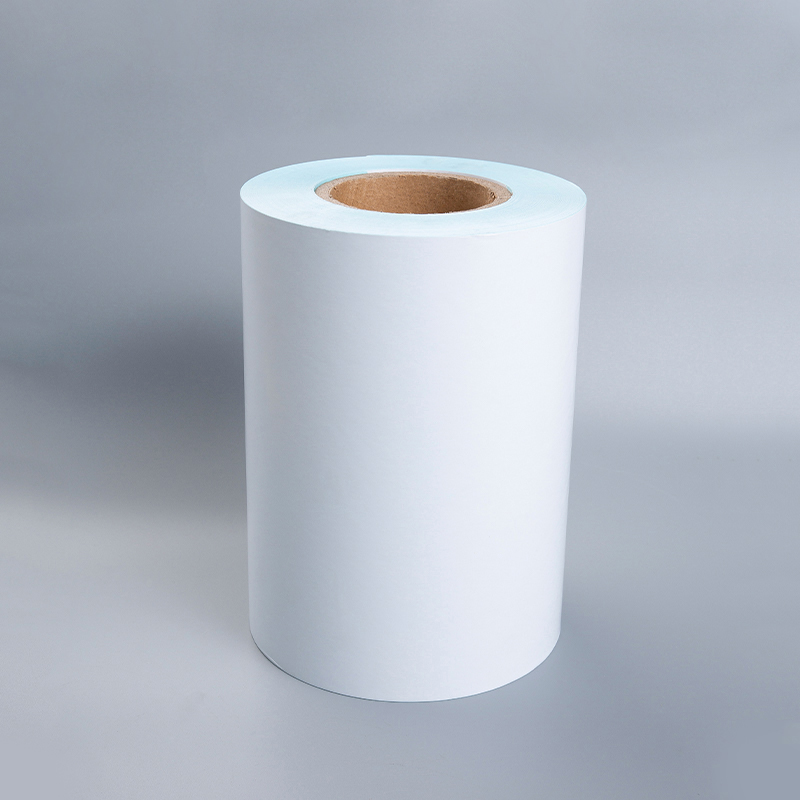
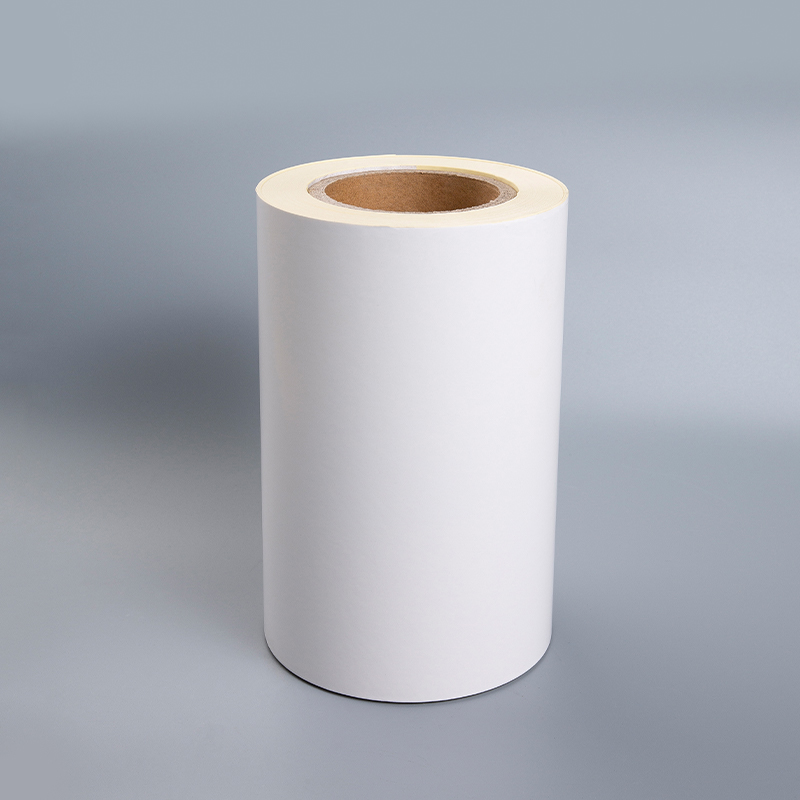
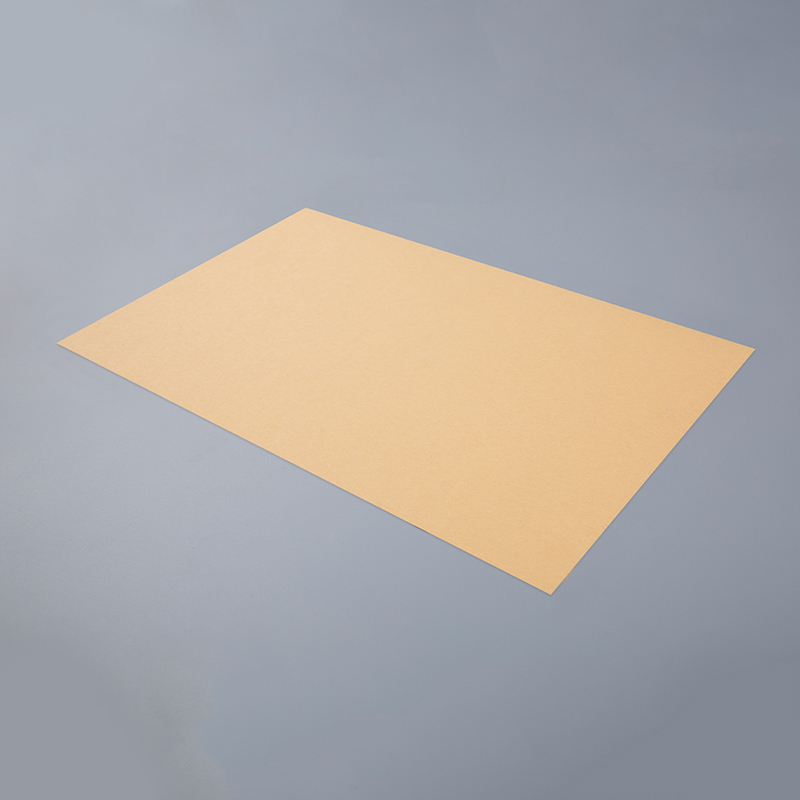
Although white is the main color, blue and yellow options are also available. Color variation can help customers differentiate product lines, identify release force categories, simplify inventory control, or meet specific visual requirements in converting and packaging environments.
Core Product Specifications
The following table summarizes the main specification information for white glassine paper. Customization is available for customers requiring specific roll widths, sheet dimensions, grammage, or packaging formats.
Item |
Specification |
Application Value |
Material |
Glassine paper |
Dense, smooth, and uniform base for release and label applications |
Available Grammage |
50 g, 60 g, 80 g, 100 g, 120 g |
Supports lightweight, standard, and heavy-duty label constructions |
Main Color |
White |
Clean appearance and broad compatibility with label production |
Optional Colors |
Blue and yellow |
Useful for product differentiation and operational identification |
Jumbo Roll Width |
1000 mm, 1020 mm, 1080 mm, 1530 mm |
Suitable for slitting, laminating, and high-volume converting |
Sheet Sizes |
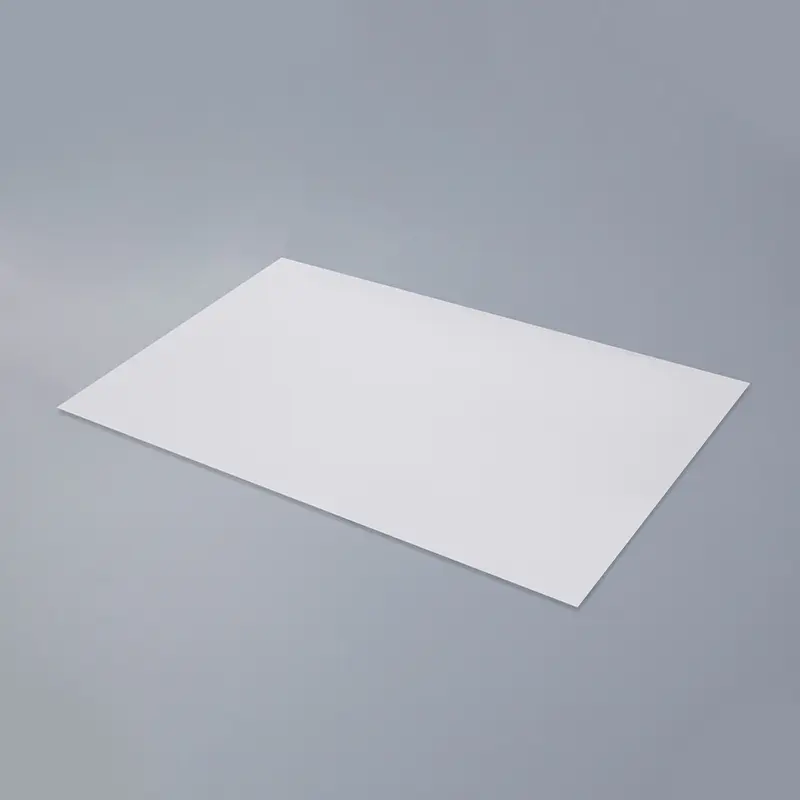
A4, A3, 20 x 30, 21 x 30, 24 x 36, 50 cm x 70 cm, 70 cm x 100 cm |
Convenient for sheet-fed applications and sample processing |
Custom Size |
Available upon request |
Supports OEM, ODM, and project-specific requirements |
Packaging |
Roll or sheet packing with pallet and carton options |
Designed for sea transit, storage safety, and efficient handling |
Why Glassine Paper Matters in Self-Adhesive Material Construction
In a typical self-adhesive label structure, there are three major layers: the face material, the adhesive, and the release liner. Many buyers focus mainly on the face material and adhesive, but the release liner has a direct effect on converting efficiency and end-use performance. A poor liner can cause adhesive transfer, unstable release, curling, die-cutting defects, label lifting, web breaks, or labeling machine downtime.
White glassine paper is widely used because it provides a strong and stable foundation for silicone release coating. Its smooth surface helps silicone distribute evenly, which contributes to stable release force. Its dense fiber structure reduces absorption variation, helping coating remain on the surface rather than penetrating too deeply into the paper. This improves consistency, reduces waste, and supports cleaner label separation during application.
For high-speed automatic labeling, release consistency is essential. Labels must separate from the liner at the right moment and with predictable force. If release is too tight, the label may fail to dispense. If it is too loose, labels may pre-release, shift, or detach during transport. White glassine paper helps maintain stable performance because of its uniform base paper formation and good mechanical strength.
For converters, the liner also affects die-cutting quality. When the base paper is dense and consistent, die-cutting depth can be controlled more accurately. The die can cut through the face material and adhesive without cutting too deeply into the liner. This reduces the risk of liner breakage, matrix stripping problems, and label edge defects.
Key Performance Advantages
Uniform and Dense Structure
One of the most important advantages of white glassine paper is its uniform and dense paper formation. A consistent structure helps reduce thickness variation, surface irregularity, and weak points across the roll or sheet. In release applications, this uniformity is valuable because silicone coating and adhesive interaction depend heavily on the surface properties of the liner.
Compared with ordinary backing paper, glassine paper offers a much more refined surface. The fibers are compacted and treated to achieve smoothness and density. This makes it less likely to absorb coating unevenly and more suitable for precision release control. For customers producing barcode labels, logistics labels, product identification labels, or specialty adhesive products, stable liner behavior improves both quality and efficiency.
Good Strength for Converting and Handling
Strength is essential during printing, laminating, slitting, die-cutting, sheeting, rewinding, and automatic labeling. White glassine paper provides good tensile strength and handling durability, making it suitable for both roll-fed and sheet-fed processes. Strong base paper reduces the risk of tearing, web breaks, and production interruptions.
In high-volume converting lines, even a small number of web breaks can result in significant material loss and downtime. A stronger liner helps converters maintain continuous production, especially when running at higher speeds or working with demanding adhesive constructions. For end users, improved liner strength also supports smoother dispensing and cleaner label application.
Light Transmission and Process Visibility
Glassine paper is known for its light transmission. Although white glassine is not fully transparent, it provides better translucency than many ordinary paper liners. This can be beneficial during inspection, positioning, and processing. In certain applications, light transmission helps operators identify registration, coating quality, or material alignment more easily.
For laser anti-counterfeiting labels and precision specialty labels, material visibility and stable processing can be important. A reliable glassine base supports cleaner production and helps reduce defects associated with inconsistent liner opacity or formation.
High Temperature Resistance
Release liners and label materials may encounter elevated temperatures during coating, drying, printing, lamination, storage, transport, or end-use conditions. White glassine paper has good high-temperature resistance, making it suitable for processes where ordinary paper may deform, curl, or lose performance.
Temperature stability is especially important in silicone release processing and adhesive material production. If the base paper is unstable under heat, coating quality may suffer and final release performance may become inconsistent. A heat-resistant glassine liner helps maintain dimensional stability and contributes to predictable converting results.
Moisture Resistance
Moisture can affect paper-based materials by causing swelling, curling, waviness, and dimensional changes. White glassine paper provides moisture resistance that helps protect the liner structure and maintain process stability. This is important for label products stored or used in changing humidity conditions.
In global supply chains, materials may experience different climates during sea transportation, warehouse storage, and final use. A moisture-resistant liner helps reduce the risk of deformation and supports better roll appearance, sheet flatness, and label dispensing reliability.
Oil Resistance
Oil resistance is another important advantage of glassine paper. Adhesive products, industrial labels, tapes, and specialty converting materials may contact oily surfaces, machine environments, or packaging materials containing oils or plasticizers. Glassine paper’s compact surface helps resist oil penetration better than conventional paper.
This resistance helps preserve liner integrity and prevents unwanted interactions that could affect release or adhesive performance. For industrial sticky products, special tapes, and double-sided tape substrate applications, oil resistance contributes to reliable handling and longer material stability.
Compatibility with Rotary and Crosscutting Processes
White glassine paper is suitable for plate crosscutting and rotary converting. This makes it versatile for both sheet production and roll-to-roll processing. In rotary label converting, the liner must withstand tension, bending, die pressure, rewinding, and rapid dispensing. In crosscutting, the material must remain flat, cut cleanly, and stack consistently.
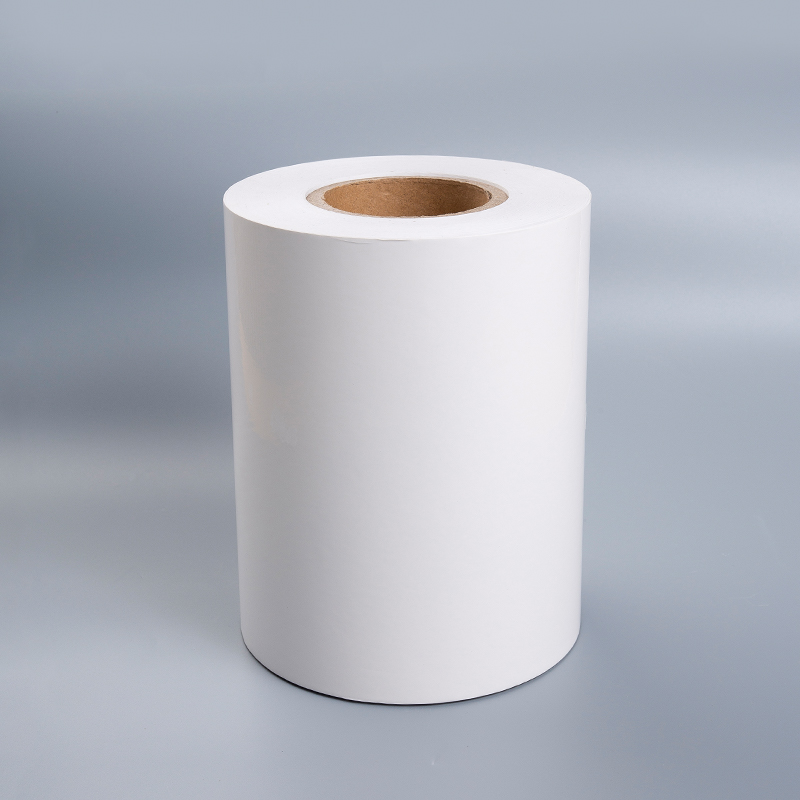
Because the product can be supplied in jumbo rolls and customized sheet sizes, it supports multiple production models. Converters can use wide rolls for slitting and laminating, while customers requiring sheets can choose standard formats such as A4, A3, 50 cm x 70 cm, and 70 cm x 100 cm, or request custom sizes.
Applications Across Label and Adhesive Industries
Self-Adhesive Labels
White glassine paper is widely used as a release base for self-adhesive labels. These labels are used in retail, logistics, food packaging, cosmetics, pharmaceuticals, electronics, industrial identification, and many other sectors. The liner must protect the adhesive until application and then allow the label to release cleanly.
In self-adhesive label production, uniform release performance helps reduce waste and improves labeling efficiency. When labels release properly, automatic applicators can run faster and more accurately. This is especially important for high-volume packaging lines where downtime can be costly.
Barcode Labels
Barcode labels require accurate printing, clean die-cutting, and reliable dispensing. In logistics, warehousing, and product traceability, barcode readability is critical. A liner that supports flatness and consistent label separation helps maintain print quality and application accuracy.
White glassine paper is a practical choice because it combines smoothness, strength, and release stability. It allows converters to produce barcode labels that can be handled efficiently in rolls or sheets and used in automatic labeling systems.
Special Tapes
Special tapes require release materials that can handle adhesive strength, roll pressure, and storage conditions. White glassine paper can serve as a release liner or substrate component for tape products, including specialty industrial tapes and double-sided tapes.
For tapes, release force must be carefully controlled. If the liner releases too easily, the tape may unwind or shift unexpectedly. If it releases too tightly, users may struggle to remove the liner. A dense glassine base supports stable release coating and helps manufacturers achieve the desired balance.
Double-Sided Tape Substrates
Double-sided tapes often require release liners on one or both sides. The liner protects adhesive surfaces and enables controlled unwinding, cutting, and application. White glassine paper is suitable for double-sided tape substrate trademarks and related adhesive constructions because it offers strong dimensional stability and release reliability.
In double-sided tape production, liner smoothness and strength are essential for clean slitting and accurate die-cutting. Glassine paper helps reduce production defects and supports efficient handling of adhesive layers.
Laser Anti-Counterfeiting Labels
Laser anti-counterfeiting labels are often used for brand protection, product authentication, and security packaging. These labels may involve special films, holographic effects, precision adhesives, and complex converting processes. A stable release liner is essential to preserve label integrity during production and application.
White glassine paper provides a reliable backing material for these demanding label structures. Its uniformity supports accurate processing, while its strength helps protect high-value labels during converting and transport.
Industrial Sticky Products
Industrial sticky products may include adhesive components used in electronics, automotive parts, appliances, building materials, medical packaging, and general manufacturing. These products often require liners that resist heat, moisture, oil, and mechanical stress. White glassine paper is suitable for many of these uses because it provides a practical combination of durability and release performance.
For industrial customers, consistency is often more important than appearance alone. Materials must perform reliably across batches and production cycles. The controlled manufacturing and inspection systems behind this white glassine paper help ensure that customers receive stable quality for repeated orders.
Advantages Over Common Competing Materials
Compared with Ordinary Kraft Paper Liners
Kraft paper liners are strong and widely used, but they may not provide the same surface smoothness, density, or release coating uniformity as glassine paper. For applications requiring precise release force and smooth automatic dispensing, white glassine paper often offers a more refined solution.
Ordinary kraft paper may have higher porosity and more visible fiber variation. This can lead to uneven silicone absorption and inconsistent release performance. White glassine paper, with its dense structure, helps reduce such variation and supports more stable coating behavior.
Compared with Low-Grade Release Papers
Low-grade release papers may appear cost-effective at first, but inconsistent caliper, weak tensile strength, poor moisture resistance, or unstable release can increase total operating cost. Production waste, web breaks, label misfeeds, and customer complaints can quickly outweigh any initial savings.
White glassine paper provides a higher-performance foundation for demanding applications. Its strength and uniformity help reduce process risk, making it suitable for converters who prioritize productivity, quality, and long-term customer satisfaction.
Compared with Film Liners in Certain Applications
Film liners such as PET or PP can offer excellent dimensional stability and transparency, but they may be more expensive and may not be necessary for all applications. Paper-based glassine liners provide a practical balance of performance, cost, and process compatibility.
For many label and tape products, white glassine paper delivers sufficient strength, smoothness, and release stability while remaining easier to handle in paper-based recycling or converting environments. Customers seeking an economical yet reliable liner often choose glassine paper over film liners when the application does not require the special properties of plastic film.
Compared with Inconsistent Imported or Spot-Market Materials
Some buyers source release liner materials from multiple suppliers or spot-market channels. While this can sometimes reduce short-term procurement cost, it may create problems in consistency, lead time, technical support, and customization. White glassine paper supplied through a professional manufacturer with integrated production and inspection capabilities offers stronger supply reliability.
Suzhou Piaozhihua Composite Material Technology Co., Ltd. supports customers with production capacity, customization, technical understanding, and after-sales service. This reduces sourcing uncertainty and helps customers establish stable long-term material standards.
Manufacturing Strength Behind the Product
Integrated Production Lines
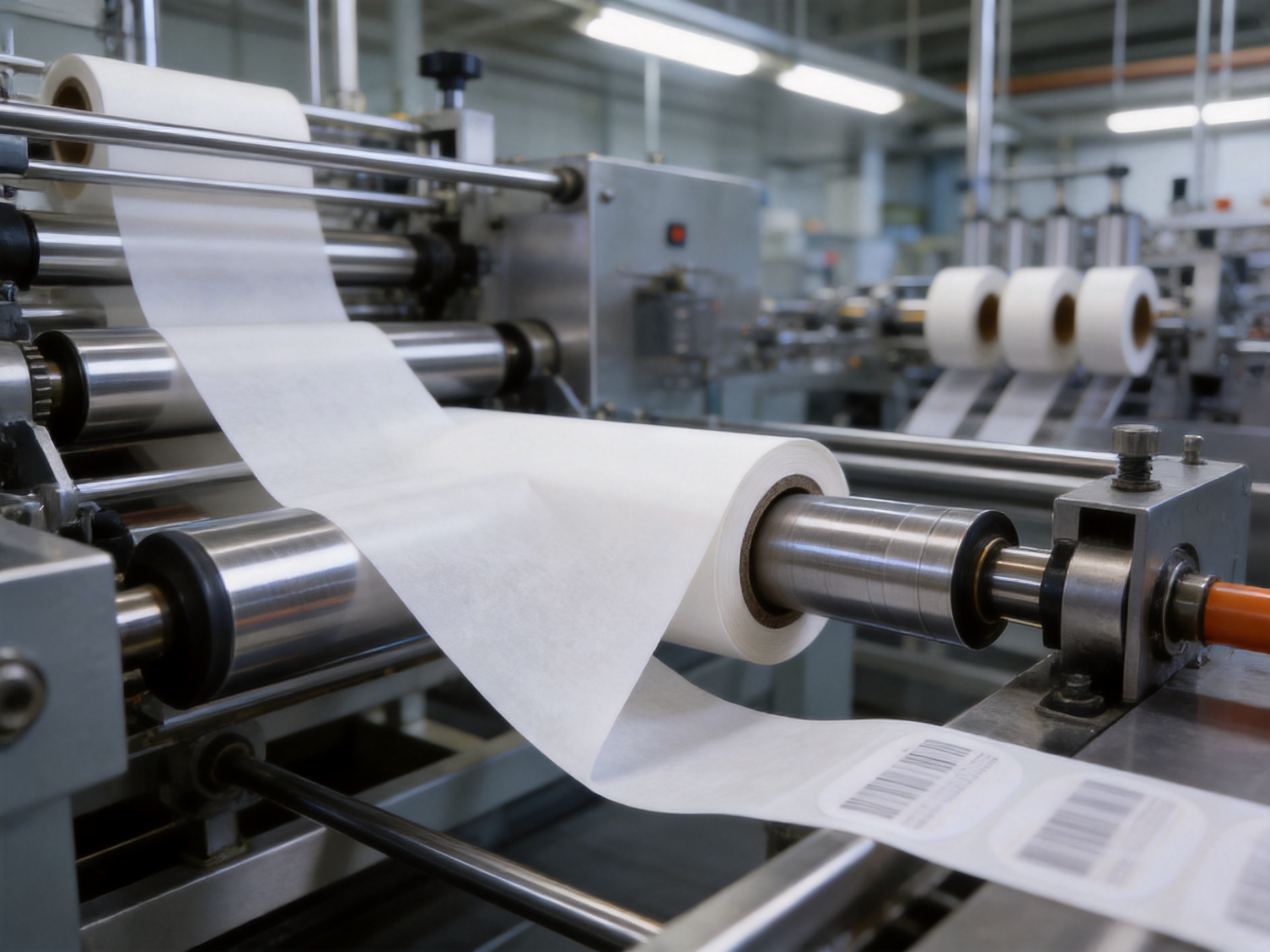
The company operates a full range of production lines, including gluing, laminating, and cutting. This integrated manufacturing structure is important because label materials are multi-layer products that require coordination between base paper, adhesive, face material, release coating, and converting processes.
When production steps are integrated, quality control can be managed more effectively. Material compatibility can be evaluated at each stage, and process adjustments can be made quickly. This gives customers a more dependable final product compared with materials assembled through disconnected supply chains.
Large-Scale Annual Capacity
With an annual production capacity of more than 280 million square meters, the company can support both regular orders and large-volume procurement programs. Capacity matters in the label material industry because customers often need stable supply for ongoing production, seasonal demand, and market expansion.
A supplier with strong production capacity can reduce lead-time pressure and help customers avoid shortages. For converters and label manufacturers serving major brands, retail chains, logistics companies, or industrial users, supply stability is a strategic advantage.
Advanced Inspection and Testing
The company maintains its own testing lab and advanced inspection equipment to ensure product quality. Testing and inspection are essential for glassine paper and self-adhesive materials because small variations in thickness, strength, moisture content, coating quality, or release force can affect downstream production.
Inspection helps detect problems before materials reach customers. A reliable quality control system can evaluate roll appearance, width accuracy, sheet size accuracy, surface quality, release behavior, adhesion compatibility, and other performance indicators according to customer requirements.
Professional R&D and Patented Innovation
Continuous innovation is a core strength of the company. A professional R&D team with multiple patents supports product improvement, customization, and application development. In a market where customers increasingly require specialized label materials, innovation helps create value beyond basic supply.
R&D capability is especially important for specialty labels, anti-counterfeiting labels, high-speed labeling materials, eco-friendly constructions, and customized adhesive systems. By combining production experience with technical development, the company can help customers solve practical challenges related to release force, adhesive compatibility, converting speed, and environmental goals.
OEM and ODM Customization
The company accepts OEM and ODM services and can produce products based on customer drawings or samples. This is valuable for customers with specific requirements for grammage, width, color, sheet size, packaging, release properties, or downstream application behavior.
Customization allows customers to optimize materials for their own production equipment and market needs. Rather than adapting production to a generic liner, customers can work with the manufacturer to develop a more suitable material specification. This can reduce waste, improve productivity, and enhance final product performance.
Quality Control from Raw Material to Delivery
Base Paper Selection
High-quality white glassine paper begins with proper base paper selection. The base must have uniform fiber formation, stable grammage, appropriate density, and reliable mechanical strength. Any weakness in the base paper can affect coating performance, converting quality, and final release behavior.
By emphasizing a uniform and dense base paper structure, the product supports consistent release performance and reliable downstream processing. This focus on the base material is one of the reasons glassine paper is preferred for self-adhesive and tape applications.
Process Control
Process control includes monitoring tension, speed, temperature, moisture, coating uniformity, cutting accuracy, and roll winding quality. For white glassine paper supplied in jumbo rolls, roll formation must be stable and clean. Poor winding can lead to wrinkles, telescoping, edge damage, or uneven tension during customer processing.
For sheets, cutting accuracy and flatness are important. Sheets must be properly stacked and packed to avoid corner damage, warping, or contamination. The availability of both roll and sheet formats allows the company to meet the needs of different production environments.
Dimensional Accuracy
Glassine paper is available in jumbo roll widths such as 1000 mm, 1020 mm, 1080 mm, and 1530 mm. These widths are suitable for laminating, slitting, coating, and converting operations. Accurate width control helps customers reduce trimming waste and improve machine efficiency.
Sheet sizes include A4, A3, 20 x 30, 21 x 30, 24 x 36, 50 cm x 70 cm, and 70 cm x 100 cm. Custom sheet sizes are also available. Dimensional accuracy in sheets supports smooth feeding, printing, cutting, and packaging operations.
Packaging Protection
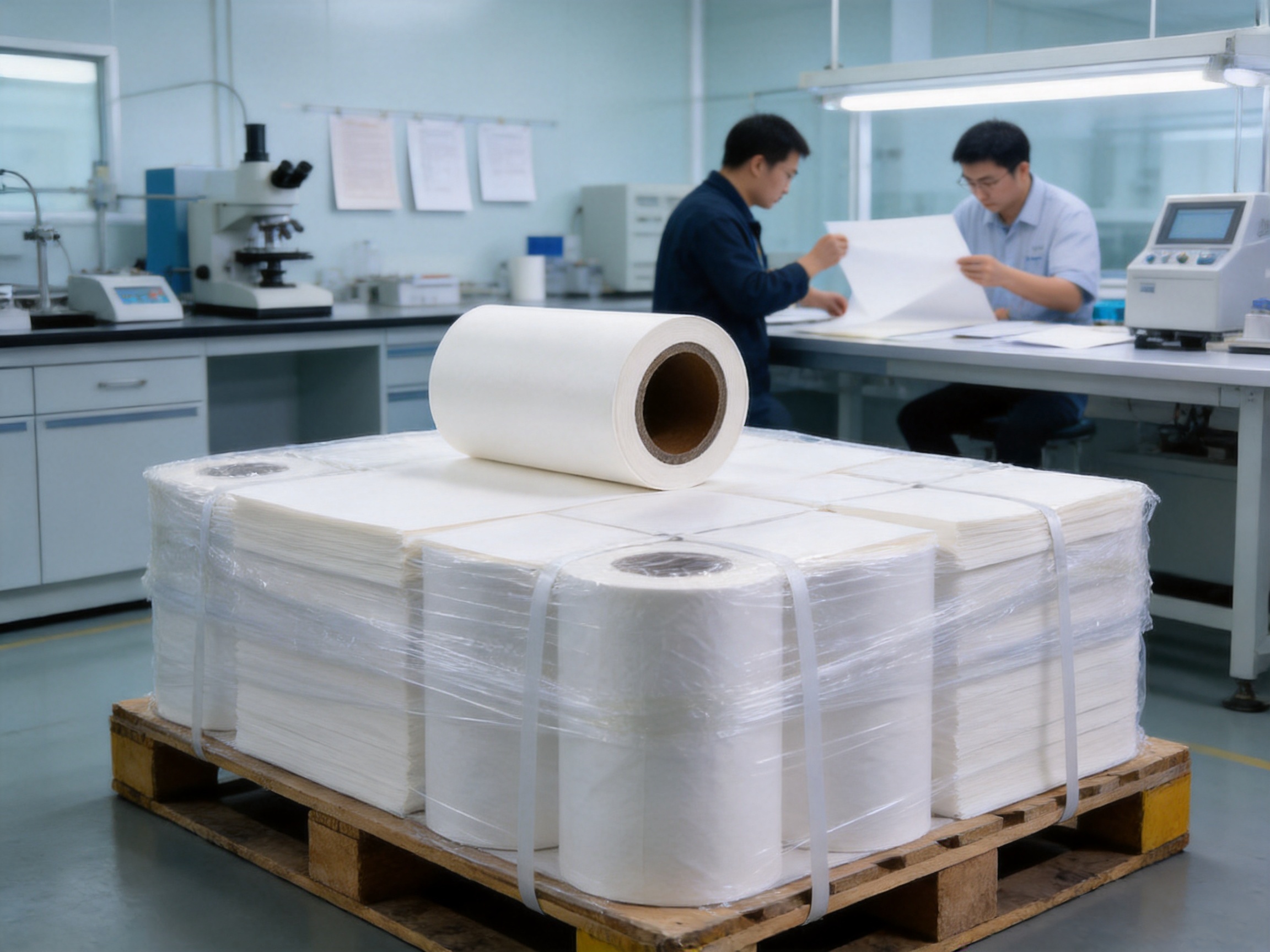
Packaging is designed to protect the material during storage and transportation. Sea-transit-worthy poly-wood pallet packing and carton packing are available for rolls or sheets from stock. For sheet products, 100 sheets per ream can be packed with strong PE-coated kraft paper wrapper. Strong pallets are wrapped with stretch film and fastened with plastic fastening belts.
Good packaging is critical for paper materials because moisture, dust, pressure, and handling damage can affect usability. Proper palletizing and wrapping help preserve product quality during sea transit and warehouse storage.
How White Glassine Paper Improves Converting Efficiency
Reduced Web Breaks
Web breaks are one of the most disruptive problems in roll-to-roll converting. They stop production, waste material, require operator intervention, and may cause schedule delays. The strength of white glassine paper helps reduce the risk of tearing during high-speed processing.
For converters running long production batches, fewer web breaks mean better output, lower labor cost, and more predictable delivery. This is a major practical advantage over weaker or inconsistent liners.
Cleaner Die-Cutting
Die-cutting requires the correct relationship between face material, adhesive, and liner. If the liner is too soft or inconsistent, the die may cut too deeply or unevenly. If the liner is unstable, matrix stripping may become difficult. White glassine paper supports clean die-cutting because of its dense and uniform structure.
Cleaner die-cutting improves label edge quality and reduces waste. It also helps labels dispense more reliably during automatic application.
Stable Release During Label Dispensing
High-speed automatic labeling depends on predictable release behavior. Labels must separate from the liner cleanly as the liner bends over the dispensing edge. White glassine paper supports this process by providing a stable base for release treatment and maintaining strength during bending and tension.
Stable release reduces label jams, missed applications, misalignment, and downtime. For customers in packaging, logistics, food, and consumer goods industries, this can directly improve production efficiency.
Better Roll and Sheet Handling
A smooth, dense paper structure contributes to better winding, unwinding, stacking, and feeding. In roll form, white glassine paper can be processed on converting equipment with good tension control. In sheet form, it can be handled for printing, cutting, or sampling applications.
Good handling characteristics help customers reduce machine adjustments and operator workload. They also support consistent production across different order sizes and application types.
Sustainability and Responsible Material Development
The label industry is increasingly focused on sustainable development and environmental responsibility. Customers are seeking eco-friendly solutions not only for face materials but also for adhesives and backing papers. White glassine paper can support these goals when produced under responsible quality and material management systems.
Suzhou Piaozhihua Composite Material Technology Co., Ltd. emphasizes sustainable development and environmental protection as part of its brand positioning. The company develops eco-friendly solutions involving face materials, adhesives, and backing papers to help customers meet sustainability requirements.
While release liners can be challenging in recycling systems due to silicone coatings and adhesive contamination, material optimization can still reduce waste. Consistent white glassine paper helps converters lower defect rates, reduce production scrap, improve yield, and design label structures more efficiently. In practical manufacturing, waste reduction is one of the most immediate and measurable environmental benefits.
The company’s core values include quality, integrity, innovation, win-win cooperation, and responsibility. These values support a long-term approach to product development, customer service, and sustainable material improvement.
Customization for Different Customer Needs
Grammage Selection
Different applications require different grammage. A 50 g or 60 g glassine paper may be suitable for lightweight label products where flexibility and material economy are priorities. An 80 g grade may be selected for standard label applications requiring balanced strength and handling. Heavier options such as 100 g and 120 g can provide additional stiffness and durability for demanding uses.
Choosing the right grammage helps customers balance cost, performance, and machine compatibility. Technical consultation can help determine the most suitable option for specific label constructions.
Color Selection
White is the main and most widely used option because it provides a clean appearance and broad compatibility. Blue and yellow glassine paper can be supplied for customers who require visual differentiation. Color coding can be useful in factories where multiple release forces, adhesive types, or product lines are handled at the same time.
Color selection may also support customer branding, internal quality systems, or operational convenience.
Roll Width and Sheet Size
Jumbo roll widths of 1000 mm, 1020 mm, 1080 mm, and 1530 mm are suitable for many industrial converting operations. Customers can slit the jumbo rolls into narrower rolls according to final label size requirements. Wide rolls can improve production efficiency and reduce procurement complexity for converters.
Sheet sizes such as A4, A3, 20 x 30, 21 x 30, 24 x 36, 50 cm x 70 cm, and 70 cm x 100 cm support printing, cutting, sampling, and specialty applications. Custom sizes can be produced to meet project-specific needs.
Packaging Format
Roll and sheet packaging options allow customers to select the most convenient format for storage, transportation, and production. Sea-transit-worthy pallet packing is particularly important for international customers. Strong wrapping and fastening help protect material quality during long-distance shipping.
For sheet products, ream packing with PE-coated kraft paper wrappers helps protect against moisture and handling damage. This attention to packaging reflects the company’s understanding that product quality must be maintained not only during manufacturing but also during delivery.
Company Strength and Market Support
Suzhou Piaozhihua Composite Material Technology Co., Ltd. is a private company specializing in high-grade self-adhesive labels and related materials. The company integrates research and development, production, sales, and after-sales service, creating a complete support system for customers in the label and adhesive material industries.
With more than 20 years of development and OEM manufacturing experience, the company has built strong technical knowledge and production capability. It is recognized among leading companies in China for self-adhesive products and has gained influence in both domestic and international markets.
The company has established sales outlets and direct sales networks in many major Chinese cities, including Shanghai, Ningbo, Hangzhou, Chengdu, Harbin, Wuhan, Chongqing, Guangzhou, Changsha, and Beijing, along with numerous franchise chains. Internationally, it has built a marketing network across countries and regions including the United States, Germany, Japan, South Korea, Brazil, Mexico, Russia, the Middle East, Asia, Europe, the Americas, and Africa.
This market coverage is valuable for customers because it reflects supply experience across different industries, climates, logistics systems, and regulatory expectations. A supplier with broad domestic and international service experience can better understand customer requirements and respond to market changes.
Why Buyers Choose This White Glassine Paper
Reliable Material Performance
Buyers choose this white glassine paper because it combines uniformity, strength, light transmission, heat resistance, moisture resistance, and oil resistance. These features directly support release liner performance, label converting efficiency, and end-use reliability.
In competitive markets, material consistency is a major differentiator. A liner that performs well across repeated batches helps customers stabilize their production and reduce quality complaints.
Strong Manufacturing Foundation
The product is supported by integrated production lines, advanced testing, and a large annual capacity. This gives customers confidence that supply can be maintained and quality can be controlled. Unlike suppliers that only trade materials, a manufacturer with production and inspection capability can provide deeper technical support.
Manufacturing strength also allows the company to respond to custom requirements and solve application problems more effectively.
Flexible Customization
Available grammage, color, roll width, sheet size, and packaging options give customers flexibility. Whether a customer needs standard white glassine paper in jumbo rolls or customized sheets for special applications, the company can provide suitable solutions.
This flexibility is especially important for OEM and ODM customers who need materials tailored to their products, equipment, and markets.
Packaging and Delivery Reliability
Material damage during transportation can create delays and waste. The company’s sea-transit-worthy pallet packing, carton packing, stretch film wrapping, plastic fastening belts, and ream packaging provide strong protection for roll and sheet materials.
For international buyers, reliable packaging reduces risk during ocean freight and warehouse handling. This supports smoother procurement and fewer unexpected losses.
Technical Considerations for Selecting White Glassine Paper
Release Force Requirements
Customers should consider the release force required by their adhesive system and application process. Release force depends on silicone coating, adhesive type, aging conditions, temperature, and liner surface properties. A stable glassine base helps control these factors, but the final release design should be matched to the customer’s production needs.
Adhesive Compatibility
Different adhesives, including hot melt, water-based, solvent-based, acrylic, and rubber-based systems, may interact differently with release liners. White glassine paper can be used in many adhesive constructions, but proper testing is recommended for specialty adhesives or demanding environments.
Machine Speed
High-speed labeling and converting lines require stronger and more consistent liners. Customers running fast equipment should prioritize tensile strength, thickness uniformity, and release stability. The product’s dense formation and good strength make it suitable for automatic labeling and rotary converting applications.
Storage Conditions
Paper-based materials should be stored in clean, dry, and stable environments. Although white glassine paper has moisture resistance, proper storage helps preserve flatness and performance. Rolls should be protected from excessive humidity, direct sunlight, heavy pressure, and contamination.
End-Use Environment
The final label or tape application may involve temperature changes, moisture, oils, handling stress, or long-term storage. Customers should select the proper grammage and construction according to these conditions. Technical support can help optimize the material selection.
Q&A Section
Q1: What is white glassine paper mainly used for?
White glassine paper is mainly used as a release liner or backing material for self-adhesive labels, barcode labels, special tapes, double-sided tapes, trademarks, laser anti-counterfeiting labels, and other sticky industrial products. It is suitable for high-speed automatic labeling, rotary converting, and plate crosscutting.
Q2: Why is glassine paper preferred for release liner applications?
Glassine paper is preferred because it has a dense, smooth, and uniform structure. This helps silicone release coating remain consistent and supports stable label release. It also offers good strength, light transmission, heat resistance, moisture resistance, and oil resistance.
Q3: What grammage options are available?
Available grammage options include 50 g, 60 g, 80 g, 100 g, and 120 g. Customers can choose lighter or heavier grades based on strength, flexibility, cost, and application requirements.
Q4: Can the paper be supplied in colors other than white?
Yes. White is the main color, while blue and yellow options are also available. Colored glassine paper can help with product identification, inventory management, or special customer requirements.
Q5: What roll widths are available?
Jumbo roll widths include 1000 mm, 1020 mm, 1080 mm, and 1530 mm. These widths are suitable for slitting, laminating, coating, and large-scale converting operations.
Q6: Are sheet sizes available?
Yes. Sheet sizes include A4, A3, 20 x 30, 21 x 30, 24 x 36, 50 cm x 70 cm, and 70 cm x 100 cm. Custom sheet sizes can also be produced according to customer needs.
Q7: What advantages does this product have over ordinary paper liners?
Compared with ordinary paper liners, white glassine paper has better density, smoother surface quality, more uniform structure, improved release coating compatibility, better strength, and stronger resistance to moisture and oil. These features help improve converting efficiency and label dispensing reliability.
Q8: Is it suitable for high-speed automatic labeling?
Yes. The product is especially suitable for high-speed automatic labeling because it provides stable release performance, good strength, and reliable handling during rapid label dispensing.
Q9: How is the product packaged for delivery?
Rolls and sheets can be packed using sea-transit-worthy poly-wood pallets or carton packing. Sheet products can be packed 100 sheets per ream with strong PE-coated kraft paper wrappers. Pallets are wrapped with stretch film and fastened with plastic fastening belts.
Q10: Does the manufacturer support OEM and ODM orders?
Yes. Suzhou Piaozhihua Composite Material Technology Co., Ltd. supports OEM and ODM services and can produce materials based on customer drawings, samples, specifications, and application requirements.
Conclusion
White glassine paper is a high-performance material for release liners, self-adhesive labels, barcode labels, tapes, double-sided tape substrates, trademarks, laser anti-counterfeiting labels, and industrial sticky products. Its uniform and dense structure, good strength, light transmission, heat resistance, moisture resistance, and oil resistance make it a dependable choice for customers who require stable converting and reliable application performance.
Compared with ordinary paper liners and low-grade release materials, white glassine paper offers superior smoothness, consistency, and process reliability. These advantages help reduce waste, improve die-cutting quality, support high-speed automatic labeling, and enhance the total value of label and adhesive products.
Behind the product is the manufacturing strength of Suzhou Piaozhihua Composite Material Technology Co., Ltd., including integrated gluing, laminating, and cutting production lines; annual capacity exceeding 280 million square meters; advanced inspection equipment; an in-house testing lab; more than 20 years of OEM experience; professional R&D capability; and strong customization support. For customers seeking a reliable, scalable, and technically capable supplier of glassine paper and self-adhesive label materials, this white glassine paper provides a practical and competitive solution.
References
1. Handbook of Pressure Sensitive Adhesive Technology, edited by Donatas Satas.
2. Paper and Paperboard Packaging Technology, edited by Mark J. Kirwan.
3. Label and Narrow Web Industry Technical Guidelines on Release Liners and Pressure-Sensitive Materials.
4. TAPPI Technical Information Papers on Paper Properties, Coating, and Converting Performance.
5. Pressure-Sensitive Adhesives and Applications, industry reference materials on label construction and release liner behavior.